
Seeing GPI in a text, Instagram comment, or TikTok post can be confusing if you have never encountered the abbreviation before. The GPI meaning in text may not be obvious at first because the three letters can look like an English acronym, but their common slang use comes from Spanish.
In informal online conversations, GPI meaning in text usually stands for “Gracias Por Invitar,” which translates to “Thanks for inviting me.” The interesting part is that people often use it when they were not invited at all. It can therefore carry a playful, teasing, or sarcastic tone.
This article explains what GPI means in text, where the expression comes from, how it works in Spanish slang, how people use it on social media, and how to understand the tone from context.
What Does GPI Mean in Text?
GPI meaning in text “Gracias Por Invitar,” a Spanish phrase that translates to “Thanks for inviting me.” In texting and social media, it is commonly used sarcastically when someone notices that they were left out of a gathering, trip, meal, party, or other activity.
For example:
Friend: “We all went out for dinner last night!”
You: “GPI 😂”
Here,GPI meaning in text does not usually mean that you genuinely received an invitation. Instead, you are jokingly pointing out that nobody invited you.
Spanish-language sources describe gpi as an informal electronic expression used particularly to call attention to being left out. Mexican outlet NMás gives examples involving social-media posts and WhatsApp conversations where someone uses “gpi” after discovering that others went somewhere without them.
Quick Meaning
| Term | Meaning | Typical tone |
|---|---|---|
| GPI | Gracias Por Invitar | Playful, teasing, or sarcastic |
| Gracias por invitar | Thanks for inviting | Literal/polite or sarcastic depending on context |
| Thanks for the invite | English equivalent | Usually literal, but can also be sarcastic |
The key is context. The same words can communicate genuine thanks in one situation and playful annoyance in another.
What Does GPI Stand For?
GPI meaning in text stands for “Gracias Por Invitar.”
The three letters correspond to:
- G = Gracias — “Thanks”
- P = Por — “For”
- I = Invitar — “Inviting”
A natural English translation is “Thanks for inviting me” or “Thanks for the invite.”
However, when someone writes only GPI online, the intended message is often closer to:
- “Wow, thanks for leaving me out.”
- “Guess I wasn’t invited.”
- “You could have invited me!”
- “Looks like everyone had fun without me.”
- “Thanks for the invite… I guess.”
The expression is therefore different from an ordinary thank-you. Its meaning depends on the social situation and the relationship between the people involved.
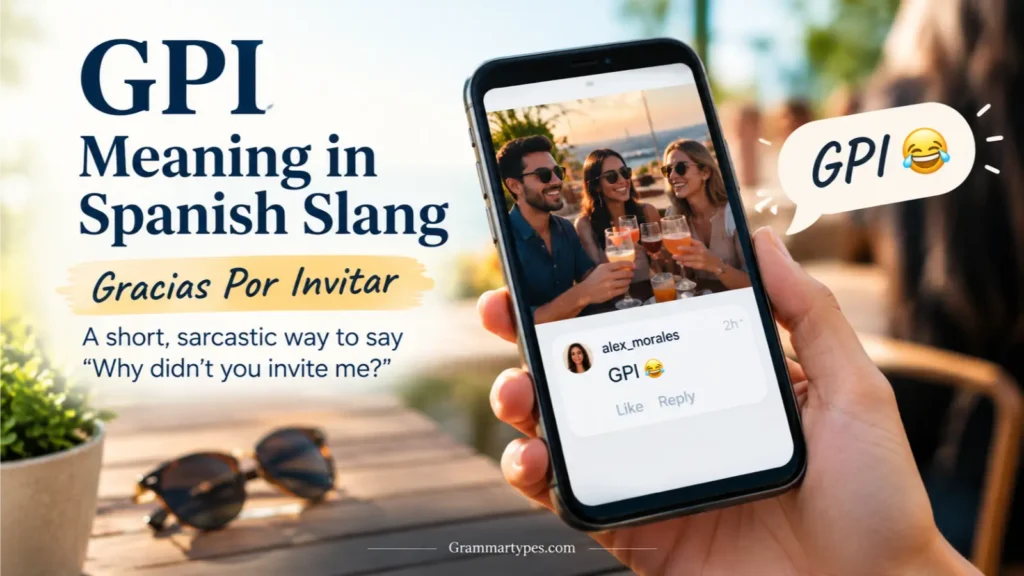
GPI Meaning in Spanish Slang
The Spanish slang meaning of GPI is “Gracias Por Invitar.” It became particularly recognizable in informal digital communication, where shortened expressions are convenient for comments, messages, and social-media replies.
The expression is strongly associated with situations in which someone sees evidence of an event they were not invited to. For example, a friend may post pictures from a restaurant, vacation, party, concert, or weekend trip. A person who was not included might simply reply:
GPI 😂
The literal words say “Thanks for inviting,” but the context communicates almost the opposite: “Why didn’t you invite me?”
Spanish-language coverage describes this use as primarily sarcastic and notes that GPI can appear on WhatsApp, Facebook, Instagram, TikTok, and other online platforms.
Is GPI a Spanish Word?
Not exactly. GPI is an abbreviation or shortened electronic expression derived from the Spanish phrase “Gracias Por Invitar.” It is not an English vocabulary word.
This distinction matters because someone unfamiliar with Spanish internet slang might assume that GPI meaning in texthas a standard English definition. In casual online communication, its meaning is instead tied to the Spanish phrase.
How Is GPI Used in Social Media?
GPI is used in social media comments, messages, stories, and group conversations, especially when someone wants to jokingly point out that they were excluded from a plan.
You might see it after:
- A friend posts vacation photos.
- A group goes out to eat.
- Someone shares pictures from a party.
- Friends attend a concert without you.
- Someone announces a weekend trip.
- A group makes plans without mentioning you.
For example:
Instagram post:
“Beach day with the best people 🌴”
Comment:
“GPI 😂”
The commenter is essentially saying, “Thanks for inviting me,” while joking that they were not invited.
The expression is not limited to one particular platform. NMás specifically notes that it can be used across social networks rather than belonging exclusively to one service.
GPI on Instagram
On Instagram, GPI can appear in a comment or reply to someone’s story.
“Dinner looks amazing. GPI 😂”
The commenter probably means:
“Dinner looks amazing. Thanks for not inviting me!”
The emoji can make the playful intention clearer.
GPI on TikTok
On TikTok, GPI may appear in comments when users see friends, creators, or groups enjoying an activity without them.
“Y’all went without me? GPI 😭”
Here, the abbreviation works as a short humorous reaction to being excluded.
GPI on WhatsApp
In WhatsApp groups, GPI can be used when someone discovers that other members met up without them.
“So you guys went for pizza yesterday? GPI 😂”
The phrase works particularly well in group chats because the people involved already understand the situation.
What Does GPI Mean When Someone Says It to You?
When someone sends you GPI, first look at what happened immediately before the message.
If you posted about an activity they were not included in,GPI meaning in text probably means:
“Thanks for inviting me” — sarcastically.
For example:
You: “We went to the new restaurant last night.”
Friend: “GPI 😭”
Your friend is probably joking that you went without them.
However, don’t automatically assume that every use is angry or genuinely offended. Between friends, GPI is often playful teasing. The meaning can become more serious if the surrounding conversation suggests that the person actually felt excluded.
Emojis can also provide clues:
- 😂 = likely joking
- 😭 = exaggerated or playful disappointment
- 😒 = teasing annoyance
- 💔 = exaggerated feeling of being left out
- No emoji = tone depends more heavily on the conversation
GPI Examples in Texting
Here are some natural examples of how the expression can appear online.
Example 1: Restaurant
Friend: “We tried that new Mexican restaurant last night.”
You: “GPI 😂”
Meaning: “Thanks for inviting me—apparently!”
Example 2: Vacation
Friend: “Look at our beach trip!”
You: “GPI 😭”
Meaning: “You went on a beach trip without inviting me?”
Example 3: Party
Friend: “Last night’s party was so much fun!”
You: “Wow, GPI.”
Meaning: “Nice. I guess I wasn’t invited.”
Example 4: Casual teasing
Friend: “We’re getting coffee after class.”
You: “GPI 👀”
Meaning: “Are you really going without me?”
These examples show why translating GPI word-for-word is not enough. The social context supplies much of the intended meaning.

Is GPI Always Sarcastic?
No. GPI is commonly sarcastic or playful online, but context determines the tone.
If someone genuinely received an invitation and is thanking another person, they would normally be more likely to write the full phrase “gracias por invitar” rather than relying on the slang abbreviation.
In online usage, GPI meaning in text has become particularly associated with joking complaints about being excluded. Spanish-language reporting describes the expression specifically in this sarcastic context.
So, if someone comments “GPI 😂” underneath pictures from an event they did not attend, interpreting it as a literal thank-you would probably miss the joke.
How to Respond to GPI
Your response should depend on whether the person is joking or genuinely upset.
If it is clearly playful, you could respond:
- “Next time you’re coming 😂”
- “My bad! You were invited!”
- “We thought you were busy 😭”
- “Okay, okay, next time!”
- “You definitely should’ve been there!”
If the person seems genuinely disappointed, a more direct response is appropriate:
“Sorry, we should have invited you. I didn’t mean to leave you out.”
The important thing is to read the relationship and surrounding conversation instead of treating GPI as having one fixed emotional tone.
GPI vs. “Thanks for the Invite”
Although GPI literally relates to “thanks for inviting,” its internet use often has an ironic meaning.
| Expression | Typical meaning |
|---|---|
| Thanks for the invite! | Can be genuine or sarcastic |
| GPI 😂 | Often jokingly points out that the person was not invited |
| Gracias por invitar | Spanish phrase; can be genuine or sarcastic |
| GPI 😒 | Often signals playful annoyance or feeling left out |
For an English-speaking reader, the closest natural interpretation of GPI in many social-media contexts is “Thanks for the invite” with an implied “even though you didn’t invite me.”
Common Mistakes When Interpreting GPI
Mistake 1: Treating GPI as an English acronym
GPI can have many technical meanings in English, but in the slang context discussed here, it refers to the Spanish phrase “Gracias Por Invitar.”
Always consider the context before choosing a definition.
Mistake 2: Taking “thanks” literally
If someone comments GPI after seeing pictures from a party they did not attend, they probably are not expressing sincere gratitude.
The phrase is often intentionally ironic.
Mistake 3: Assuming the person is seriously angry
A message such as “GPI 😂” is generally much lighter than a direct complaint.
The relationship, wording, and emojis can help distinguish playful teasing from genuine frustration.
Mistake 4: Assuming GPI belongs to only one platform
GPI is not exclusive to Instagram, TikTok, WhatsApp, or another individual platform. It can appear across different forms of informal digital communication.
What Does GPI Mean in English?
In English, GPI usually translates from the Spanish “Gracias Por Invitar” as “Thanks for inviting me” or “Thanks for the invite.”
But when used as internet slang, a more natural interpretation may be:
“Wow, thanks for leaving me out.”
The second interpretation captures the sarcasm that often accompanies the abbreviation.
This is why a direct dictionary-style translation can be misleading. The words themselves express thanks, while the situation may express exclusion or playful disappointment.
Other Meanings of GPI
GPI can have meanings outside Spanish slang. Acronyms are often reused in different fields, so context matters.
For example, GPI can refer to Genuine Progress Indicator in economic and environmental discussions. It is also used in specialized technical contexts, including finance and other fields.
One important example is SWIFT GPI, where GPI refers to Global Payments Innovation, a service associated with cross-border payments.
These meanings are unrelated to the Spanish texting expression.
Therefore, if you encounter GPI in a banking document, academic paper, business discussion, or technical publication, don’t automatically interpret it as slang.
For a casual comment such as “GPI 😂”, however, the Spanish slang interpretation is the relevant one.
Final Thoughts
GPI meaning in text is most commonly “Gracias Por Invitar,” a Spanish phrase meaning “Thanks for inviting me.” In casual texting and social media, however, the expression is often ironic: someone uses GPI because they were not invited and want to jokingly point that out.
You may see it after pictures of a party, restaurant visit, vacation, concert, or other group activity. The tone can range from playful teasing to genuine disappointment, so the surrounding conversation and emojis matter.
Remember the basic idea: GPI literally expresses thanks for an invitation, but online it often jokes about the lack of one. If you see “GPI 😂” under a friend’s event photo, “Thanks for leaving me out” is usually much closer to the intended message.
FAQs
In Spanish texting slang, GPI stands for “Gracias Por Invitar,” meaning “Thanks for inviting me.” It is frequently used sarcastically when someone notices that they were not actually invited to an event or activity.
In slang and casual online communication, GPI commonly stands for “Gracias Por Invitar.” It is usually a playful or sarcastic way of saying that someone feels left out of a plan.
GPI is commonly used after someone discovers that friends or other people went somewhere without them. For example, commenting “GPI 😂” on a friend’s vacation photo can jokingly mean, “Thanks for inviting me,” even though no invitation was received.
On social media, GPI is commonly used as a short, humorous reaction to being excluded from an event, outing, meal, trip, or other activity. It can appear in comments, direct messages, stories, and group chats.
The slang expression GPI comes from Spanish, specifically “Gracias Por Invitar.” Its literal English equivalent is “Thanks for inviting me.”
Not necessarily. Among friends, GPI is often playful teasing. However, depending on the relationship and context, it can also communicate genuine annoyance about being left out. If you are unsure, consider the conversation and any emojis before interpreting the tone.
On WhatsApp, GPI generally has the same Spanish slang meaning: “Gracias Por Invitar.” It is commonly used when someone jokingly points out that they were not included in a gathering or plan.
Explore More Grammar Guides:
TMP Meaning in Text: What Does TMP Mean in Messages?
YFM Meaning: What Does YFM Mean in Text and Chat?
PWYP Meaning in Text: What Does PWYP Mean?
IMAO Meaning in Text: Full Form, Examples, and How to Use It
NMMS Meaning in Text: What Does NMMS Mean in Chat and Spanish Slang?
