
Have you ever tried calling someone repeatedly, fixing a problem several times, or persuading someone to change their mind only to get nowhere? You may describe that situation by saying your efforts were to no avail. If you are wondering about the no avail meaning, the expression refers to an attempt that produces no success or useful result. It is common in English, but the wording can be confusing because avail is not a word people often use by itself in everyday conversation.
The phrase to no avail describes an effort that produces no success, benefit, or useful result. It is especially common in writing, news reports, professional communication, and more formal speech.
In this guide, you will learn the no avail meaning, why “to no avail” is the standard expression, how to use it in sentences, which alternatives work best, and what common mistakes to avoid.
What Does “No Avail” Mean?
The phrase to no avail means without success, without effect, or without achieving the desired result.
In simple English, if you do something to no avail, you make an effort, but the effort does not accomplish what you wanted.
For example:
I tried to call her several times, but to no avail.
This means I tried several times, but I was unsuccessful.
Another example is:
They searched the building for hours to no avail.
The people searched for a long time, but they did not find what they were looking for.
Cambridge defines to no avail as “without any success or any effect” and identifies it as a formal idiom.
Quick Meaning
To no avail = without success = without result = unsuccessfully
It usually describes an attempt, effort, action, or series of actions that fails to produce the intended result.
Is “To No Avail” the Correct Expression?
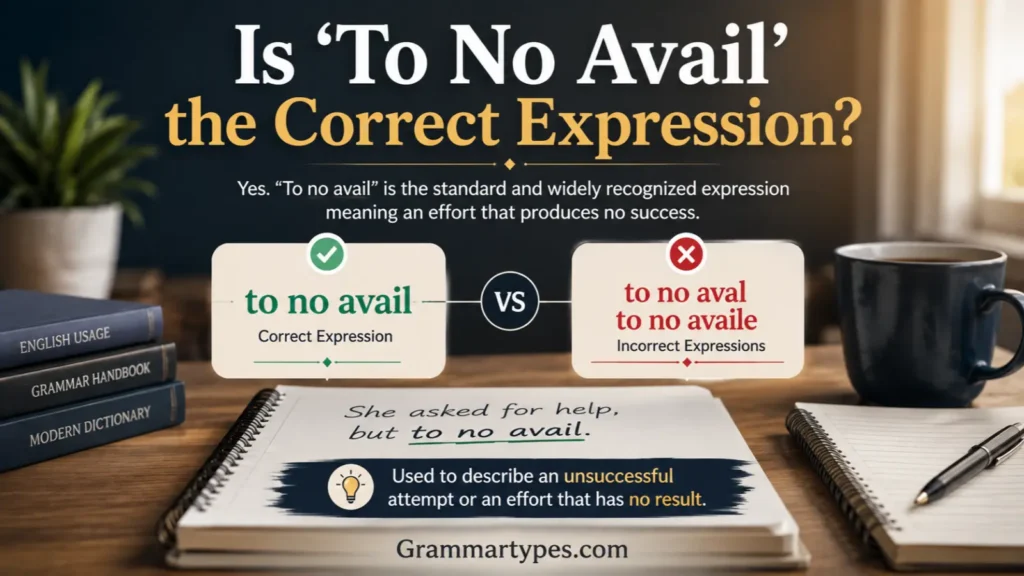
Yes. To no avail is the standard and widely recognized expression.
Although people sometimes search for “no avail meaning”, the expression normally appears with to:
- ✅ to no avail
- ❌ to no aval
- ❌ to no availe
- ⚠️ no avail — possible in other constructions, but not normally used alone as a replacement for “to no avail”
For example:
She asked for help, but to no avail.
Here, the phrase clearly tells us that her request did not succeed.
You can also use avail in expressions such as of no avail or of little avail:
His warnings were of no avail.
The extra precautions were of little avail.
Cambridge lists avail as a noun meaning “use, purpose, advantage, or profit,” which explains why no avail conveys the idea of having no useful effect or benefit.
How Do You Use “To No Avail” in a Sentence?
To no avail usually follows an action or effort and tells the reader that the action did not work.
Examples
- I tried to restart the computer, but to no avail.
- She called customer service several times to no avail.
- We searched everywhere for the missing keys, to no avail.
- He tried to convince his parents, but to no avail.
- The team attempted a late comeback, but to no avail.
- Doctors tried several treatments, to no avail.
- They negotiated for hours, but their efforts were to no avail.
- I sent three emails and received no response, to no avail.
The expression can appear after a complete clause, after an action, or after a statement describing an unsuccessful effort.
“But to No Avail” in a Sentence
The combination but to no avail is particularly common when contrasting an attempt with its unsuccessful result.
I tried to explain the problem, but to no avail.
She knocked on the door repeatedly, but to no avail.
They asked him to reconsider, but to no avail.
Here, but introduces the contrast: an effort was made, but the desired result did not happen.
What Is the Difference Between “No Avail” and “To No Avail”?
The expression most commonly used to describe an unsuccessful effort is to no avail.
No avail by itself is not usually a complete replacement for the idiom.
Compare:
✅ We tried to contact him, but to no avail.
✅ Our attempts were of no avail.
❌ We tried to contact him, but no avail.
The last sentence is not standard English because it leaves the expression incomplete.
You may also encounter:
- to no avail — without success or effect
- of no avail — of no use or benefit
- of little avail — of little use or benefit
- to little avail — with little success or effect
The exact construction depends on the sentence.
What Does “Avail” Mean?
Avail has a somewhat old-fashioned or formal feel when used as a noun. In this sense, it means use, benefit, advantage, or helpful effect.
For example:
His advice was of no avail.
This means his advice was of no use or benefit.
As a verb, avail has a different grammatical use. Merriam-Webster defines the verb avail as meaning “to be of use or help,” while the noun refers to help toward reaching a goal.
However, most learners will encounter the word in established expressions such as to no avail rather than using avail as an everyday standalone verb.
Pronunciation
Avail is pronounced approximately:
uh-VAIL
The stress falls on the second syllable.
“To No Avail” vs. “In Vain”
To no avail and in vain are very close in meaning. Both can describe an effort that fails to produce the desired result.
| Expression | Basic meaning | Typical tone |
|---|---|---|
| to no avail | Without success or effect | Formal/neutral |
| in vain | Without achieving the desired result | Neutral, sometimes more literary |
| without success | Unsuccessfully | Direct and neutral |
| fruitlessly | Without producing a useful result | Formal |
| to no effect | Without producing an effect | Neutral/formal |
| unsuccessfully | Without success | Direct/formal |
For example:
She tried to persuade him, but to no avail.
She tried to persuade him, but in vain.
Both sentences communicate essentially the same idea.
The choice depends partly on style. To no avail is a particularly useful expression when you want to emphasize that an attempt produced no useful result.
Synonyms for “To No Avail”
If you want another way to express the same idea, several alternatives are available.
Formal or Professional Alternatives
- without success
- without result
- without effect
- unsuccessfully
- in vain
- fruitlessly
- to no effect
- without achieving the desired result
Example:
The investigators searched the area without success.
This has a similar meaning to:
The investigators searched the area to no avail.
Casual Alternatives
In everyday conversation, you might use simpler expressions:
- with no luck
- got nowhere
- it didn’t work
- nothing came of it
- it didn’t pan out
For example:
I tried calling him, but I got no luck.
A more natural version would be:
I tried calling him, but I had no luck.
For professional or formal writing, to no avail or without success is generally more polished.
Common Mistakes With “To No Avail”
Mistake 1: Writing “to no aval”
❌ I tried to contact her, but to no aval.
✅ I tried to contact her, but to no avail.
The correct spelling is avail, ending in -ail.
Mistake 2: Using “no avail” without the required construction
❌ I called him several times, but no avail.
✅ I called him several times, but to no avail.
The standard idiom is to no avail.
Mistake 3: Confusing “to no avail” with “to no end”
These expressions have completely different meanings.
To no avail means without success.
He tried to fix the leak, but to no avail.
To no end can mean continually, excessively, or without stopping.
She talked about the incident to no end.
So do not use them interchangeably.
Mistake 4: Using “to no avail” when something actually succeeds
The expression indicates a lack of success or effect.
❌ I studied hard for the exam and passed, to no avail.
This is contradictory because the effort produced the desired result.
✅ I studied hard for the exam, but my efforts were to no avail because I missed the test.
Now the phrase makes sense because the effort did not accomplish the intended goal.
Is “To No Avail” Formal or Informal?
To no avail is generally considered formal or somewhat formal, but it is not obsolete or restricted to highly formal writing.
It appears in journalism, professional writing, general nonfiction, and everyday written English. Dictionary.com also gives contemporary examples of the phrase in news writing, showing that it remains in active use.
For casual texting, however, people may naturally choose simpler expressions such as:
I tried calling, but no luck.
Instead of:
I tried calling, but to no avail.
Neither is inherently wrong. The difference is mainly one of tone and style.
Can You Start a Sentence With “To No Avail”?
Yes, to no avail can grammatically appear at the beginning of a sentence, although it is often smoother when placed after the action it describes.
For example:
To no avail, she tried to convince him to stay.
This is grammatically understandable.
However, many writers would prefer:
She tried to convince him to stay, but to no avail.
The second version makes the relationship between the effort and its unsuccessful outcome especially clear.
So there is no absolute grammar rule saying that to no avail cannot begin a sentence. It is primarily a matter of clarity, rhythm, and style.
“With No Avail” and “Of No Avail”
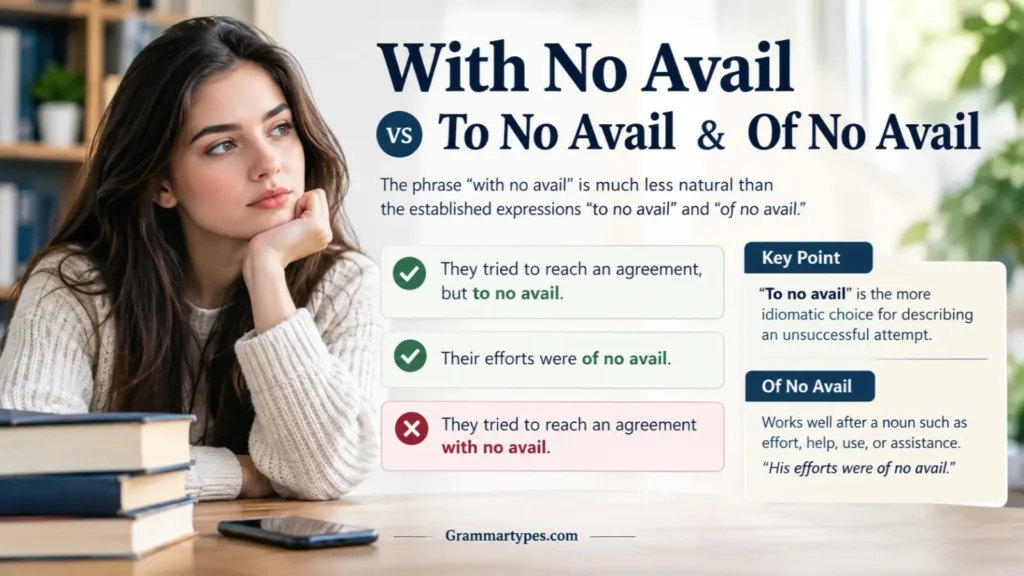
The phrase with no avail is much less natural than the established expressions to no avail and of no avail.
Compare:
✅ They tried to reach an agreement, but to no avail.
✅ Their efforts were of no avail.
⚠️ They tried to reach an agreement with no avail.
The third sentence may be understood, but to no avail is the more idiomatic choice for describing an unsuccessful attempt.
Similarly, of no avail works well after a noun such as effort, help, use, or assistance:
His efforts were of no avail.
What Does “Little to No Avail” Mean?
Little to no avail means very little or no useful effect.
It is useful when you do not want to claim that something had absolutely zero effect.
For example:
The new measures were introduced with little to no avail.
This suggests that the measures produced little benefit or possibly none.
Compare:
- to no avail = no success or effect
- to little avail = little success or effect
- little to no avail = very little or possibly no success or effect
This distinction can be useful in careful professional or academic writing.
Is “To No Avail” Slang?
No. To no avail is not slang.
It is an established English idiom that has a relatively formal or polished tone. If someone searches for no avail meaning slang, they may simply be wondering whether the phrase has a special modern texting meaning.
It does not normally have a separate slang definition.
If someone writes:
I tried to call you, but to no avail.
They simply mean:
I tried to call you, but I was unsuccessful.
The expression is about the result of an attempt, not internet slang or a hidden message.
Easy Way to Remember the Expression
A simple way to remember to no avail is:
Effort + no useful result = to no avail
Think:
I tried → it didn’t work → to no avail
For example:
We tried to repair the printer, but to no avail.
The effort happened, but it produced no successful result.
FAQs
Yes. To no avail is the standard idiomatic expression meaning without success or effect.
Depending on the context, alternatives include futility, ineffectiveness, failure, uselessness, or lack of success. For the phrase to no avail, natural alternatives include without success, in vain, fruitlessly, and to no effect.
As a noun, avail can mean use, benefit, advantage, help, or utility, depending on context. Cambridge defines it as use, purpose, advantage, or profit.
Use but to no avail after describing an unsuccessful attempt:
I tried to explain the situation, but to no avail.
It means I tried to call you, but I was unsuccessful, usually because the person did not answer or the call could not be completed.
They are very similar and are often interchangeable. Both describe an effort that does not achieve its intended result.
Yes. Of no avail is a valid expression meaning of no use, benefit, or help.
His warnings were of no avail.
Yes. It is particularly suitable for formal, professional, journalistic, and polished general writing.
Final Thought
The no avail meaning is closely connected to the standard expression to no avail, which means without success, effect, or useful result. It is normally used to describe an effort that fails to accomplish its intended purpose.
For example, “She tried to contact him, but to no avail” means that she tried to contact him but was unsuccessful. The expression is not slang; it is an established idiom with a somewhat formal tone.
Remember the key distinction: use to no avail for an unsuccessful attempt, of no avail for something that provides no benefit, and in vain as a close alternative to to no avail. When in doubt, the safest standard expression is to no avail.
Explore More Grammar Guides:
Texting Abbreviations, Chat Slang & Emoji Meanings Guide
YK Meaning: What Does YK Mean in Text and Chat?
HMU Meaning: What Does HMU Mean in Text?
LG Meaning in Text: Snapchat, TikTok & Chat Slang Explained
[authorbox]
