
If someone asks, “How are you doing?” and you answer, “I’m hanging in there,” you are not saying that everything is going perfectly. You are usually saying that things are difficult, stressful, or tiring, but you are still managing and refusing to give up.
The expression can also be used to encourage another person: “Hang in there!” means to keep going despite a difficult situation. Cambridge Dictionary defines hang in there as an idiom used to tell someone not to give up despite difficulties, while Oxford Learner’s Dictionaries similarly describes hang (on) in there as remaining determined to succeed when a situation is difficult.
This guide explains what hanging in there means, how to use it in conversation, what to say instead, how to reply when someone says it, and how it differs from hanging on.

What Does “Hanging in There” Mean?
Hanging in there means continuing to cope with a difficult or stressful situation without giving up.
It often suggests that the person is not doing especially well, but they are managing to continue.
For example:
“How are you doing after everything that happened?”
“I’m hanging in there.”
This response communicates something like:
- “I’m managing.”
- “I’m getting by.”
- “Things are difficult, but I’m continuing.”
- “I’m not giving up.”
- “I’m doing okay under the circumstances.”
The expression is informal and is especially natural in everyday conversation, texts, messages, and supportive conversations.
“Hanging in There” in Simple English
Think of it as:
“Things are hard, but I’m still going.”
The phrase does not necessarily mean that someone is in serious trouble. The difficulty could be anything from a stressful workweek to exams, financial pressure, a breakup, a demanding project, or simply a tiring period of life.
“I’m Hanging in There” Meaning
“I’m hanging in there” is commonly used as an answer to “How are you?”, “How are things?”, or a similar question.
It means the speaker is coping with a challenging situation and continuing despite the difficulty.
For example:
“How are you holding up with all those deadlines?”
“I’m hanging in there. I should finish everything by Friday.”
The wording is deliberately somewhat understated. Instead of saying “I’m struggling badly,” the speaker can acknowledge that things are tough without giving a long explanation.
What Does “I Am Hanging in There” Mean?
“I am hanging in there” has the same meaning as “I’m hanging in there.”
The difference is simply that “I’m” is the contraction of “I am.”
- I’m hanging in there. — More natural in everyday conversation.
- I am hanging in there. — Slightly more deliberate or emphatic.
Both are grammatically correct.
“Hang in There” vs. “Hanging in There”
These forms are related but perform different jobs.
| Expression | Typical function | Meaning |
|---|---|---|
| Hang in there! | Encouragement | Keep going; don’t give up |
| I’m hanging in there. | Personal response | I’m coping despite difficulties |
| She’s hanging in there. | Description | She is continuing despite difficulties |
| Keep hanging in there. | Encouragement | Continue to persevere |
Compare:
“Hang in there!”
I am encouraging you.
“I’m hanging in there.”
I am describing how I am doing.
Cambridge specifically lists hang in there as an idiom of encouragement.
How to Use “Hanging in There” in a Sentence
The expression usually appears after a form of be when describing someone’s condition or response.
Examples
“I’m hanging in there despite the pressure at work.”
“She’s been hanging in there through a difficult semester.”
“We’re hanging in there and hoping things improve soon.”
“I’m just hanging in there until the project is finished.”
“He’s still hanging in there after a very difficult year.”
You can also add words such as just, still, or barely to change the nuance.
“Just Hanging in There”
“I’m just hanging in there” usually suggests that the situation is difficult and the speaker is managing, but only with some effort.
“How have you been?”
“Just hanging in there.”
This can sound casual, modest, or slightly weary depending on the context.
“Still Hanging in There”
“I’m still hanging in there” emphasizes persistence over time.
“The course has been much harder than I expected, but I’m still hanging in there.”
“Barely Hanging in There”
“I’m barely hanging in there” is considerably stronger.
It suggests that the person is having a very hard time coping.
“Between work, school, and everything else, I’m barely hanging in there.”
Because of this stronger meaning, don’t treat barely hanging in there as a simple synonym for doing okay.
“Hang in There” or “Hang on”?
Both expressions can communicate persistence, but they are not interchangeable in every situation.
Hang in there specifically works as an encouragement to continue through difficulty. Cambridge notes that hang on in there is also used in British English.
Hang on, however, has several meanings. It can mean wait, as in:
“Hang on a second while I check.”
It can also express holding on or continuing despite difficulty:
“Hang on—we’re almost there.”
So if your intended meaning is “Don’t give up,” hang in there is the clearer expression.
Is “Hanging on in There” Correct?
Yes. “Hang on in there” is a recognized informal expression, particularly associated with British English. Oxford also records hang (on) in there with the meaning of remaining determined when a situation is difficult.
For example:
“Things are difficult right now, but hang on in there.”
In American English, hang in there is generally the more familiar choice.
What Can I Say Instead of “Hanging in There”?
The best alternative depends on how positive, casual, honest, or professional you want to sound.
| Alternative | Nuance | Example |
|---|---|---|
| I’m getting by. | Managing with some difficulty | “I’m getting by, thanks.” |
| I’m managing. | Neutral and understated | “I’m managing despite the workload.” |
| I’m doing okay. | Mildly positive | “I’m doing okay, all things considered.” |
| I’m holding up. | Coping with pressure | “I’m holding up pretty well.” |
| I’m pushing through. | Emphasizes effort | “I’m pushing through the busy season.” |
| I’m taking it one day at a time. | Difficult ongoing situation | “I’m taking it one day at a time.” |
| I’m getting there. | Gradual improvement | “I’m getting there.” |
| I’m doing my best. | Honest effort | “I’m doing my best to keep up.” |
| I’m staying positive. | Focuses on optimism | “I’m staying positive.” |
| I’m keeping things moving. | Professional/workplace tone | “We’re keeping things moving despite the delays.” |
One important distinction is that these alternatives are not perfect synonyms in every context. For instance, “I’m doing great” is more positive and may remove the suggestion of difficulty contained in hanging in there.
What Is a Good Reply to “I’m Hanging in There”?
If someone tells you “I’m hanging in there,” a good response depends on your relationship and what they seem to need.
Supportive replies
“I’m glad you’re hanging in there.”
“Keep going—you’ve got this.”
“I’m here if you need anything.”
“I hope things get easier soon.”
“Take it one day at a time.”
Casual replies
“Same here!”
“I hear you.”
“Hopefully things turn around soon.”
“You’re doing better than you think.”
Avoid immediately responding with something overly cheerful if the person is clearly struggling. A simple, supportive response can be more appropriate.
Is “Hanging in There” Formal or Informal?
Hanging in there is informal and conversational.
It is perfectly natural in:
- Text messages
- Conversations with friends
- Casual workplace chats
- Social media
- Informal emails
- Supportive personal conversations
It is less suitable for highly formal writing, such as academic papers, official reports, or formal business correspondence.
For professional writing, you might use:
“We are managing the current challenges.”
“We are continuing to make progress.”
“We are working through the remaining difficulties.”
The important point is that informal does not mean grammatically incorrect. Hanging in there is a standard idiomatic expression; it simply has a conversational tone.
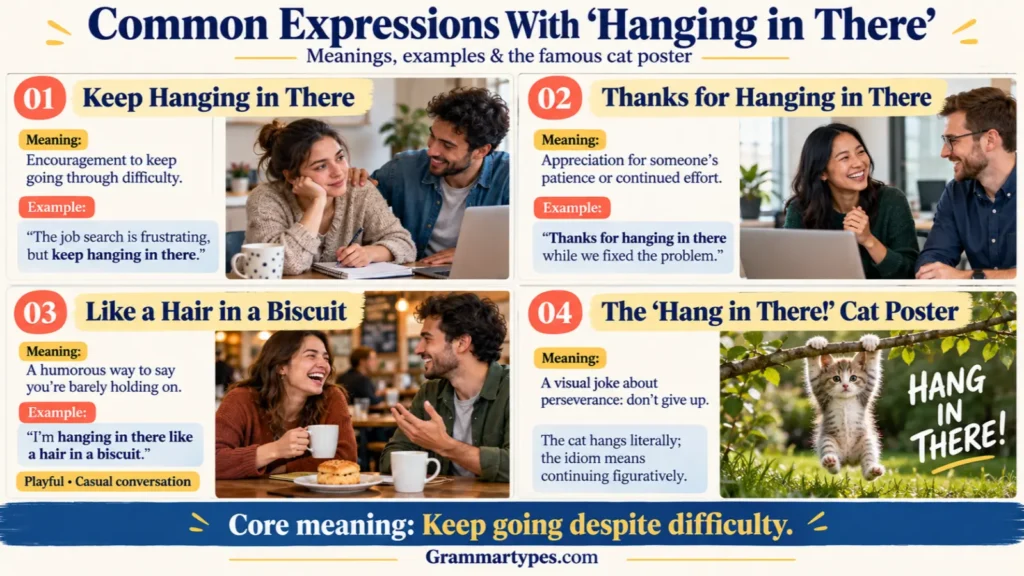
Common Expressions With “Hanging in There”
Several variations appear naturally in everyday English.
“Keep Hanging in There”
Keep hanging in there is encouragement to continue coping with a difficult situation.
“I know the job search is frustrating, but keep hanging in there.”
“Thanks for Hanging in There”
This phrase acknowledges someone’s patience or continued effort.
“Thanks for hanging in there while we worked through the technical problems.”
Here, the expression focuses on patience and persistence rather than simply answering “How are you?”
“Hanging in There Like a Hair in a Biscuit”
“Hanging in there like a hair in a biscuit” is a humorous, exaggerated variation of the normal idiom.
It communicates the idea of barely holding on or stubbornly continuing, usually in a joking way.
Because it is playful and unusual, it is much more appropriate for casual conversation than formal writing.
“Hanging in There” Cat Meme and Poster Meaning
The phrase is also strongly associated with humorous cat posters and memes, especially images of a cat holding onto a branch with a message encouraging it to persevere.
The visual joke works because the literal image of a cat physically Enduring on reinforces the figurative meaning of not giving up.
This explains searches such as hanging in there cat, cat hanging in there, hanging in there cat poster, kitten hanging in there, and hanging in there poster. These searches relate to the familiar motivational image rather than a different grammatical meaning of the expression.
The phrase itself, however, is an idiom; its meaning is figurative perseverance, not literally Persisting from something.
Common Mistakes
❌ “I am hang in there.”
✅ “I am hanging in there.”
After am, use the present participle hanging, not the base form hang.
❌ “I’m hanging on there”
✅ “I’m hanging in there.”
When you mean coping with a difficult situation, the established expression is hanging in there.
However, hanging on can be grammatical when on has a different function:
“I’m hanging on to my old job.”
That means you are retaining or refusing to let go of something, not simply using the idiom Enduring in there.
❌ “Hang in here!” for the usual idiom
✅ “Hang in there!”
Hang in there is the established expression when encouraging someone to persevere. Hang in here may occur in a literal or location-specific context, but it is not the normal replacement for the idiom.
A Quick Way to Remember It
Think of there as referring to the difficult situation you’re currently facing:
Hang in there = Don’t give up while you’re in that difficult situation.
And when describing yourself:
I’m hanging in there = Things are hard, but I’m continuing.
That simple distinction makes the expression easy to use correctly.
Examples in Everyday English
Here are several natural examples across different situations:
Work:
“The new job is stressful, but I’m hanging in there.”
School:
“Final exams are exhausting, but I’m hanging in there.”
Friendship:
“I know you’re having a rough week. Hang in there.”
Project:
“We’re hanging in there despite the delays.”
Text message:
“How are you doing?”
“I’m hanging in there.”
Encouragement:
“Hang in there. You’re closer to the finish line than you think.”
Final Thoughts
Hanging in there means continuing to cope with a difficult situation without giving up. When you say “I’m hanging in there,” you usually mean that things are challenging, but you are managing and continuing forward. When you tell someone “Hang in there,” you are encouraging them to stay strong and persevere.
Remember that hanging in there is an informal idiomatic expression, while Persevering on can have several other meanings. If you need a more professional alternative, “I’m managing” or “I’m continuing to work through the challenges” may fit better. For everyday conversation, however, “I’m hanging in there” is natural, clear, and widely understood.
FAQs About “Hanging in There”
It means “I am coping with a difficult situation and continuing despite the challenges.” It often communicates that things are not easy, but the speaker has not given up.
Hanging on in there means continuing to persevere despite difficulties. It is a recognized variation of hang in there, particularly in British English.
Both can be correct, but they are used differently. Hanging in there is the clearer idiom for coping with difficulties. Persisting on has additional meanings, including waiting or physically holding onto something.
Depending on the situation, you can say “I’m getting by,” “I’m managing,” “I’m doing okay,” “I’m holding up,” “I’m pushing through,” or “I’m taking it one day at a time.”
It is generally neither strongly positive nor negative. It acknowledges difficulty while suggesting persistence. The exact tone depends on modifiers: “I’m still hanging in there” sounds persistent, while “I’m barely Enduring in there” suggests serious difficulty.
Yes. Hang in there is an idiom used to encourage someone not to give up despite difficulties.
You can use it in casual workplace communication, especially when speaking with familiar colleagues. For formal emails, reports, or business documents, a phrase such as “I’m managing,” “we’re continuing to make progress,” or “we’re working through the challenges” is usually more appropriate.
Explore More Grammar Guides:
Greetings and Wishes: 50+ Messages, Examples, and Everyday Expressions
Have an Amazing Day: Meaning, Correct Usage, Grammar & 25 Best Wishes
75+ You Can Do It Quotes to Inspire and Motivate You
