
A simple message can be surprisingly difficult to write. You may know exactly what you want to say, yet hesitate over whether “Good afternoon” sounds natural, how to congratulate two people, or whether “Have an amazing day” is appropriate for a coworker. These greetings and wishes may seem simple, but small choices in everyday messages can change the tone of a conversation.
The confusion often comes from context. A message to a close friend does not need the same wording as a professional email, and a congratulatory note requires a different tone from a casual vacation message. Even familiar expressions can raise questions about punctuation, capitalization, formality, and word choice.
This everyday wishes & Everyday Messages Guide brings these situations together in one practical resource. You will find explanations, examples, tone guidance, common mistakes, and ready-to-adapt expressions for everyday conversations, professional communication, celebrations, encouragement, gratitude, and special occasions.
What Are Greetings and Wishes?
A greeting is an expression used when meeting, addressing, or welcoming someone. Merriam-Webster defines greetings and wishes as a salutation at meeting or an expression of good wishes.
A greetings and wishes expresses a desire for something good to happen or communicates good fortune toward another person. For example, you can wish someone a happy birthday, a pleasant vacation, or success in an upcoming event. Merriam-Webster also gives wish the sense of expressing a desire or offering good wishes.
Everyday messages are broader. They can include:
- greetings and wishes when you meet someone
- Good wishes for someone’s day or week
- Congratulations
- Thank-you messages
- Encouragement
- Vacation wishes
- Birthday and holiday messages
- Supportive messages
- Short professional greetings
- Friendly texts and social messages
The right expression depends on who you are addressing, why you are writing, and how formal the situation is.
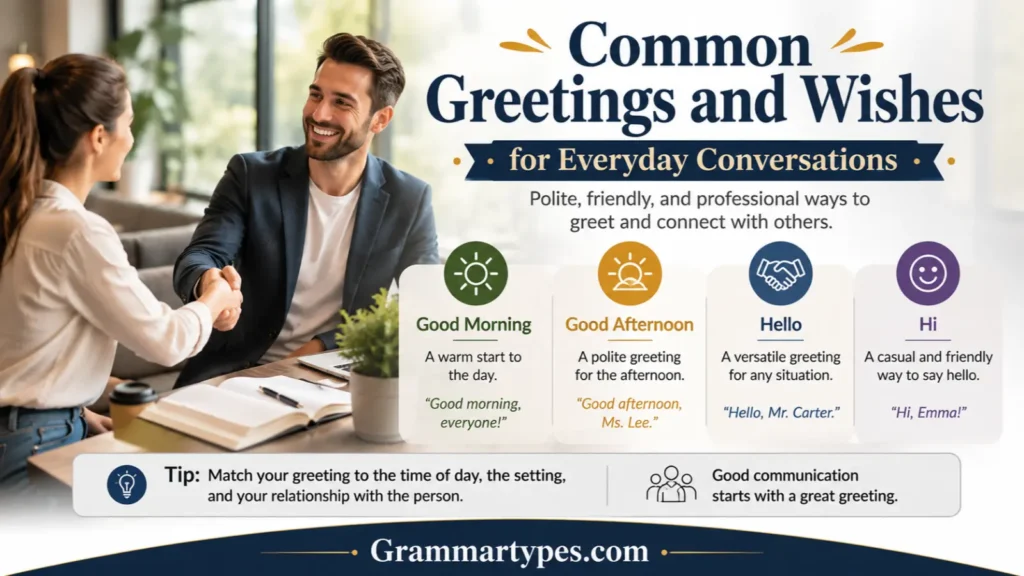
Common Greetings and Wishes for Everyday Conversations
Some greetings and wishes work across many ordinary situations. The best choice usually depends on the time of day and the relationship between the speakers.
Good Morning
Good morning is a standard greeting used when meeting someone in the morning. Cambridge Dictionary classifies it as an expression used to greet someone politely in the morning.
Examples:
- Good morning, Sarah.
- Good morning, everyone.
- Good morning! How are you?
- Good morning, team. Are we ready to begin?
When addressing someone directly, a comma can separate the greeting from the person’s name:
Good morning, James.
The phrase is normally written as two words, not goodmorning. It works in professional communication as well as casual conversation.
Good Afternoon
Good afternoon is used when greeting someone in the afternoon. Cambridge Dictionary describes it as a polite afternoon greeting and provides examples such as “Good afternoon, everyone.”
Examples:
- Good afternoon, everyone.
- Good afternoon, Ms. Lee.
- Good afternoon! I hope you’re doing well.
It is especially useful when you want a polite, neutral greeting in a workplace, classroom, meeting, phone call, or other formal setting.
Hello and Hi
Hello is a versatile greeting that works in both formal and informal situations. Hi is generally more casual.
Compare:
| Greeting | Typical tone | Example |
|---|---|---|
| Hello | Neutral to formal | Hello, Mr. Carter. |
| Hi | Friendly and casual | Hi, Emma! |
| Good morning | Polite and time-specific | Good morning, everyone. |
| Good afternoon | Polite and time-specific | Good afternoon, Dr. Smith. |
You do not need to make every greeting sound formal. Choose wording that matches the relationship and situation.
Everyday Wishes and Friendly Messages
Short wishes can make ordinary communication warmer without sounding overly elaborate.
Have an Amazing Day
Have an amazing day expresses a positive wish for someone’s day. It works especially well in friendly conversation, texts, social messages, and customer-facing communication when a warm tone is appropriate.
Examples:
- Have an amazing day!
- Thanks for your help. Have an amazing day!
- I hope everything goes well. Have an amazing day!
For a more neutral or professional tone, you can use Have a great day or Have a wonderful day.
Have a Great Week Ahead
Have a great week ahead is useful when ending a conversation near the beginning of a workweek or before someone starts a new week.
Examples:
- Thanks again for your help. Have a great week ahead!
- It was wonderful catching up. Have a great week ahead.
- Take care, and have a great week ahead!
You can also say Have a great week. The shorter version is often more natural in everyday conversation.
Enjoy Your Lunch
Enjoy your lunch is a simple expression used when someone is about to eat or is heading out for lunch.
Examples:
- Enjoy your lunch!
- I’m heading back to work. Enjoy your lunch.
- Thanks for meeting with me. Enjoy your lunch!
It is friendly rather than highly formal, making it suitable for coworkers, friends, family, and everyday interactions.
Greetings and Wishes for Special Occasions
Supportive messages should sound sincere rather than overly dramatic. A short sentence can sometimes provide more comfort than a long speech.
Encouraging Words for Difficult Times
“You can do it” is a direct expression of encouragement. Depending on the situation, you can make the message more personal or supportive:
- You can do it! Keep going.
- I know this is difficult, but you can do it.
- Take it one step at a time. You can do it.
- You’ve worked hard for this. Believe in yourself.
If someone is hanging in there, you can acknowledge the difficulty without pretending everything is easy.
Examples:
- I know things are tough right now, but keep hanging in there.
- You’re doing your best, so give yourself some credit.
- Hang in there. Better days are ahead.
The phrase hanging in there is informal and supportive. It fits conversations with friends, family, classmates, and colleagues you know well.
Thank You and Appreciation Messages
Gratitude messages do not have to be complicated. The strongest messages usually identify what you appreciate.
Thank You Both
Use thank you both when expressing gratitude to two people.
Examples:
- Thank you both for helping me with the project.
- Thank you both for coming to the celebration.
- I really appreciate your support. Thank you both.
A common mistake is using a singular reference when addressing two people.
❌ Thank you both of you for helping.
This is understandable, but it is unnecessarily repetitive.
✅ Thank you both for helping.
You can also write:
✅ Thank you to both of you for your support.
Both constructions are natural; choose the shorter version when you want a simple everyday message.

Congratulations and Celebration Messages
Congratulatory messages recognize an achievement, milestone, or happy event.
Congratulations to Both of You
Use congratulations to both of you when two people share an achievement or occasion.
Examples:
- Congratulations to both of you on your new home!
- Congratulations to both of you on your wedding.
- Congratulations to both of you on this wonderful achievement.
The expression is especially useful when addressing a couple or two people who accomplished something together.
You can make the message warmer by adding a personal wish:
Congratulations to both of you! Wishing you many happy years ahead.
Remember that congratulations is normally plural when used as the noun for praise given after an achievement.
Greeting And Wishes Messages for Vacations and Time Away
Vacation messages are usually warm, positive, and relaxed. The wording can range from casual to professional.
Enjoy Your Vacation
Enjoy your vacation is a natural way to wish someone a pleasant trip or period away from work.
Examples:
- Enjoy your vacation! You deserve the break.
- Have a safe trip and enjoy your vacation.
- I hope you have a relaxing time. Enjoy your vacation!
For a colleague, you might write:
Enjoy your vacation, and we’ll see you when you get back.
For a close friend:
Have fun and enjoy your vacation! Send me some pictures.
The expression have a great vacation is another natural alternative.
Messages About Good Experiences
Sometimes you want to tell someone that you enjoyed spending time with them.
I Had a Great Time
I had a great time is a natural way to express that you enjoyed an event, meeting, trip, conversation, or social activity.
Examples:
- I had a great time at dinner last night.
- Thanks for inviting me. I had a great time.
- I had a great time talking with you.
You can also use We had a great time when speaking for a group.
Avoid adding unnecessary words:
❌ I had a great time experience.
✅ I had a great time.
The phrase already communicates that you enjoyed the experience.
Encouraging Greetings and Wishes
Some messages communicate affection or gratitude rather than simply offering a greetings and wishes.
I Am Lucky to Have You
I am lucky to have you expresses appreciation for someone’s presence and support. It is personal and emotional, so it works best with people you know well.
Examples:
- I am lucky to have you as a friend.
- I’m lucky to have you in my life.
- I am so grateful for everything you do. I’m lucky to have you.
For professional communication, a less personal alternative may be more appropriate:
I’m grateful for your support and guidance.
This distinction matters because a grammatically correct message can still feel inappropriate if its emotional tone does not match the relationship.
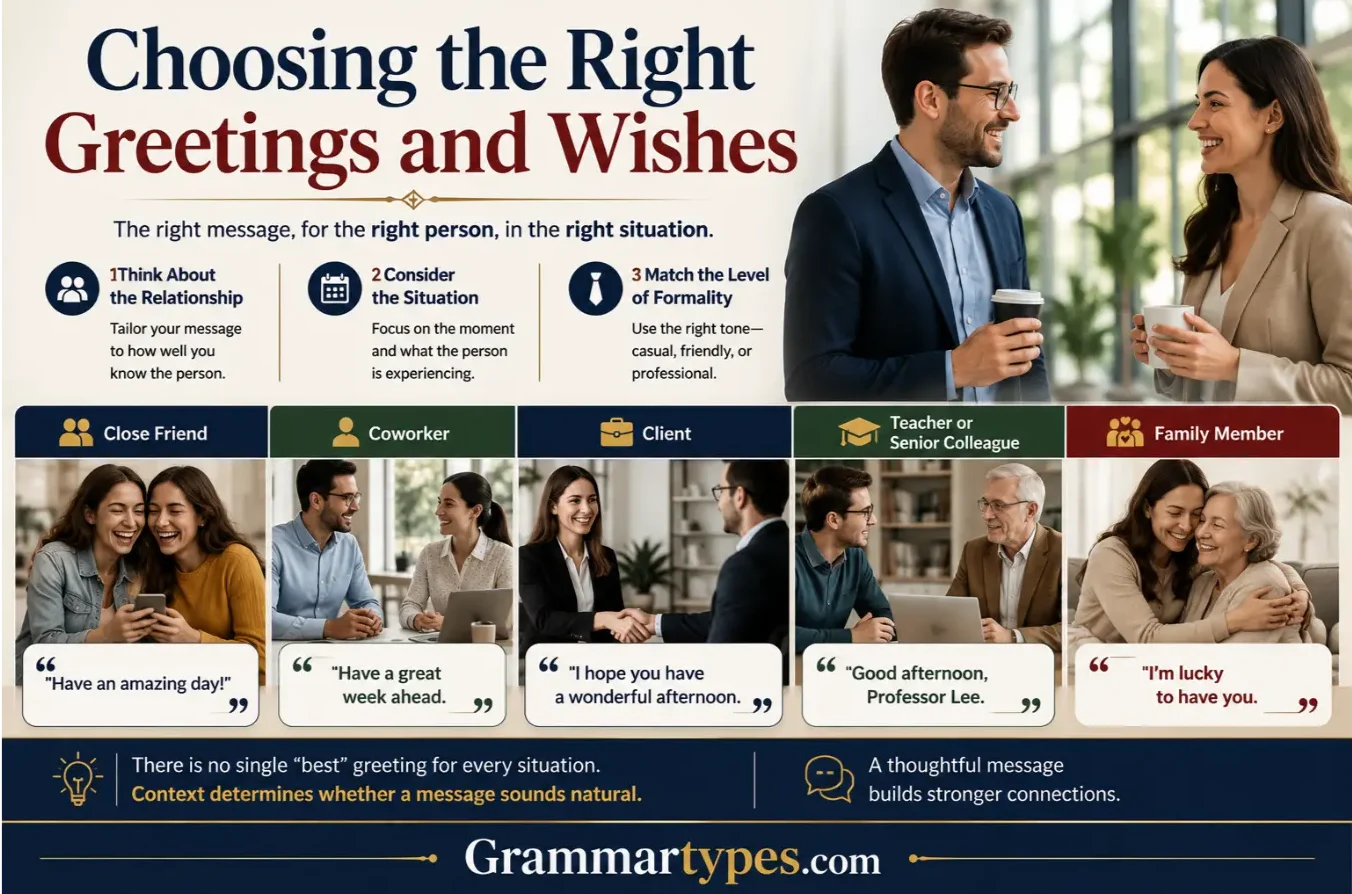
Choosing the Right Greetings and Wishes
Before sending an everyday message, consider three things:
1. Think About the Relationship
A message to a close friend can be relaxed:
Hope you’re having an amazing day!
A professional message may be more restrained:
I hope you’re having a great day.
2. Consider the Situation
A congratulatory message should focus on the achievement:
Congratulations to both of you on this wonderful milestone!
A supportive message should acknowledge the person’s situation:
I know this has been challenging. Keep hanging in there.
3. Match the Level of Formality
| Situation | Suitable style | Example |
|---|---|---|
| Close friend | Casual | Have an amazing day! |
| Coworker | Friendly-neutral | Have a great week ahead. |
| Client | Polite-professional | I hope you have a wonderful afternoon. |
| Teacher or senior colleague | Respectful | Good afternoon, Professor Lee. |
| Family member | Warm | I’m lucky to have you. |
There is no single “best” greeting for every situation. Context determines whether a message sounds natural.
Common Mistakes in Greetings and Messages
Mistake 1: Writing “Goodmorning”
❌ Goodmorning, everyone.
✅ Good morning, everyone.
Why: Good morning is written as two words in standard English. Cambridge Dictionary lists it as the standard greeting expression.
Mistake 2: Forgetting the Comma in Direct Address
❌ Good morning Sarah.
✅ Good morning, Sarah.
The comma helps separate the greetings and wishes from the person’s name.
Mistake 3: Using “Thank You Both” for More Than Two People
Thank you both specifically refers to two people.
If you are thanking three or more people, use:
Thank you all for your help.
Mistake 4: Making a Professional Message Too Personal
A phrase such as I am lucky to have you can be warm and meaningful, but it may not suit every workplace relationship.
Instead, consider:
I really appreciate your support.
Mistake 5: Confusing a Wish With a Greeting
A greeting starts or acknowledges an interaction:
Good afternoon, Maria.
A wish expresses something you hope someone experiences:
Have a great afternoon, Maria.
They can appear together:
Good afternoon, Maria. I hope you’re having a great day.
Quick Guide to Choosing an Expression
When you are unsure what to write, use this quick reference:
- Morning greeting: Good morning.
- Afternoon greeting: Good afternoon.
- Friendly greeting: Hi!
- Professional greeting: Hello / Good morning / Good afternoon.
- Positive day wish: Have a great day.
- Stronger positive wish: Have an amazing day.
- Week-ending message: Have a great week ahead.
- Vacation message: Enjoy your vacation.
- Two-person thank-you: Thank you both.
- Two-person congratulations: Congratulations to both of you.
- Encouragement: You can do it!
- Support during difficulty: Hang in there.
- Appreciation: I’m lucky to have you.
- Lunch wish: Enjoy your lunch.
- Positive experience: I had a great time.
FAQs
Good morning is written as two words. It is a standard greeting used when meeting someone in the morning. Goodmorning is not the standard written form.
Good afternoon is a polite, neutral greetings and wishes. You can use it in professional situations such as meetings, emails, classrooms, and phone calls, as well as in ordinary conversations.
You can say Have a great day, Have a wonderful day, Hope you have a fantastic day, or Wishing you a lovely day. Choose the version that matches the relationship and tone.
Use Congratulations to both of you when two people share an achievement or special occasion. You can then add the specific reason: Congratulations to both of you on your new home!
Yes. Thank you both is correct when you are thanking two people. For more than two people, Thank you all is generally the better choice.
Simple expressions such as You can do it, Keep going, Hang in there, and I believe in you can work well. Choose one that feels sincere and appropriate to the person’s situation.
You can say Enjoy your vacation, Have a great vacation, or Have a safe and enjoyable trip. A personal addition can make the message warmer.
Final Thought
Good everyday messages do not need complicated vocabulary. The most effective wording is usually clear, natural, and appropriate for the person and situation. Use good morning and good afternoon as straightforward everyday wishes, while expressions such as have an amazing day, enjoy your vacation, and have a great week ahead communicate positive wishes. For gratitude, thank you both works when addressing two people, and congratulations to both of you is appropriate for shared achievements.
When you want to encourage someone, you can do it or hang in there can sound supportive without becoming overly formal. And when expressing personal appreciation, I am lucky to have you carries a warmer, more intimate tone. The key is not simply choosing grammatically correct words; it is choosing words that fit the relationship, purpose, and setting.
[authorbox]
