
Have you ever received a text that simply says “mk” and wondered whether the person meant “okay,” sounded annoyed, or was trying to end the conversation? Because texting often removes facial expressions and voice tone, two simple letters can sometimes feel more complicated than they really are.
If you are searching what does MK mean in text, the most common answer is “okay,” “alright,” or “got it.” It is an informal shorthand often used to acknowledge a message, accept a suggestion, or show that someone understands.
However, the tone can change with the situation. A friendly “mk” may feel relaxed, while a blunt “mk.” after an argument can sound cold or dismissive. This guide explains the meaning, common uses, tone, differences between “mk” and similar replies, and what it may mean when a girl or boy sends it.
What Does MK Mean in Text?
In everyday texting, MK usually means “okay” or “m’kay.” It is an informal way to acknowledge something without typing the full word “okay.”
For example:
Person A: “I’ll meet you at 7 instead of 6.”
Person B: “mk”
Here, mk most likely means “okay” or “got it.”
The expression is related to informal spellings such as m’kay, mkay, mmkay, and mm-kay, which represent a conversational pronunciation of “okay.” Dictionary.com defines m’kay as an informal form of “OK,” while Wiktionary lists mk among alternative forms of m’kay.
So, when someone types MK in a casual conversation, you generally do not need to look for a complicated hidden meaning.
Quick Answer
MK in text usually means “okay,” “alright,” “got it,” or “I understand.” It is an informal acknowledgment used in texting and online conversations. Depending on the context, it can sound neutral, friendly, reluctant, dry, or slightly dismissive.
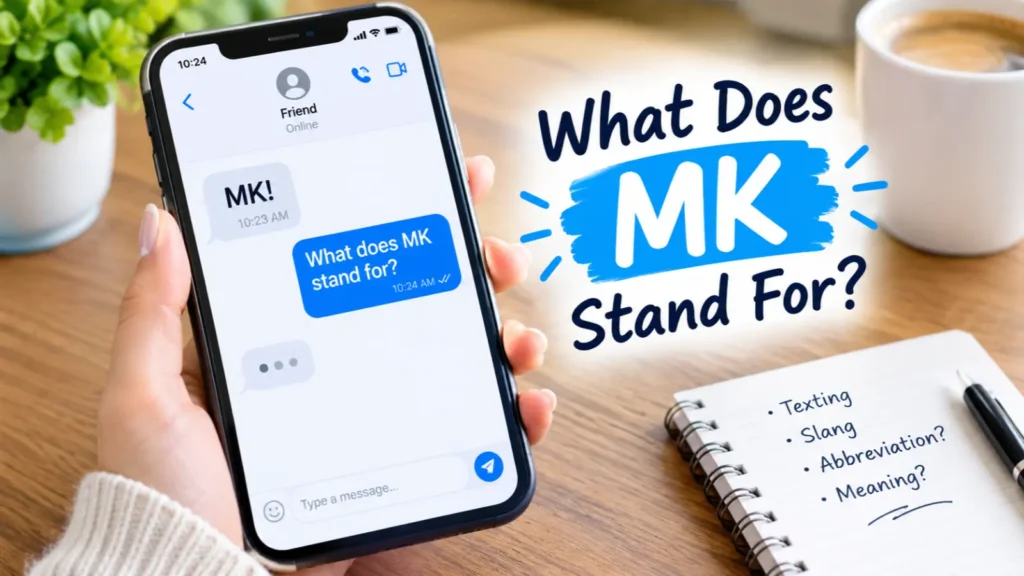
What Does MK Stand For?
Unlike abbreviations such as LOL (“laugh out loud”), MK is not best understood as an acronym in which each letter represents a separate word.
In texting, MK is generally a shortened written form associated with “m’kay” or “okay.” The spelling represents a casual conversational sound rather than a formal abbreviation.
You may see several versions:
| Form | Common interpretation | Typical tone |
|---|---|---|
| mk | Okay / got it | Casual |
| MK | Okay / got it | Casual |
| mkay | M’kay / okay | Conversational |
| mmkay | Mmm, okay | More expressive |
| m’kay | Okay | Informal |
| okay | Okay | Clearer and more neutral |
The capitalization usually does not create a completely different meaning. The surrounding message is much more important.
How Is MK Used in Text Messages?
People commonly use mk when they want to acknowledge something quickly. It can perform several slightly different conversational functions.
1. To Show Agreement
Someone may use MK to agree to a plan or suggestion.
“Want to grab coffee after class?”
“mk, sure.”
Here, the sender is agreeing.
2. To Confirm They Understand
MK can also mean that the person has received and understood information.
“The appointment is at 3:30, not 3.”
“mk, thanks.”
In this situation, it simply means “Got it.”
3. To Accept a Request
A person might respond with MK after someone asks them to do something.
“Can you send me the notes tonight?”
“mk.”
The response indicates acknowledgment, although it does not necessarily sound enthusiastic.
4. To Keep the Conversation Moving
Sometimes the sender has nothing else to add.
“I already told Sarah about the change.”
“mk.”
Here, MK can simply close that part of the conversation.
5. To Sound Casual
Some people naturally prefer short replies. For them, “mk” may have no negative intention at all.
That is why it is risky to assume that every short MK means the sender is angry or annoyed.
What Does MK Mean for a Girl?
If a girl sends you “mk,” it usually has the same basic meaning: “okay,” “alright,” or “got it.”
The fact that the sender is a girl does not give MK a special dictionary meaning. What changes is the context and tone of the conversation.
For example:
You: “I’ll text you when I get home.”
Her: “mk 😊”
This likely sounds friendly or neutral.
Compare that with:
You: “I’m sorry, but I can’t come tonight.”
Her: “mk.”
The second response may feel colder, but you still cannot conclude from “mk” alone that she is angry.
Look at the conversation before and after the message. Her usual texting style, punctuation, emojis, and the subject of the conversation can provide better clues than the abbreviation itself.
Why Do Girls Say MK?
Girls may use MK for the same reasons anyone else does:
- To acknowledge a message
- To agree with something
- To confirm information
- To respond quickly
- To keep a conversation brief
- To indicate that they understand
It does not automatically mean she is upset, uninterested, flirting, or ending the relationship.
If you are trying to understand the emotional meaning, consider the entire exchange rather than interpreting two letters in isolation.
What Does MK Mean From a Boy?
If a boy sends “mk,” the usual interpretation is also “okay,” “alright,” or “got it.”
For example:
You: “We’re meeting outside the library at 5.”
Him: “mk”
That is most likely a simple acknowledgment.
If he normally sends long, enthusiastic messages but suddenly replies with only “mk.”, the change in communication style may make the response seem distant. Still, it is better to consider the surrounding conversation before assuming a particular emotion.
MK does not have a special male-specific meaning.
Is MK Rude or Passive-Aggressive?
MK is not inherently rude. However, it can sometimes sound dismissive because it is such a short response.
Compare these replies:
“Okay!”
“Okay, sounds good.”
“mk 😊”
“mk.”
They all can communicate acknowledgment, but they may create different impressions.
A longer response gives you more information about the sender’s attitude. A one-word or two-letter response leaves more room for interpretation.
A particularly short “mk.” after a disagreement may feel passive-aggressive, but that interpretation depends on context. Informal m’kay itself can sometimes carry an ironic or condescending sense, according to dictionary references.
Signs That MK Is Probably Neutral
It is more likely neutral when:
- The conversation is already casual.
- The person normally uses short replies.
- They add an emoji or another friendly phrase.
- They are simply confirming information.
- Nothing happened immediately before the message that would suggest conflict.
Signs It May Sound Cold
It may feel more dismissive when:
- It appears after an argument.
- The sender suddenly becomes unusually brief.
- The message is simply “mk.”
- They stop responding afterward.
- Their previous messages suggest frustration.
Even then, tone cannot be determined with certainty from MK alone.
MK on Snapchat, Instagram, TikTok, and WhatsApp
The basic meaning of MK generally remains the same across messaging platforms.
You might encounter it in:
- Snapchat messages
- Instagram DMs
- TikTok messages
- WhatsApp chats
- Text messages
- Discord conversations
- Online gaming chats
For example:
Snapchat:
“I’ll send it later.”
“mk”
Instagram:
“Are you coming tonight?”
“mk, I’ll be there.”
WhatsApp:
“Don’t forget your charger.”
“mk 👍”
The platform does not normally change the core meaning. The conversation determines the intended tone.
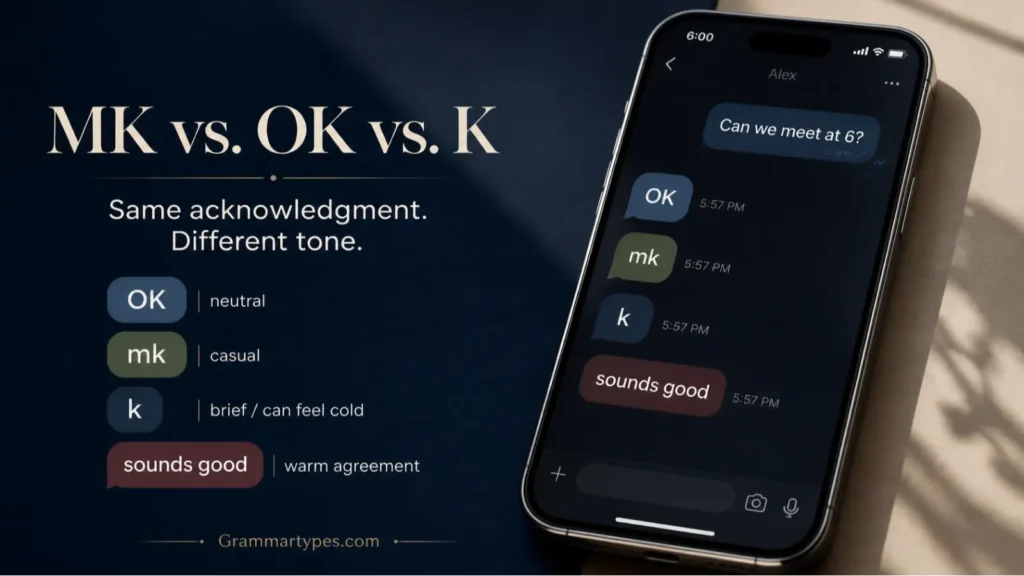
MK vs. OK vs. K: What Is the Difference?
Although MK, OK, and K can all communicate acknowledgment, they do not always feel identical.
| Reply | Common meaning | Possible impression |
|---|---|---|
| Okay | Agreement or acknowledgment | Clear, neutral |
| OK | Agreement or acknowledgment | Neutral, direct |
| mk | Okay / got it | Casual, brief |
| k | Okay | Very short; can feel cold |
| kk | Okay / sure | Casual and often friendly |
| sounds good | Agreement | Positive and clear |
For example:
“Can we meet at 6?”
“Sounds good.”
This clearly communicates enthusiasm or agreement.
“Can we meet at 6?”
“mk.”
This confirms the message but provides much less emotional information.
That does not mean MK is automatically negative. It simply leaves more room for interpretation.
How to Respond When Someone Says MK
Your response should depend on what you want to communicate.
If the conversation is finished, you may not need to reply at all.
you want to continue talking, you can respond naturally:
“Cool, see you then!”
Or:
“Sounds good.”
If you are worried that the person sounded annoyed, avoid immediately assuming the worst. You could ask:
“Everything okay?”
For a casual conversation, you might simply continue with the next topic.
If you want to avoid sounding cold yourself, “okay,” “sure,” “sounds good,” or “got it” usually communicates your intention more clearly than a very short “mk.”
Common Misunderstandings About MK
Mistake 1: Assuming MK Always Means Anger
A short reply can feel cold, but MK does not automatically mean someone is angry.
Better approach: Look at the conversation and the person’s normal texting habits.
Mistake 2: Thinking MK Has a Special Meaning From a Girl
The sender’s gender does not automatically change the definition.
Better approach: Interpret the message using context, not gender.
Mistake 3: Assuming MK Means “I Don’t Care”
Sometimes it can sound uninterested, but that is only one possible interpretation.
Better approach: Consider whether the person is simply a brief texter.
Mistake 4: Treating MK as Formal English
MK is informal digital communication. It is not the best choice for professional emails, academic writing, or formal documents.
Use “okay,” “understood,” “certainly,” or another appropriate expression instead.
Mistake 5: Assuming Every MK Has the Same Tone
The punctuation and surrounding words can affect how a message feels.
Compare:
“mk 😊”
with:
“mk.”
The first may feel warmer, while the second can feel more abrupt. But neither punctuation pattern guarantees a particular emotion.
When Should You Use MK?
MK works best in casual, informal communication with people who are familiar with texting shorthand.
It can be appropriate when:
- Chatting with friends
- Messaging family
- Talking casually online
- Confirming simple plans
- Acknowledging information
It is better to avoid it in:
- Formal emails
- Job applications
- Academic assignments
- Business proposals
- Official correspondence
- Customer-service communication
For professional writing, clarity is usually more important than saving two or three characters.
Instead of:
“mk”
write:
“Okay, thank you.”
Or:
“Understood. I’ll take care of it.”
These responses communicate the same basic idea more clearly and professionally.
Is MMK the Same as MK?
MMK is closely related to MK and can represent an informal “mm-kay” or “okay.”
For example:
“You need to finish this before Friday.”
“mmk.”
Depending on the context, this could mean “okay,” but it may also sound hesitant, reluctant, sarcastic, or dismissive.
The important point is that MMK does not automatically carry a negative meaning. The surrounding conversation determines how it should be interpreted.
The spelling m’kay is an established informal form meaning “OK,” and related spellings include mkay and mmkay.
Does MK Mean Anything Else?
Yes. Like many short letter combinations, MK can have meanings outside texting.
For example, the same letters can appear as initials, names, abbreviations, product references, technical terms, or titles. In a specialized conversation, you should not automatically interpret MK as texting slang.
Context is therefore the key.
If the message is:
“Can you send me the address?”
“MK.”
then “okay” is a reasonable interpretation.
But if you see MK in a technical document, game title, business name, or another specialized context, it may mean something completely different.
FAQs
MK usually means “okay,” “alright,” “got it,” or “I understand.” It is an informal texting shorthand often used to acknowledge a message or agree with something.
When a girl says MK, it usually means “okay” or “got it.” It does not have a special meaning simply because a girl uses it. The conversation and tone determine whether it sounds friendly, neutral, or dismissive.
Girls may say MK because it is a quick and casual way to acknowledge a message. The same applies to boys and other texters. It does not automatically indicate anger, disinterest, or flirting.
MMK can be an informal spelling of “mm-kay,” meaning “okay.” Depending on context, it can sound neutral, reluctant, playful, or slightly dismissive.
On Snapchat, MK usually means “okay,” “alright,” or “got it.” Snapchat itself does not give the abbreviation a special meaning; the context of the message matters.
From a boy, MK generally means “okay,” “alright,” or “understood.” It does not have a separate male-specific definition.
Not necessarily. MK is informal and can sometimes sound blunt, especially when it appears alone or with a period. However, it can also be completely neutral when used by someone who normally writes short messages.
In most casual text conversations, yes. MK is generally used as a shortened, informal way to communicate “okay.” However, its tone may differ from a fuller response such as “okay, sounds good.”
Final Thought
If you have been wondering what does MK mean in text, the simplest answer is “okay,” “alright,” “got it,” or “I understand.” It is an informal shorthand commonly used to acknowledge information, accept a plan, or keep a conversation moving.
The most important point is that MK does not have one fixed emotional tone. A casual “mk” may be completely neutral, while “mk.” during an argument could feel cold or dismissive. Likewise, receiving MK from a girl or boy does not automatically create a special romantic or emotional meaning.
When you see MK, read the surrounding conversation before interpreting the sender’s attitude. And when clarity matters especially in professional writing use “okay,” “understood,” or “sounds good” instead.
Discover More Grammar Tips:
What Does ONB Meaning in Text? Explore Its Slang Meaning & Uses
SYBAU Meaning: What Does SYBAU Mean in Text and Slang?
What Does ETA Mean? ETA Meaning in Texts, Work & Everyday English
[authorbox]
