
Have you ever typed fulness or fullness and wondered whether you forgot an extra “l”? Or perhaps you have seen fulness in a Bible verse or an older book and assumed it was a spelling mistake. The confusion is understandable because both forms appear in English, and they look almost identical.
The good news is that you do not need to learn two completely different words. Fullness is the spelling you will normally want in modern English, while fulness is an accepted alternative spelling that you may encounter in older, traditional, literary, or religious writing.
Understanding when each form appears makes the choice much easier. Below, you will see the difference, meanings, examples, Bible usage, and practical rules for choosing the right spelling.
Fulness or Fullness: What Is the Difference?
Fullness and fulness have essentially the same meaning. The main difference is their spelling and how commonly they are used today.
Fullness is the familiar form in contemporary English. Fulness is a variant that appears less often and can have an older or traditional feel.
For example:
- Modern: The fullness of the report surprised everyone.
- Traditional: The fulness of the text was difficult to understand.
In both sentences, the noun refers to a sense of being full, complete, or containing a great deal.
So, if you are writing a school assignment, website article, email, or professional document, fullness is generally the straightforward choice.
Quick answer
| Spelling | Meaning | Typical context |
|---|---|---|
| Fullness | Being full or complete | Modern everyday and formal English |
| Fulness | Same basic meaning | Older, traditional, literary, or religious texts |
The important point is that fulness is not a completely different word. It is an alternative spelling of fullness.
What Does Fullness Mean?
Fullness is a noun that describes the state or quality of being full. Depending on the context, it can refer to physical quantity, completeness, richness, or the feeling of having eaten enough.
Consider this simple example:
The fullness of the basket showed that the harvest had been successful.
Here, fullness means that the basket contains a large amount.
But the word can also describe something less physical:
The fullness of the report made it useful to the research team.
In this sentence, the report is not physically full. Instead, fullness means that it contains a lot of information and detail.
That is why the meaning of fullness should always be understood from its context.
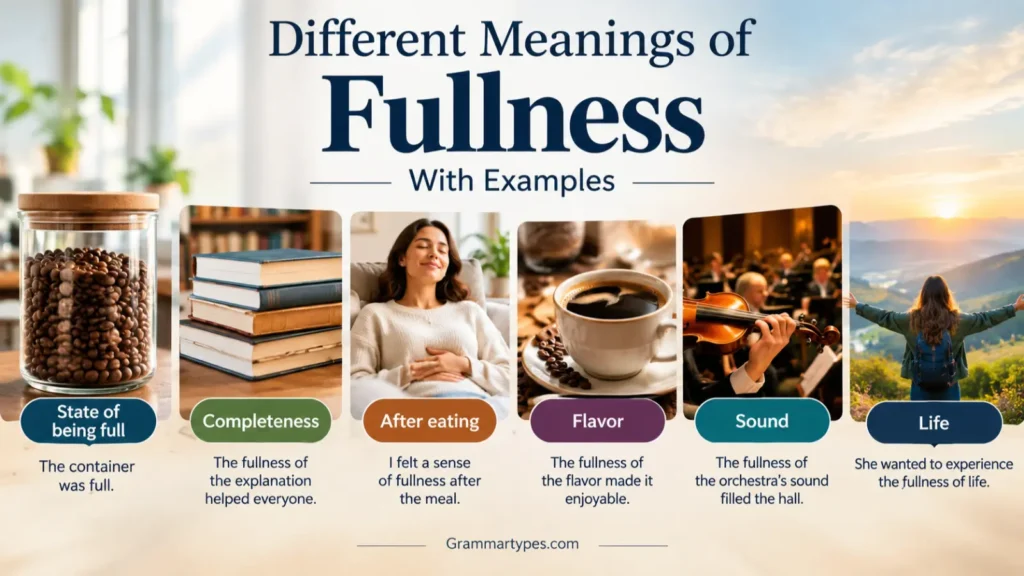
Different Meanings of Fullness With Examples
The word fullness can be used in several natural ways. Here are the most useful ones.
1. Fullness as a state of being full
This is the most direct meaning.
The fullness of the container made it difficult to lift.
The container has a lot inside it, so its fullness describes its filled state.
2. Fullness as completeness
The word can also describe something that is complete or rich in detail.
The fullness of the explanation helped the students understand the rule.
Here, fullness means the explanation provides enough detail rather than being brief or incomplete.
3. Fullness after eating
You can use fullness to describe the sensation you experience after eating.
I felt a strong sense of fullness after the large meal.
This is a common everyday use of the word. The meaning is not simply “food”; it refers to the feeling of having eaten enough or a lot.
4. Fullness of flavor
The word can describe a rich or strong quality in food and drink.
The fullness of the coffee’s flavor made it especially enjoyable.
Here, fullness refers to the richness of the flavor.
5. Fullness of sound
The same idea can apply to music or other sounds.
The fullness of the orchestra’s sound filled the concert hall.
The orchestra is not physically full. Instead, the sound is rich, powerful, and complete.
6. Fullness of life
In expressions about life, fullness can suggest richness, completeness, or having many meaningful experiences.
She wanted to experience the fullness of life rather than simply follow a routine.
The word therefore has both literal and abstract uses.
What Does Fulness Mean?
Fulness generally means the same thing as fullness.
The difference is primarily spelling, not meaning.
For example:
The fullness of the harvest was remarkable.
and:
The fulness of the harvest was remarkable.
Both sentences can express the same basic idea. However, the second spelling is less familiar to many modern readers.
You may come across fulness when reading an older book, a historical document, or a traditional religious text. In those situations, it is better to understand the spelling as a variant rather than automatically treating it as an error.
Example
Suppose you are reading an old text that says:
“The fulness of time had arrived.”
If you are discussing or quoting that text, retaining fulness may be appropriate because you are preserving the source’s wording.
If you are writing your own modern sentence, however, you would normally write:
“In the fullness of time, the plan became clear.”
This distinction between writing your own sentence and preserving an original quotation is useful.
Is Fulness a Misspelling of Fullness?
No. Fulness is not simply an incorrect spelling.
Major dictionaries recognize it as an alternative form of fullness. That is why you can find the single-l spelling in legitimate English texts.
However, recognizing a spelling as valid does not mean that both forms are equally common in every situation.
For modern general writing, fullness is the more natural choice.
Think of it this way:
Fulness = accepted variant
Fullness = usual modern spelling
This is more accurate than saying that fulness is always wrong.
Why Do Some Texts Use “Fulness”?
The single-l spelling can appear because English spelling has changed over time and because some texts preserve traditional forms.
This is particularly noticeable in religious writing and older literature.
For example, readers of the King James Bible may encounter fulness in passages where many modern translations use fullness.
The spelling therefore sometimes tells you something about the source or translation, rather than changing the meaning of the word.
That is an important distinction for anyone reading older English.
Fulness or Fullness in the Bible
Bible-related searches can make the spelling question especially confusing because different English translations do not always use the same spelling.
For example, the King James Version uses “fulness” in Ephesians 3:19:
“…filled with all the fulness of God.”
Other modern English translations use “fullness” in the same verse.
This does not mean that the two words have different meanings in these translations. The difference is connected to the spelling conventions of the translation.
What Does “Fullness of God” Mean?
In a biblical context, fullness of God refers to the idea of God’s fullness, completeness, or entirety within the theological context of the passage.
For example:
The phrase “fullness of God” appears in discussions of Ephesians 3:19.
If you are quoting a particular Bible translation, keep the spelling used by that translation. If you are explaining the phrase in your own modern English, fullness is the more familiar spelling.
So:
- Quoting the KJV: preserve fulness
- Writing a modern explanation: fullness is natural
What Does “In the Fullness of Time” Mean?
In the fullness of time is a common English expression meaning that something happens when the appropriate time arrives or after the necessary period has passed.
For example:
In the fullness of time, the truth became known.
The sentence suggests that the truth was revealed eventually, when the time was right.
You may also see the older form:
In the fulness of time, the truth became known.
The meaning remains essentially the same.
The expression is useful because it shows how an older spelling can survive in traditional or historical language even when modern writers usually prefer fullness.
Fullness in a Sentence: Examples
Here are some natural examples showing how the word works in different contexts.
Everyday English
The fullness of the box made it difficult to close.
Here, fullness describes how much the box contains.
Academic writing
The fullness of the evidence supports a more detailed analysis.
Here, it means the evidence is extensive or complete.
Food
I experienced a feeling of fullness after lunch.
Here, it describes the physical sensation of having eaten.
Music
The fullness of the piano’s sound surprised the audience.
Here, it refers to richness and depth of sound.
Personal or abstract meaning
She appreciated the fullness of her new life.
Here, the word suggests richness and completeness rather than physical fullness.
Common Mistakes With Fulness and Fullness
Mistake 1: Saying “fulness” is always wrong
❌ Fulness is an incorrect English word.
That statement is too broad.
✅ Fulness is an accepted variant of fullness.
It may be less familiar in modern writing, but it appears in established texts.
Mistake 2: Assuming the two words have different meanings
❌ Fulness means something different from fullness.
✅ Fulness and fullness generally have the same meaning.
The important distinction is spelling and context.
Mistake 3: Changing a historical quotation
Suppose an original source says:
“the fulness of time”
If you are directly quoting the source, changing it to fullness may no longer represent the original wording exactly.
Instead, preserve the source’s spelling when an exact quotation is required.
Mistake 4: Treating this as a UK-versus-US spelling rule
It is tempting to assume that one form belongs to British English and the other belongs to American English.
That is not the best way to understand the distinction. Cambridge lists fulness as an alternative form in both its UK and US dictionary presentations.
So this is not a simple:
British = fulness
American = fullness
rule.
For contemporary writing in either variety, fullness is the familiar choice.
Which Spelling Should You Use?
If you are writing something yourself and simply want the normal modern spelling, choose:
Fullness
Use it in:
- School and university writing
- Business communication
- Blog posts
- Website content
- General correspondence
- Modern articles
- Everyday English
You may want to retain fulness when:
- Quoting an older source
- Reproducing a traditional text
- Referring to a historical document
- Discussing a particular Bible translation
- Preserving an author’s original spelling
A simple memory rule
Writing modern English? → Fullness
Quoting or discussing traditional wording? → Fulness may appear
This rule will help you choose without having to memorize complicated spelling rules.
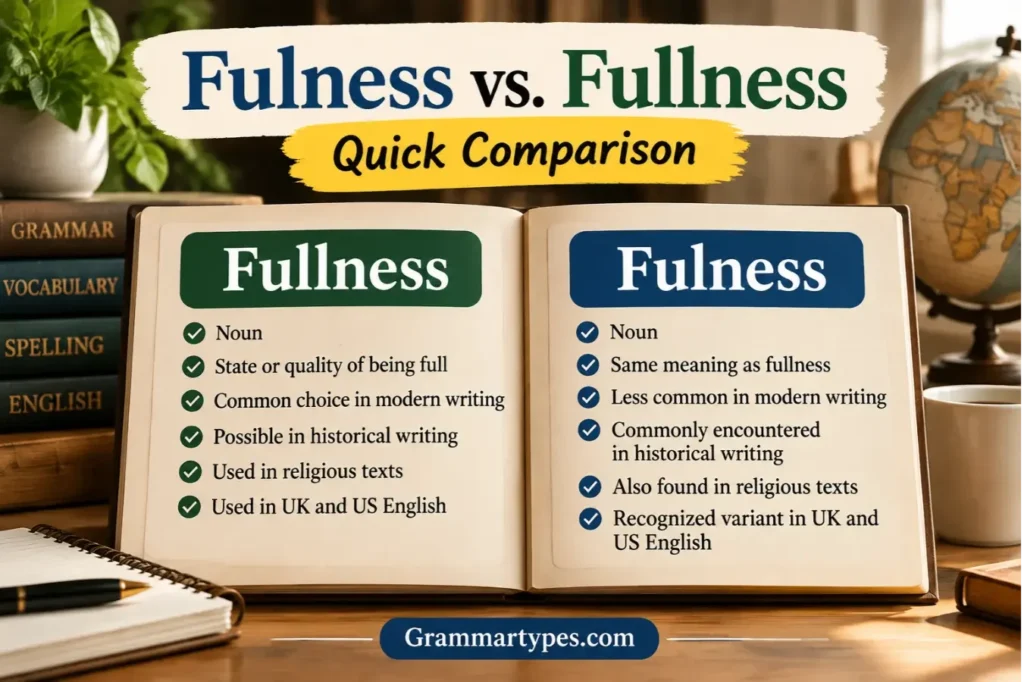
Fulness vs. Fullness: Quick Comparison
| Point | Fullness | Fulness |
|---|---|---|
| Part of speech | Noun | Noun |
| Basic meaning | State or quality of being full | Same |
| Modern writing | Common choice | Less common |
| Historical writing | Possible | Commonly encountered |
| Religious texts | Used | Also found |
| UK English | Used | Recognized variant |
| US English | Used | Recognized variant |
| Meaning difference | None in ordinary use | None in ordinary use |
The biggest takeaway is simple: the spelling changes, but the basic meaning does not.
Final Thought
When choosing between fulness or fullness, the simplest modern rule is to use fullness in your own contemporary English writing. It is the familiar spelling and works naturally in academic, professional, everyday, and online writing.
At the same time, fulness is not simply a spelling mistake. It is an accepted variant that appears in older literature, traditional writing, and some religious texts. That is why you may encounter both forms while reading.
The two spellings generally carry the same meaning, so the real difference is usage and context, not definition. If you are writing a new sentence, choose fullness. If you are reproducing a historical or religious source, keep fulness when that is the spelling used by the original text.
FAQs
Fulness means essentially the same thing as fullness: the state or quality of being full, complete, abundant, or rich. It is an accepted alternative spelling.
The usual modern spelling is fullness, written f-u-l-l-n-e-s-s.
Fullness can mean being completely full, having a lot of something, being complete, or having a rich quality. The exact meaning depends on the context.
Both spellings are recognized, but fullness is the usual modern form. Fulness is an alternative spelling that you may see in older, traditional, literary, or religious texts.
Yes. Fulness is recognized as an alternative spelling in British English, but fullness is also used and is the familiar modern form.
Yes. Some English Bible translations use fulness. For example, the King James Version uses the spelling in Ephesians 3:19. Other translations use fullness.
Full is usually an adjective, while fullness is a noun.
For example:
The glass is full.
The fullness of the glass made it difficult to carry.
The first describes the glass. Th
Depending on the context, possible synonyms include completeness, abundance, richness, entirety, and plenitude. They are not interchangeable in every sentence, so the best choice depends on the intended meaning.
Explore More Grammar Guides:
Defence or Defense: Which Spelling Is Correct?(2026 Guides)
Onsite or On Site: What’s the Difference and Which Is Correct?
Puddy or Putty: Which Spelling Is Correct? (2026 Guide)
Weather and Whether: Meaning, Difference, Usage & Easy Examples
