
When two shapes curve in opposite directions, it is easy to mix up convex vs concave. You may encounter these terms in geometry, graphs, lenses, mirrors, anatomy, and even descriptions of the spine. The basic distinction is simple, but the exact meaning changes slightly depending on the subject.
In general, convex describes something that curves or bulges outward, while concave describes something that curves inward. Cambridge Dictionary gives essentially this distinction: convex means “curved or swelling out,” whereas concave means “curving in.”
This guide explains the difference with easy examples, then applies the terms to functions, graphs, lenses, mirrors, polygons, curves, and anatomy so you can recognize the correct meaning in each context.
Convex vs Concave: What Is the Difference?
The easiest way to remember the difference is:
- Convex = curves outward
- Concave = curves inward
Think about the outside of a ball. Its surface bulges toward you, so that part is convex. Now think about the inside of a bowl. It curves away from you and creates a hollow area, so it is concave.
| Feature | Convex | Concave |
|---|---|---|
| Basic shape | Curves outward | Curves inward |
| Visual idea | Bulging | Hollowing |
| Simple example | Outside of a ball | Inside of a bowl |
| Common lens | Converging | Diverging |
| Common mirror | Diverging | Converging |
| Polygon | No inward indentation | Has an inward indentation |
The words are not interchangeable. However, the practical meaning depends on what is being described.
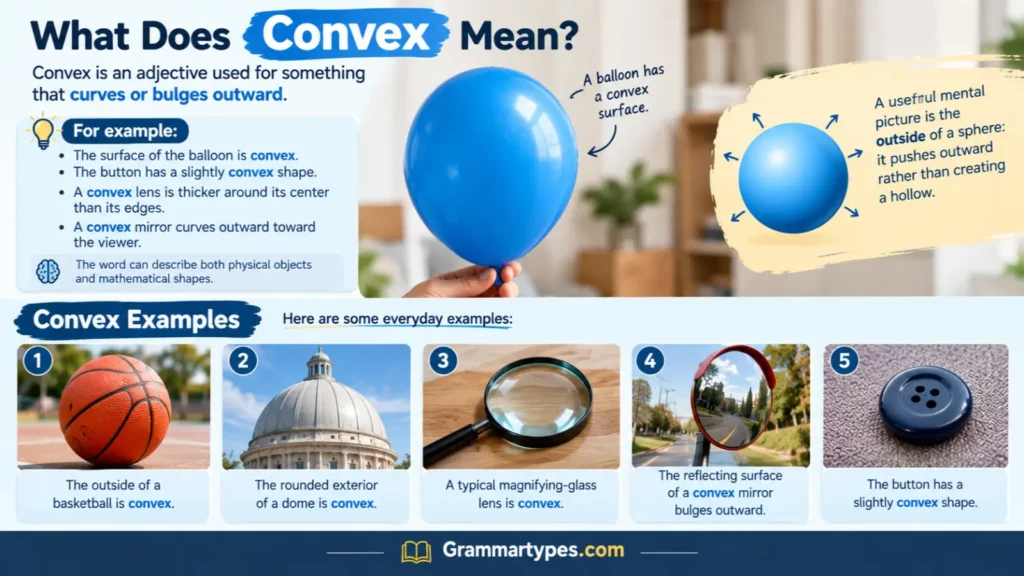
What Does Convex Mean?
Convex is an adjective used for something that curves or bulges outward.
For example:
- The surface of the balloon is convex.
- The button has a slightly convex shape.
- A convex lens is thicker around its center than its edges.
- A convex mirror curves outward toward the viewer.
The word can describe both physical objects and mathematical shapes.
A useful mental picture is the outside of a sphere: it pushes outward rather than creating a hollow.
Convex examples
Here are some everyday examples:
- The outside of a basketball is convex.
- The rounded exterior of a dome is convex.
- A typical magnifying-glass lens is convex.
- The reflecting surface of a convex mirror bulges outward.
What Does Concave Mean?
Concave describes something that curves inward or forms a hollow.
For example:
- The inside of a bowl is concave.
- The cave has a concave opening.
- A concave lens curves inward on both sides.
- A concave mirror has a reflecting surface that curves inward.
A simple memory image is a cave: the surface goes inward, creating a hollow.
Concave examples
You can see concave shapes in:
- The inside of a spoon
- The inside of a bowl
- A shallow dish
- Certain curved lenses
- Certain curved mirrors
An Easy Way to Remember Convex and Concave
If you frequently forget which word means which, use this shortcut:
Concave → cave → curves inward.
Once you remember concave = cave-like/inward, the opposite is easier:
Convex → outward bulge.
Another useful visual test is to imagine holding the shape in your hand. If the surface seems to push outward, think convex. If it seems to make a hollow, think concave.
Convex vs Concave in Geometry
In geometry, the terms can describe curves, shapes, sets, and polygons.
A convex shape has no inward indentation. More formally, if you choose any two points inside a convex set, the straight line segment connecting those points remains inside the set.
A concave shape, by contrast, has an inward indentation.
Convex polygon
A convex polygon has all of its interior angles less than 180°. It does not have a “dent” pointing inward.
Examples include:
- Triangle
- Rectangle
- Square
- Regular pentagon
Concave polygon
A concave polygon has at least one interior angle greater than 180°. Its boundary contains an inward indentation.
For example, an arrow-shaped polygon can be concave if one section points inward.
So when someone asks about a convex vs concave polygon, the quickest visual test is:
No inward dent = convex.
At least one inward dent = concave.
Convex vs Concave Function
In calculus, convex and concave can describe the behavior of a function, but the terminology can be more subtle than simply looking for an object that bulges outward.
A function is convex on an interval when its graph lies below the straight line segments connecting appropriate pairs of points. For a twice-differentiable function, a common test is:
- f″(x) ≥ 0 → convex
- f″(x) ≤ 0 → concave
Wolfram MathWorld gives the corresponding second-derivative characterization for convex functions.
In elementary calculus, you will also commonly hear:
- Concave up: the graph curves upward like a U.
- Concave down: the graph curves downward like an upside-down U.
The second derivative provides the standard test: if f″(x) > 0, the function is concave up; if f″(x) < 0, it is concave down, on the relevant interval.
This is one reason convex vs concave function can seem confusing: mathematical texts sometimes use “convex” in a way that corresponds to what calculus courses call concave up.
Example
Consider:
f(x) = x²
Its second derivative is:
f″(x) = 2
Because 2 is positive, the graph is concave up. In the broader mathematical terminology, this function is also convex.
By contrast:
f(x) = −x²
has:
f″(x) = −2
So its graph is concave down and the function is concave in the mathematical sense.
Convex vs Concave Graph
When looking at a graph, do not confuse increasing/decreasing with concavity.
A graph can be increasing while being concave up or concave down. Likewise, a decreasing graph can also be either concave up or concave down.
The important question is not simply:
Is the graph going upward or downward?
Instead, ask:
How is the slope changing?
If the slopes are becoming larger from left to right, the graph is concave up. If the slopes are becoming smaller, it is concave down.
A change from concave up to concave down, or vice versa, can indicate an inflection point, provided the function meets the relevant conditions.
Convex vs Concave Lens
In optics, the distinction becomes especially practical.
A convex lens is generally thicker in the middle and causes parallel light rays to converge. That is why it is also called a converging lens. A magnifying glass is a familiar example.
A concave lens is thinner in the middle and causes light rays to diverge. It is therefore called a diverging lens.
| Lens | Shape | Effect on light |
|---|---|---|
| Convex lens | Bulges outward | Converges light |
| Concave lens | Curves inward | Diverges light |
A convex lens can produce real or virtual images depending on the object’s position. A concave lens produces a virtual, upright, reduced image under the standard thin-lens model.
So for convex vs concave lens, remember:
Convex lens = converging.
Concave lens = diverging.
Convex vs Concave Mirror
Mirrors use the same shape words, but their optical behavior is different from lenses.
A concave mirror has its reflecting surface on the inside of a spherical surface. A convex mirror has its reflecting surface on the outside.
| Mirror | Reflecting surface | Effect on light |
|---|---|---|
| Concave mirror | Inside surface | Converges light |
| Convex mirror | Outside surface | Diverges light |
A concave mirror can produce different kinds of images depending on the object’s distance from the focal point. A convex mirror produces an upright, virtual, smaller image.
This is why a concave mirror vs convex mirror comparison should not be based only on appearance. Their optical behavior is an important part of the distinction.
Convex vs Concave in Anatomy
In anatomy, convex and concave describe the direction of a body’s surface or structure.
A surface that bulges outward can be described as convex, while one that curves inward can be described as concave.
The terms can also appear when describing the spine or other anatomical curves. However, it is important not to treat “convex” and “concave” as diagnoses by themselves.
For example, scoliosis is a three-dimensional deformity involving lateral and rotational curvature of the spine; the AAOS describes scoliosis as a sideways curve that can have C- or S-like patterns.
Therefore, searches such as convex vs concave spine, convex vs concave scoliosis, or scoliosis concave vs convex need anatomical context rather than a simple “one is normal and the other is abnormal” rule.
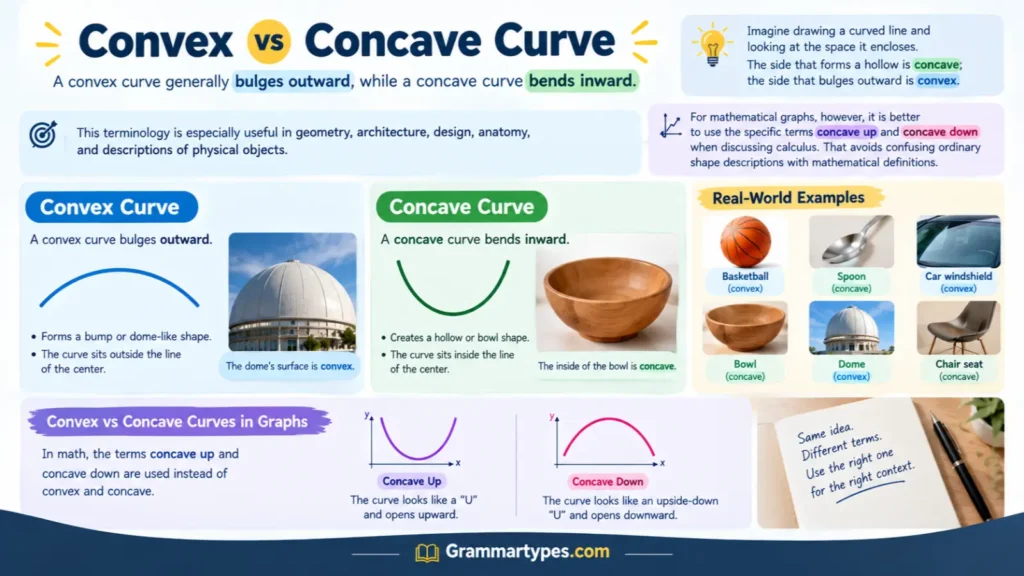
Convex vs Concave Curve
A convex curve generally bulges outward, while a concave curve bends inward.
Imagine drawing a curved line and looking at the space it encloses. The side that forms a hollow is concave; the side that bulges outward is convex.
This terminology is especially useful in geometry, architecture, design, anatomy, and descriptions of physical objects.
For mathematical graphs, however, it is better to use the specific terms concave up and concave down when discussing calculus. That avoids confusing ordinary shape descriptions with mathematical definitions.
Convex vs Concave Line
A straight line itself is neither convex nor concave in the usual visual sense because it does not curve.
However, a line segment plays an important role in defining convexity. A set is convex when the segment joining any two points in the set stays entirely within the set.
So if you see “convex vs concave line” in a geometry or calculus context, check what the writer actually means. They may be talking about a curved graph, a line segment used to test convexity, or the shape of a function.
Common Mistakes With These Terms
Mistake 1: Treating convex as inward
❌ The inside of the bowl is convex.
✅ The inside of the bowl is concave.
The inside creates a hollow, so it curves inward.
Mistake 2: Assuming every upward graph is convex
❌ The graph goes upward, so it must be convex.
✅ Check the graph’s curvature or the change in its slope.
Increasing/decreasing describes the direction of the function. Concavity describes how its slope changes.
Mistake 3: Mixing up lenses and mirrors
❌ A concave lens converges light.
✅ A convex lens generally converges light, while a concave lens diverges light.
For mirrors, the relationship is different: a concave mirror converges light, while a convex mirror diverges it.
Mistake 4: Assuming concave always means “bad”
Neither word means good or bad. Convex and concave are shape or mathematical descriptions. Whether one is desirable depends entirely on the context.
Convex and Concave: Quick Comparison
| Context | Convex | Concave |
|---|---|---|
| Everyday shape | Bulges outward | Curves inward |
| Bowl | Outside | Inside |
| Polygon | No inward indentation | Has inward indentation |
| Function | Often corresponds to concave-up behavior in calculus | Often corresponds to concave-down behavior |
| Lens | Converging | Diverging |
| Mirror | Diverging | Converging |
| Anatomy | Curves/bulges outward | Curves inward |
The function row deserves special attention because mathematical terminology can vary by field. In calculus, “concave up/down” is the standard description of graph shape, while convex analysis uses “convex” and “concave” according to mathematical inequalities.
A Simple Rule to Remember
Use this two-step memory trick:
1. Concave = cave = inward.
2. Convex = the opposite = outward.
Then add the optics shortcut:
Convex lens → converges.
Concave lens → diverges.
For mirrors, reverse the optical behavior:
Concave mirror → converges.
Convex mirror → diverges.
That distinction can save you from one of the most common sources of confusion when studying lenses and mirrors.
Quiz: Can You Tell the Difference?
1. Which shape curves inward?
A. Convex
B. Concave
Answer: B. Concave
2. Which lens is generally converging?
A. Convex lens
B. Concave lens
Answer: A. Convex lens
3. Which mirror is a diverging mirror?
A. Concave mirror
B. Convex mirror
Answer: B. Convex mirror
4. A polygon has an inward indentation. What is it?
A. Convex
B. Concave
Answer: B. Concave
5. If a twice-differentiable function has f″(x) > 0 throughout an interval, what is its calculus concavity?
A. Concave up
B. Concave down
Answer: A. Concave up Mathematics LibreTexts
Final Thoughts
The easiest way to understand convex vs concave is to focus on direction: convex curves outward, while concave curves inward. The outside of a ball is convex; the inside of a bowl is concave. The same basic distinction appears in geometry and anatomy, while mathematics and optics add more specialized meanings.
For lenses, a convex lens generally converges light and a concave lens diverges it. For mirrors, a concave mirror converges light and a convex mirror diverges it. In calculus, pay attention to how a graph’s slope changes rather than simply whether the graph rises or falls.
When in doubt, remember: concave = cave = inward; convex = outward.
FAQs
Convex means curved or bulging outward, while concave means curved inward. The distinction is straightforward for physical shapes, although mathematical fields may define convexity and concavity using specific properties or inequalities.
The outside of a ball is a simple convex example, while the inside of a bowl is concave. In optics, convex and concave lenses and mirrors provide additional examples.
A standard triangle is convex because it has no inward indentation and every line segment connecting two points inside it remains inside the triangle.
They have opposite effects on parallel light rays in the usual thin-lens context. A convex lens is converging, whereas a concave lens is diverging.
Their optical effects are opposite in the basic classification. A concave mirror is converging, while a convex mirror is diverging.
In anatomy, concave means that a surface or curve bends inward. The exact interpretation depends on the anatomical structure being described.
In calculus, a graph can be concave up when its slope is increasing and concave down when its slope is decreasing. The second derivative is commonly used to determine this when it exists.
In many mathematical contexts, a convex function corresponds to what introductory calculus calls concave up, particularly when the function is twice differentiable and has a nonnegative second derivative. Terminology should therefore be interpreted according to the mathematical context.
Explore More Grammar Guides:
Flier vs. Flyer: Meaning, Difference, and Correct Usage
Vender vs Vendor: Which Spelling Is Correct? Meaning & Examples
Lovey or Lovie: Meaning, Spelling & Examples
Discard or Disgard: Meaning, Correct Spelling, and Examples
