
If you are unsure whether to write discard or disgard, the correct spelling is discard. Disgard is a misspelling, not a standard English variant. The verb discard means to throw something away, get rid of it, or reject something you no longer need or want.
The confusion often comes from the similar-looking word disregard, which means to ignore something rather than get rid of it. In this guide, you will learn the meaning of discard, see correct examples, understand the difference between discard and disregard, and discover how to spell related forms such as discarded and discarding.
Discard or Disgard: Which One Is Correct?
Discard is the correct spelling in standard English. Disgard is an incorrect spelling of the same word.
| Spelling | Status | Meaning |
|---|---|---|
| discard | Correct | To throw away, remove, or get rid of something |
| disgard | Incorrect | A misspelling of discard |
| disregard | Correct word, different meaning | To ignore or pay no attention to something |
For example:
- Correct: Please discard the damaged documents.
- Incorrect: Please disgard the damaged documents.
- Different meaning: Please disregard my previous email.
Cambridge Dictionary defines discard as getting rid of something because it is no longer wanted or needed. It also recognizes the word’s use in card games. See the Cambridge Dictionary definition of discard.
Remember: Write discard with a c, not a g.ndable to a reader, but disgard is not the standard spelling.
What Does “Discard” Mean?
Discard means to get rid of something because you no longer want, need, or consider it useful.
It can refer to physical objects, information, ideas, plans, choices, or other things that someone decides to remove or reject.
For example:
- Please discard the empty container.
- We should discard these damaged files.
- The editor decided to discard the unnecessary paragraph.
- She discarded her old shoes.
- The researchers discarded the unreliable results.
Oxford defines discard as getting rid of something that is no longer wanted or needed. It also gives a figurative use, such as discarding an idea or thought.
How to Use “Discard” in a Sentence
Here are a few everyday examples showing how discard works as a verb:
- At home: Discard the empty packaging after opening the product.
- At work: Please discard the outdated version of the report.
- In writing: The editor decided to discard a paragraph that repeated the same point.
- In research: The team discarded results that did not meet its criteria.
- In a card game: She decided to discard one card and keep the others.
In each example, discard describes getting rid of something that is unwanted, unnecessary, or no longer useful.
In everyday language, you can often replace discard with throw away, get rid of, or remove, depending on the context.
Is “Disgard” a Real Word?
No. Disgard is not the standard spelling of the English word meaning “throw away” or “get rid of.” If you encounter disgard in a message, document, or online post, it is generally intended to mean discard.
The same spelling rule applies to its common verb forms:
- Discarded, not disgarded
- Discarding, not disgarding
- Discards, not disgards
Examples:
- Incorrect: The team disgarded the old proposal.
- Correct: The team discarded the old proposal.
- Incorrect: We are disgarding unnecessary files.
- Correct: We are discarding unnecessary files.
For standard English writing, use discard and its correctly spelled forms.

Why Do People Confuse “Discard” With “Disgard”?
There are several reasonable reasons this spelling mistake occurs.
1. You may hear the word before you see it.
Someone who learns a word primarily through conversation may try to spell it from memory. When discard is spoken quickly, the exact spelling may not be obvious from the sound alone.
Cambridge gives the pronunciation of discard as /dɪˈskɑːrd/ in American English and /dɪˈskɑːd/ in British English.
2. “Guard” may influence the spelling
English has familiar words ending in -guard, including guard and disregard. That pattern can make disgard look more believable than it actually is.
However, discard is not formed from dis + gard.
3. Fast typing can create simple spelling errors
A writer may know the word perfectly well but type the wrong letter. Once an incorrect spelling becomes familiar, it can be surprisingly difficult to notice during proofreading.
Whatever the reason, the correction remains the same:
disgard → discard
The Easy Way to Remember the Correct Spelling
Here is one of the simplest memory tricks for this word:
Think of “card”
Look at the spelling:
DIS + CARD = DISCARD
The word card appears inside discard.
This connection is especially useful because discard has a genuine connection with card games. Oxford notes that the word originally referred to rejecting a playing card and later developed broader uses.
So when you hesitate between discard and disgard, think:
You can discard a card.
That gives you the c you need.
How to Use “Discard” Correctly
People commonly use “discard” as a transitive verb, so it normally takes an object—the thing they throw away, remove, or reject.
Physical objects
Please discard the empty bottle.
The restaurant discarded the spoiled ingredients.
Information or files
The system automatically discards duplicate files.
The editor discarded several unnecessary sentences.
Ideas or plans
Discard can also be used figuratively.
The team discarded the original plan.
She discarded the idea after considering the alternatives.
Playing cards
The word has a specific use in card games:
He decided to discard one card.
Cambridge specifically includes the card-game sense of getting rid of a card held by a player.
Discarded, Discarding, and Discards
Once you know the correct base form, the related forms are straightforward.
| Form | Use | Example |
|---|---|---|
| discard | Base form | Please discard the receipt. |
| discards | Third-person singular | The machine discards damaged items. |
| discarded | Past tense/past participle | She discarded the old notes. |
| discarding | -ing form | They are discarding unnecessary materials. |
Oxford lists discarded as the past simple and past participle and discarding as the -ing form.
Is it “discarded” or “disgarded”?
The correct form is discarded.
❌ She disgarded the old report.
✅ She discarded the old report.
Because the base verb is discard, the past form keeps the c:
discard → discarded
It does not become disgard → disgarded.
Discard vs. Disregard: What Is the Difference?
Discard and disregard are both correct English words, but they have different meanings. discard means to get rid of something, while disregard means to ignore something or pay no attention to it.
| Word | Meaning | Example |
|---|---|---|
| Discard | Get rid of something | Discard the damaged files. |
| Disregard | Ignore something | Disregard the previous instructions. |
When Should You Use “Discard”?
Use discard when you want to throw something away, remove it, or stop using it because it is no longer needed.
- Please discard the expired product.
- The editor discarded the repeated paragraph.
- The computer program discards duplicate entries.
When Should You Use “Disregard”?
Use disregard when you mean that someone should ignore a message, instruction, warning, or other information.
- Please disregard my previous email.
- Do not disregard the safety instructions.
- She disregarded the advice and made her own decision.
Is It “Discard or Disregard” in an Email?
The correct choice depends on what you want the recipient to do.
If you want someone to ignore a previous email, write:
“Please disregard my previous email. I will send a corrected version shortly.”
If you want someone to remove an unwanted file, write:
“Please discard the outdated attachment.”
Easy way to remember the difference: Discard means get rid of something; disregard means ignore something. Cambridge Dictionary also defines disregard as ignoring something, which confirms this distinction. Read the Cambridge Dictionary definition of disregard.
Discard vs. Reject
Reject and discard can overlap, but they emphasize different ideas.
Reject usually focuses on refusing to accept something.
The committee rejected the proposal.
Discard focuses more on getting rid of something that is no longer wanted, useful, or necessary.
The editor discarded the extra paragraph.
You might reject an application, proposal, suggestion, or offer. You might discard a document, object, idea, or piece of information.
The right choice depends on what you want to emphasize.
Discard vs. Dispose Of
Dispose of is another common alternative to discard.
People use both expressions to mean getting rid of something, but they often prefer “dispose of” when they discuss waste, materials, or proper handling.
Compare:
Please discard the wrapper.
Please dispose of the chemical waste properly.
Discard is generally more direct and flexible, while dispose of can sound more formal in certain contexts.
Is It “Discard Of” or “Discard”?
In standard English, use discard something, not discard of something, when you mean to throw it away or get rid of it.
- Correct: Please discard the old receipt.
- Incorrect: Please discard of the old receipt.
The verb discard takes a direct object in this meaning. You can write “discard the file,” “discard the idea,” or “discard the old packaging” without adding of.
However, dispose of is a correct expression:
- Correct: Please dispose of the old packaging responsibly.
Remember the difference: discard something, but dispose of something.
What Is Another Word for “Discard”?
The best synonym depends on the sentence.
| Alternative | Typical meaning or tone | Example |
|---|---|---|
| throw away | Everyday and direct | Throw away the empty box. |
| get rid of | Conversational | I need to get rid of these old papers. |
| dispose of | More formal | Dispose of the waste safely. |
| remove | Take something away | Remove the damaged component. |
| reject | Refuse to accept | The committee rejected the proposal. |
| abandon | Stop supporting or continuing | They abandoned the original plan. |
| eliminate | Remove completely | The process eliminates unnecessary steps. |
These words are related to discard, but they are not always interchangeable.
For example, abandon is more natural for a project or plan, while throw away is more natural in casual conversation about physical objects.
Discard Crossword Clue: What Is a Five-Letter Word for Discard?
If you are solving a crossword puzzle, a possible five-letter synonym for discard is ditch, meaning to get rid of or abandon something. The correct answer depends on the clue’s wording and the number of letters required.
Other possible answers include reject, dump, or shed, depending on the context and available spaces. Always check the crossing letters before choosing an answer.
For ordinary English writing, however, the correct spelling remains discard, not disgard.
Common Spelling Mistakes
The main mistake is replacing the c in discard with g.
Mistake 1: Disgard
❌ Please disgard the old files.
✅ Please discard the old files.
Mistake 2: Disgarded
❌ The company disgarded the outdated policy.
✅ The company discarded the outdated policy.
Mistake 3: Disgarding
❌ They are disgarding unnecessary materials.
✅ They are discarding unnecessary materials.
Mistake 4: Confusing discard with disregard
❌ Please discard my previous email.
If you mean “ignore my previous email,” this is usually not the best word.
✅ Please disregard my previous email.
The distinction is simple: discard involves getting rid of something, while disregard involves ignoring it.
Is “Discard” Used in American and British English?
Yes. Discard is used in both American and British English.
There is no standard American-versus-British spelling difference here. You do not need to write disgard in British English or discard only in American English.
The standard spelling is:
American English: discard
British English: discard
The related forms remain the same as well:
- discarded
- discarding
- discards
So if you were wondering whether disgard is a British variant, the answer is no.
Can “Discard” Be Used in Formal Writing?
Yes. Discard is perfectly suitable for formal, academic, professional, and technical writing.
For example:
The researchers discarded the results that did not meet the required criteria.
The editor discarded information that was irrelevant to the article.
Employees should discard confidential documents according to company policy.
In casual conversation, alternatives such as throw away or get rid of may sound more natural. In formal writing, discard can provide a concise and precise way to express the idea of removal or rejection.
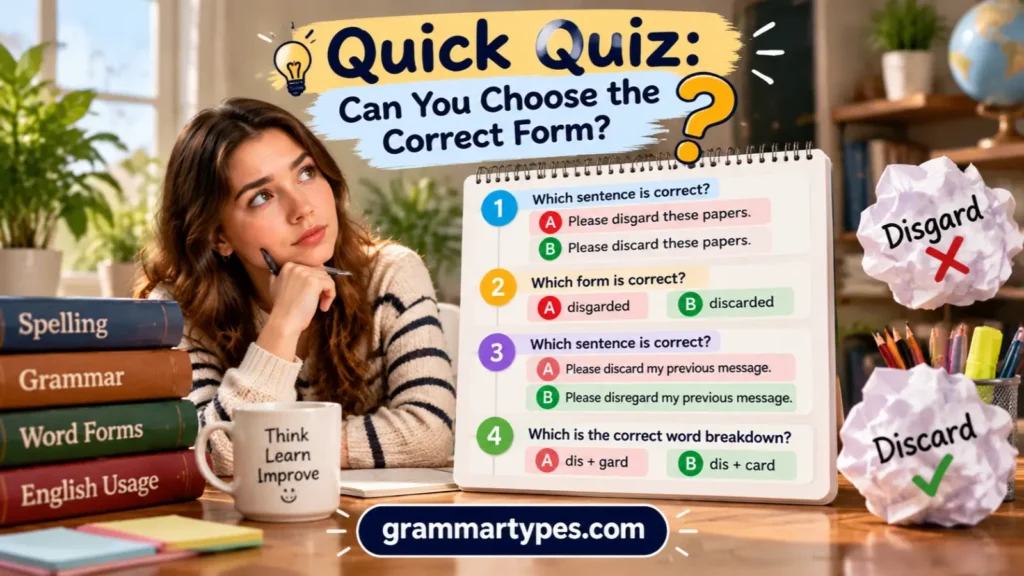
Quick Quiz: Can You Choose the Correct Form?
1. Which sentence is correct?
A. Please disgard these papers.
B. Please discard these papers.
Answer: B.
Discard is the standard spelling.
2. Which past-tense form is correct?
A. disgarded
B. discarded
Answer: B.
The correct form is discarded.
3. Which sentence means “ignore my previous message”?
A. Please discard my previous message.
B. Please disregard my previous message.
Answer: B.
Disregard means to ignore or pay no attention to something.
4. Which memory trick helps you spell discard?
A. dis + gard
B. dis + card
Answer: B.
Think of card inside discard.
Final Thoughts
When choosing between discard or disgard, the correct spelling is discard. The word means to throw away, get rid of, remove, or reject something that is no longer wanted or needed. It can also be used as a noun, particularly in card-game contexts.
Disgard is simply a misspelling, not an American or British alternative. The related forms are discarded, discarding, and discards, all of which retain the important c.
The easiest way to remember the spelling is to see card inside discard:
DIS + CARD = DISCARD
So whenever you are unsure, remember the card and choose discard, not disgard.
FAQs
Disgard is a misspelling of discard when the intended meaning is to throw something away, remove it, or get rid of it. Use discard in standard English writing.
Discard is the correct spelling. Disgard is not the standard spelling of this word. For example, write “Please discard the old documents,” not “Please disgard the old documents.”
Discard means to throw something away or get rid of it because it is no longer wanted or needed. It can also mean rejecting an idea, removing unnecessary information, or getting rid of a playing card.
Discarded is correct. It is the past-tense and past-participle form of discard. For example: “She discarded the outdated report.” Disgarded is a misspelling.
Depending on context, alternatives include throw away, get rid of, dispose of, remove, reject, abandon, and eliminate. The best synonym depends on whether you are talking about an object, idea, decision, plan, or piece of information.
When discard means to get rid of something, it normally takes a direct object without of. Write “discard the document.” However, “dispose of the document” is also correct.
Discard means to get rid of something, while disregard means to ignore something. For example, you discard an unwanted file but disregard an outdated instruction.
Explore More Grammar Guides:
Greatly or Grately: Which Spelling Is Correct? (2026 Guides)
In-Person or In Person: Which Is Correct?
Fulness or Fullness: Which Is Correct? Meaning & Examples
Weather and Whether: Meaning, Difference, Usage & Easy Examples
