
Have you ever wanted to call someone a sweet nickname in a text message but paused because you weren’t sure whether to write lovey or lovie? Both spellings appear in affectionate messages, social media posts, and conversations with loved ones. The difference can seem confusing because the two words are usually pronounced alike.
Lovey is the more established spelling in standard English, especially when referring to a term of endearment or a child’s favorite comfort object. Lovie is also used as an affectionate nickname, personal spelling choice, or given name. However, the two forms are not equally common in every context.
Understanding their meanings will help you choose the right spelling for a romantic message, a conversation with a friend, or a description of a baby’s favorite stuffed animal.
Is It Lovey or Lovie?
Lovey is generally the standard spelling in English. It is an established English word that can mean a sweetheart, an affectionate form of address, or a soft toy or blanket that comforts a young child. Lovie is a less conventional alternative often used as a personal nickname or name.
Neither spelling is automatically wrong in every situation. The best choice depends on what you mean and whether you are following conventional spelling or someone’s personal preference.
Compare these examples:
- Common spelling: “Good morning, lovey! I hope you have a wonderful day.”
- Personal nickname: “Goodnight, Lovie. Talk to you tomorrow!”
- Baby’s comfort object: “My daughter takes her lovey everywhere.”
If you’re writing a general English sentence and want the more widely recognized form, choose lovey. If someone prefers Lovie as their nickname or name, respect that spelling.
What Does Lovey Mean?
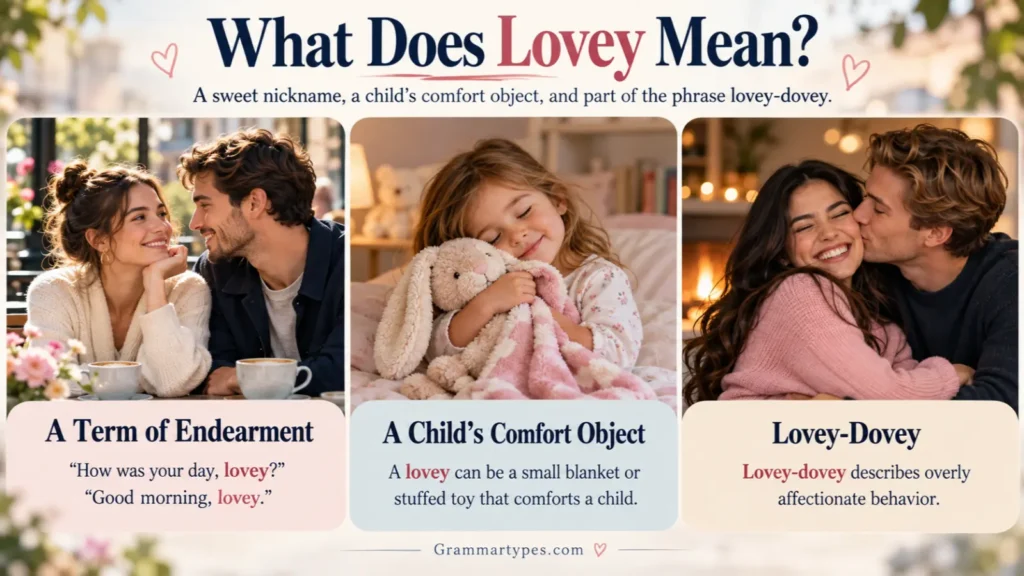
The word lovey has several meanings, depending on the context. It is particularly associated with affectionate language and children’s comfort objects.
1. Lovey as a Term of Endearment
A lovey can be a sweet, affectionate way to address someone you care about. Depending on the relationship, it can be similar to sweetheart, darling, dear, or love.
Examples:
- “How was your day, lovey?”
- “Good morning, lovey. Did you sleep well?”
- “Don’t worry, lovey. Everything will be okay.”
This use communicates warmth, familiarity, and affection. It may sound romantic between partners, but it can also be used in a friendly or caring way.
The word is associated with informal British speech when used to address another person. Whether it sounds natural depends on the speaker, relationship, and region.
2. Lovey as a Baby’s Comfort Object
In American English, lovey can also refer to a familiar object that provides comfort to a baby or young child.
A lovey might be:
- A small, soft blanket
- A stuffed animal
- A little doll
- A soft cloth or blanket with an attached toy
For example:
“My son holds his lovey whenever he feels tired.”
Here, lovey does not refer to a person. It describes the child’s familiar comfort object.
Parents may use the term when discussing an object their child carries while sleeping, traveling, or adjusting to unfamiliar surroundings.
3. Lovey as Part of Lovey-Dovey
Lovey also appears in the expression lovey-dovey, which describes people displaying affectionate or romantic behavior, sometimes in an exaggerated way.
Example:
“They were being so lovey-dovey during the movie that their friends started teasing them.”
The expression is informal and often playful. It can describe couples who are especially affectionate, holding hands, hugging, or using sweet nicknames.
Remember that lovey-dovey is the conventional spelling of the expression. Lovie-dovie is not the standard form.
What Does Lovie Mean?
Lovie is commonly used as an affectionate nickname or a personal variation of lovey. It can convey the same warmth as sweetie, honey, or darling when someone uses it to address a loved one.
Examples:
- “I miss you, lovie!”
- “Sleep well, lovie. I’ll see you tomorrow.”
- “Thank you for always being there for me, lovie.”
In these sentences, lovie functions as a pet name. Its meaning comes from the way the speaker uses it rather than from a special grammatical rule.
There is also an important distinction between a nickname and a dictionary word. Someone may choose to spell their nickname Lovie, with a capital L, because that is their chosen name. In that case, the spelling is a personal choice, not a spelling mistake that needs correcting.
However, when writing for a general audience, lovey is the safer conventional choice.
Lovey vs. Lovie: Key Differences
Although the two forms can serve similar purposes, their spelling conventions and common uses differ.
| Feature | Lovey | Lovie |
|---|---|---|
| Status | Established English word | Alternative spelling and personal name |
| As a pet name | Commonly used | Also used informally |
| Baby’s comfort toy | Recognized meaning | Less established for this meaning |
| Pronunciation | Usually LUV-ee | Usually LUV-ee |
| Formal writing | Generally too informal as a nickname | Generally too informal as a nickname |
| Best use | General writing and conventional usage | A personal nickname or chosen name |
The main distinction is not that one spelling expresses more love than the other. Both can communicate affection. Rather, lovey has established dictionary meanings, while lovie is often a personalized spelling.
What Does Lovey Mean in a Relationship?
In a relationship, lovey is an affectionate nickname for a romantic partner. It can express tenderness, closeness, and familiarity, much like babe, baby, sweetheart, or my love.
For example:
- “Good morning, lovey. I wish I could wake up next to you.”
- “I had a wonderful time with you tonight, lovey.”
- “Take care of yourself, lovey. Text me when you get home.”
The word does not automatically indicate a particular level of commitment or romantic intention. Its meaning depends on the relationship and how the people involved communicate.
Some couples use lovey regularly, while others prefer different nicknames. A friend or family member might also use it affectionately, so context matters when interpreting a message.
Is Lovie Also Romantic?
Yes. Lovie can be used romantically in texts, private conversations, and social media messages.
For example:
“Good night, lovie. I love you more than words can say.”
The spelling does not change the basic affectionate meaning. If your partner likes lovie, you can use it without worrying that the nickname must be changed to lovey.
For general writing, though, lovey remains the more established spelling.
What Does Lovie Mean in Friendship?
Among friends, lovie can be a warm, playful way to address someone you care about. It may express closeness without implying a romantic relationship.
Examples:
- “Thanks for checking on me, lovie!”
- “You’ve got this, lovie. I’m rooting for you.”
- “Miss you, lovie. We need to catch up soon.”
Whether this nickname sounds natural depends on the friendship. Some friends use affectionate language frequently, while others prefer more neutral expressions.
If you are unsure whether someone would appreciate the nickname, pay attention to how they address you and whether they are comfortable with affectionate language.
The important point: Lovie does not necessarily mean boyfriend, girlfriend, or romantic partner. It can be a friendly pet name, too.
Lovey or Lovie Blanket: Which Is Correct?
When referring to a baby’s favorite blanket, stuffed animal, or similar comfort object, lovey is the established spelling.
For example:
- “The baby fell asleep while holding her lovey.”
- “We packed his favorite lovey for the trip.”
- “She keeps a spare lovey in the nursery.”
A lovey can be a blanket, a soft toy, or another familiar object that a child finds comforting. The term is especially common in American parenting contexts.
You may encounter lovie blanket in product descriptions, family conversations, or personalized labels. That does not make it the conventional spelling for the object.
Use lovey blanket when writing a general description, an article, or a product category.
How Do You Spell Lovey or Lovie?
The spelling depends on the context.
Use Lovey for Conventional English Usage
Example: “Are you okay, lovey?”
Choose lovey when you need the established spelling for a general English sentence or a child’s comfort object.
Use Lovie for a Personal Nickname
Example: “Happy birthday, Lovie!”
Choose Lovie when it is someone’s chosen name or personal nickname. Personal names do not need to follow the most common dictionary spelling.
Use Lovey for a Child’s Comfort Object
Example: “He brought his lovey to daycare.”
When describing a child’s favorite comfort toy or blanket, lovey is the conventional choice.
Is Lovy a Correct Spelling?
Lovy is a less established spelling and is not the usual standard form for the affectionate term or a child’s comfort object.
If you want to address someone affectionately, use lovey unless that person prefers another spelling. If Lovy is someone’s chosen name or username, preserve it as written.
- Less conventional: “Good morning, lovy!”
- Conventional: “Good morning, lovey!”
This is primarily a matter of conventional spelling rather than a grammatical rule about sentence construction.
How Do You Pronounce Lovey and Lovie?
Both lovey and lovie are usually pronounced LUV-ee, with the stress on the first syllable.
You can break it down like this:
- LUV: Sounds like the first syllable of loving.
- ee: Sounds like the ending of happy.
Because the two spellings are typically pronounced the same way, you usually cannot tell which spelling someone intends just by hearing the word. The context or the person’s preferred spelling can help you decide.

What Is Another Word for Lovey?
If you want a different affectionate word, several alternatives can work. The best choice depends on your relationship with the person and the tone you want to convey.
| Alternative | Meaning or tone | Example |
|---|---|---|
| Sweetheart | Warm and affectionate | “Thank you, sweetheart.” |
| Darling | Affectionate, sometimes romantic | “Good night, darling.” |
| Sweetie | Friendly, gentle, or loving | “Are you feeling better, sweetie?” |
| Honey | Familiar and affectionate | “How was work, honey?” |
| Babe | Casual and often romantic | “See you later, babe.” |
| My love | Intimate and affectionate | “Take care, my love.” |
| Dear | Gentle or caring | “Don’t worry, dear.” |
These expressions are not always interchangeable. For example, babe is often associated with romantic relationships, while dear can also be used in caring or polite conversation.
For a baby’s comfort object, alternatives include blankie, comfort blanket, security blanket, and stuffed animal. These describe the object rather than a nickname for a person.
Common Mistakes to Avoid
1. Assuming Lovie Is Always Incorrect
Incorrect assumption: “Lovie is never acceptable in English.”
Better explanation: Lovie is used as a nickname, personal spelling, and name. Lovey is the more established conventional spelling, but a person’s chosen name should be respected.
2. Using Lovey in Formal Business Writing
Less suitable: “Dear lovey, please find the attached report.”
Better: “Dear Alex, please find the attached report.”
Why: Lovey is affectionate and informal. It may sound natural in a personal message but inappropriate in a professional email unless the relationship and context clearly support it.
3. Confusing Lovey-Dovey With Lovie-Dovie
Standard: “They were acting lovey-dovey.”
Less conventional: “They were acting lovie-dovie.”
Why: Use lovey-dovey for the established expression describing romantic or exaggerated affection.
4. Treating Lovey and Lovie as Different Pronunciations
Correct understanding: Both spellings are usually pronounced LUV-ee.
Why: The final y in lovey and the final ie in lovie generally produce the same ending sound.
Final Thoughts
When deciding between lovey or lovie, choose lovey if you want the more established spelling in standard English. It can be used as an affectionate nickname, a friendly term of address, or the name of a baby’s favorite comfort blanket or stuffed toy. Lovie is also used, particularly as a personal nickname or chosen name, and it can carry the same affectionate meaning.
The key is to distinguish conventional spelling from personal preference. You do not need to correct someone who deliberately spells their nickname Lovie. For general writing, however, lovey is the clearest choice. Remember that lovey-dovey is the standard expression, and the usual plural of lovey is loveys. When in doubt, use lovey unless the context calls for a person’s preferred spelling.
FAQs
Lovey is the more established spelling in standard English. Lovie is also used as an affectionate nickname, alternative spelling, or personal name. Choose lovey for conventional usage unless a person’s preferred spelling is Lovie.
Lovey can mean a sweetheart or a friendly, affectionate form of address. In American English, it can also refer to a child’s favorite comfort object, such as a soft blanket or stuffed animal.
Lovie is commonly used as a sweet nickname for someone dear to you. It can express affection in a romantic relationship or friendship. It is also used as a personal name.
Lovy is a less conventional spelling of the affectionate term. If you mean a sweetheart or a child’s comfort object, lovey is the usual spelling. However, Lovy can be a personal name or username.
Lovey-dovey is the standard spelling. It describes people who are being especially affectionate or romantic, sometimes in a way that others find overly sentimental.
Yes, a family may choose Lovie as a special name for a grandmother. Family nicknames do not have one universally required spelling, so the preferred form depends on the individual and the family.
Lovey is informal when used as a term of endearment. It is generally appropriate for personal conversations, affectionate messages, and familiar relationships rather than formal academic or professional writing.
The regular plural of lovey is loveys.
Example: “The nursery has several spare loveys for the children.”
If Lovie is a person’s name, the appropriate plural form depends on the sentence. For example, “Two people named Lovie attended the event” avoids changing the spelling of the name itself.
Explore More Grammar Guides:
You Too or You To: Which Is Correct? Meaning, Usage & Examples
Gauging Interest vs Gaging Interest: Which Spelling Is Correct?
Fulness or Fullness: Which Is Correct? Meaning & Examples
Discard or Disgard: Which Spelling Is Correct?
