
If you are writing about a promotional handout, you may pause over a surprisingly simple question: should it be called a flyer or flier? Both spellings appear in English, and you can find both in dictionaries, advertisements, and everyday writing.
The confusion exists because flyer and flier are established spellings of the same word in several of its meanings. They can refer to a small printed advertisement or handout, as well as someone who flies or travels by air. Major dictionaries treat the two forms as alternatives rather than treating one as an outright spelling error.
So which should you use? For a promotional paper, advertisement, event handout, or similar material, flyer is generally the safest and clearest choice. However, flier is also correct and remains common, particularly in American English.
Flyer or Flier: Which One Is Correct?
Both “flyer” and “flier” are correct spellings.
The difference is primarily one of spelling preference and usage rather than meaning. Cambridge lists flier as another spelling of flyer, while Oxford gives flyer with flier as an alternative.
For example, these sentences are both acceptable:
- ✅ We printed 500 flyers for the event.
- ✅ We printed 500 fliers for the event.
When referring specifically to a promotional handout, however, flyer is often the better default because it is widely recognized and clearly associated with advertising material.
Quick comparison
| Spelling | Correct? | Common meaning | Best default for advertising? |
|---|---|---|---|
| flyer | Yes | Advertisement, handout, or person who flies | Yes |
| flier | Yes | Advertisement, handout, or person who flies | Yes, but less common as the default in some contexts |
Oxford defines a flyer as a small sheet of paper advertising a product or event and also lists flier as an alternative spelling.
What Does “Flyer” Mean?
Flyer is a noun with several related meanings.
The most common meaning in advertising is a small piece of paper used to advertise a product, service, event, business, or activity. Cambridge describes a flyer as a small piece of paper advertising a business, show, event, or similar activity.
For example:
The restaurant distributed flyers announcing its new menu.
I picked up a flyer for the local music festival.
The company designed a colorful flyer for its summer sale.
The word can also refer to a person who flies or travels by aircraft. For example:
She is a frequent flyer.
In that sense, both flyer and flier are used.
What Does “Flier” Mean?
Flier has essentially the same core meanings as flyer.
It can describe a small piece of paper containing information or an advertisement:
Volunteers handed out fliers outside the stadium.
It can also describe someone who travels by air:
He is an experienced flier.
Cambridge specifically identifies flier as a mainly American spelling and gives flyer as an alternative. Its entries also use flier for both printed information and people who travel by air.
Therefore, it would be inaccurate to say that flier is always incorrect. It is a recognized English spelling.
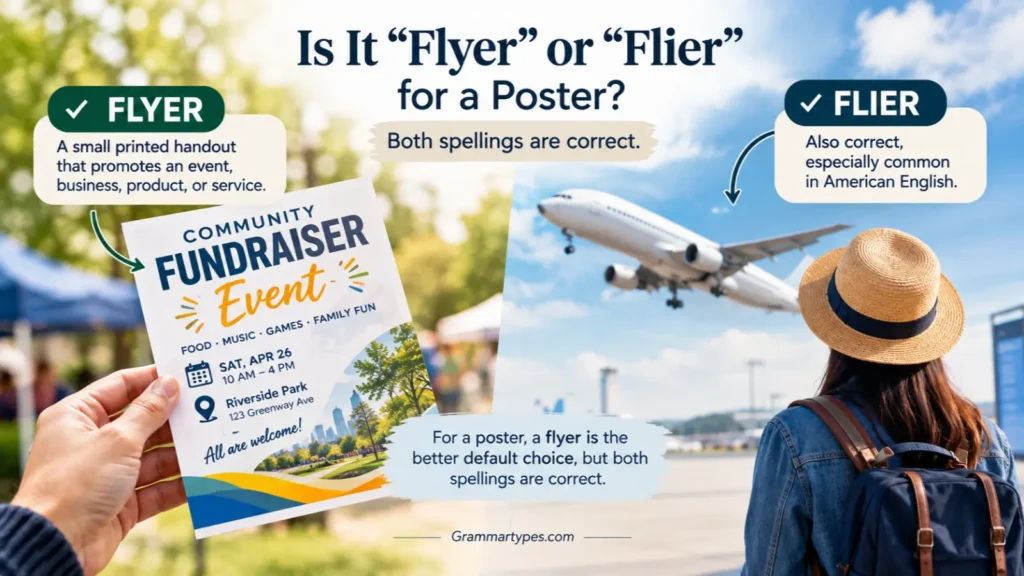
Is It “Flyer” or “Flier” for a Poster?
If you mean a small printed advertisement that promotes an event, business, product, or service, flyer is the better default spelling.
For example:
We created a flyer for the school fundraiser.
However, there is a small difference between a flyer and a poster.
A flyer is generally a small printed handout designed to be distributed to people. A poster is usually a larger printed notice intended to be displayed on a wall, board, window, or another surface.
For example:
- Flyer: “Pick up a flyer at the entrance.”
- Poster: “Put the poster on the classroom wall.”
A flyer can contain the same promotional information as a poster, but the two terms describe different formats and typical uses.
So if you are asking “Is it flyer or flier for a poster?”, the answer depends on what you are actually describing. If it is a small promotional handout, flyer is a natural choice. If it is a large display designed to be hung up, poster is usually the more precise word.
Is It “Flyer” or “Flier” for a Handout?
For a printed handout containing advertising or event information, flyer is a strong default.
For example:
The volunteers passed out flyers at the train station.
She designed a flyer for the charity event.
Flier is also acceptable:
The volunteers passed out fliers at the train station.
Cambridge explicitly recognizes flier as an alternative spelling for this meaning.
If you are writing for a general audience and simply want the spelling most readers will immediately recognize in an advertising context, flyer is usually the easiest choice.
Flyer or Flier for a Brochure?
Both flyer and flier can describe a printed promotional piece, but brochure is not always an exact synonym.
A flyer is typically a relatively simple promotional sheet. A brochure may be folded, multi-panel, or contain more detailed information about a company, destination, product, or service.
For example:
The hotel handed out flyers advertising its weekend discount.
The travel agency gave us a brochure describing its vacation packages.
Calling every brochure a flyer can therefore be imprecise.
If the item is a single promotional sheet intended for quick distribution, flyer is usually the more natural term.
Is “Flyer” More Common Than “Flier”?
In practical writing, flyer is an especially useful default because it is widely recognized for advertising material and is used by major dictionaries in that sense. Oxford lists flyer as the main entry and flier as an alternative.
Cambridge takes a similar approach: its flyer entry identifies it as another spelling of flier, while its flier entry identifies the word as mainly American and also gives flyer.
This means you should not think of the choice as:
flyer = correct
flier = incorrect
A more accurate way to think about it is:
flyer = widely used standard spelling
flier = accepted alternative spelling
For consistent writing, choose one spelling and use it consistently throughout the same document.
American vs. British English
There is some regional variation in how flyer and flier are preferred, but it is not accurate to treat the words as a strict British-versus-American spelling pair.
Cambridge identifies flier as a mainly U.S. spelling and lists flyer as the alternative.
Oxford, meanwhile, lists flyer as its main form and flier as an alternative.
Both spellings can therefore appear in American and British English.
If you are writing for an international audience, flyer is a sensible choice because it is familiar and unambiguous in promotional contexts.
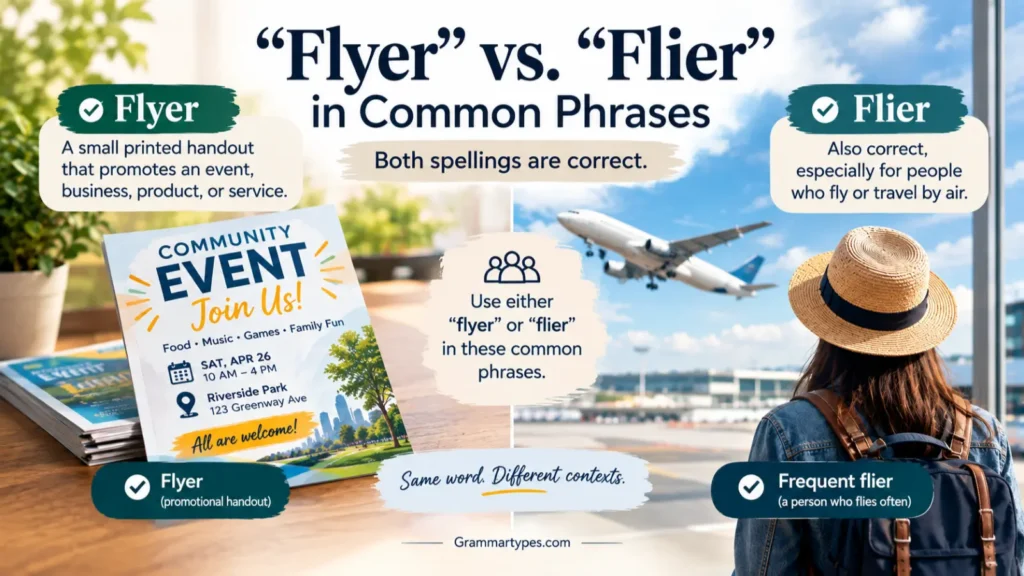
“Flyer” vs. “Flier” in Common Phrases
Both spellings can occur in phrases involving people who fly.
For example:
- frequent flyer
- frequent flier
- high flyer
- high flier
Oxford lists frequent flyer and also recognizes flier as an alternative spelling.
There is also the expression take a flyer, meaning to take a risk or chance. Cambridge includes take a flyer as an informal expression meaning to take a risk.
So if you encounter both spellings in real writing, that does not necessarily indicate a spelling mistake.
Common Mistakes With Flyer and Flier
Mistake 1: Assuming “flier” is wrong
❌ A flier is always a misspelling.
This is incorrect. Flier is an established spelling, and dictionaries recognize it as an alternative to flyer.
Mistake 2: Assuming the words have completely different meanings
❌ A flyer is a paper, but a flier is always a person who flies.
This distinction is too strict.
Both forms can refer to printed advertising material and to people who fly.
Mistake 3: Using “poster” and “flyer” as exact synonyms
❌ The large flyer was attached to the wall.
This may be understandable, but if the item is a large display intended to be hung up, poster is usually the more precise word.
Mistake 4: Switching spellings randomly
Using flyer in one paragraph and flier in the next is not necessarily grammatically wrong, but consistency improves professional writing.
For example:
The company printed 1,000 flyers. The flyers were distributed downtown.
This is cleaner than switching unnecessarily between flyers and fliers.
Flyer or Flier: Examples in Sentences
Here are some natural examples:
For advertising:
We handed out flyers for the new coffee shop.
The school printed flyers for the charity fundraiser.
She designed a colorful flyer for the concert.
Using the alternative spelling:
Volunteers distributed fliers around the neighborhood.
The campaign printed thousands of fliers.
For people who fly:
He is a frequent flyer.
She is an experienced flier.
Many nervous flyers dislike turbulence.
Some frequent fliers prefer nonstop flights.
These examples show why context matters: the two spellings can perform the same grammatical role.
Which Should You Use in Professional Writing?
If you need one recommendation, use flyer.
It is particularly natural when referring to:
- Advertising material
- Event promotions
- Business handouts
- Marketing sheets
- Promotional papers
- Community announcements
- Printed advertisements
For example:
Please attach the event flyer to the email.
We distributed flyers throughout the neighborhood.
That does not make flier wrong. If a publication, organization, style guide, or house style prefers flier, you can use it confidently.
The most important point is consistency. Once you choose a spelling for a document, use that form consistently unless a particular phrase or established name requires otherwise.
Easy Way to Remember
A simple practical rule is:
When you mean a promotional handout, choose “flyer” as your default.
Remember:
Flyer = the safest general-purpose choice.
But don’t mark flier as an automatic spelling error. It is an accepted alternative, and reputable dictionaries recognize both forms.
Quick Answer: Flyer or Flier?
If you’re still unsure, here’s the short version:
| Question | Best answer |
|---|---|
| Is flyer correct? | Yes |
| Is flier correct? | Yes |
| Which is better for an advertisement? | Flyer is a strong default |
| Can you say “flyer” for a handout? | Yes |
| Can you say “flier” for a handout? | Yes |
| Is a flyer exactly the same as a poster? | Not usually |
| Can both mean a person who flies? | Yes |
| Should you use both spellings randomly? | No; be consistent |
FAQs
If you mean a small promotional handout, flyer is the preferred general-purpose choice. If you mean a large sheet intended to be displayed on a wall, poster is usually the more precise term.
Both are correct. “Passing out flyers” is a very common choice, but “passing out fliers” is also grammatically acceptable.
Both are correct. They are alternative spellings, although flyer is a particularly useful default for advertising material. Cambridge and Oxford both recognize the two forms.
For a small promotional sheet, flyer is usually the clearer term. If the material is folded or contains several panels of detailed information, brochure may be more accurate.
Flier is mainly identified as a U.S. spelling by Cambridge, but it is not exclusively American. Flyer is also widely used in American English.
The plural is flyers.
The company distributed 2,000 flyers.
The plural of flier is fliers.
Volunteers distributed 2,000 fliers.
Final Thought
So, flyer or flier? The good news is that you do not have to treat one as a spelling mistake. Both are accepted English spellings, and both can refer to promotional handouts as well as people who fly.
If you are writing about an advertisement, event handout, or small promotional paper, flyer is the best general-purpose choice. It is clear, familiar, and widely recognized. Flier remains a legitimate alternative, especially in American usage.
Also remember that a flyer is not necessarily the same thing as a poster or brochure. The right word depends partly on the format and purpose of the material.
The simplest rule: use “flyer” as your default, but don’t assume “flier” is wrong.
Explore More Grammar Guides:
Have a Great Vacation: Meaning, Correct Usage & Better Ways to Say It
Commonly Confused Words: Spelling, Meaning & Usage Guide
Texting Abbreviations, Chat Slang & Emoji Meanings Guide
[authorbox]
