
You may come across combating meaning in phrases such as “combating crime,” “combating disease,” or “combating climate change” and wonder exactly what the word means. It can also cause spelling confusion because you may see combatting with two t’s.
Combating means actively fighting against, opposing, or trying to stop something harmful or unwanted. It is the -ing form of the verb combat and is commonly used for problems such as crime, poverty, disease, corruption, and misinformation.
In this article, you’ll learn the combating meaning, pronunciation, synonyms, antonyms, common uses, and the difference between combating and combatting. You’ll also see simple examples that show how the word works in everyday, professional, medical, and military contexts.
What Does Combating Mean?
Combating means fighting against something, opposing it, or taking action to stop, reduce, or prevent it.
It comes from the verb combat, which means to try to stop something unpleasant or harmful from happening or becoming worse.
For example:
- The government is combating corruption.
- Scientists are combating the spread of the disease.
- New laws are aimed at combating online fraud.
- The organization is combating poverty in rural communities.
In these sentences, combating does not necessarily mean physical fighting. It usually describes a determined effort to deal with a problem, threat, or harmful condition.
Simple Meaning of Combating
In simple English:
Combating = fighting against or trying to stop something harmful.
For example, if a city is combating pollution, it is taking action to reduce or control pollution.
If scientists are combating a disease, they are working to prevent, control, or overcome it.
Is Combating a Verb?
Yes. Combating is a verb form of combat.
More specifically, it is the present participle of combat. It can also function as a gerund when the -ing form acts as a noun.
| Form | Example |
|---|---|
| Base verb | combat |
| Third-person singular | combats |
| Present participle | combating / combatting |
| Past tense | combated / combatted |
| Past participle | combated / combatted |
Oxford lists both combating and combatting as possible -ing forms of combat. Cambridge likewise identifies combatting as the present participle of combat and lists both -t- and -tt- forms.
Combating as a Present Participle
The word is a present participle when it helps form a continuous verb:
The organization is combating misinformation.
Here, is combating describes an ongoing action.
Combating as a Gerund
It can also act as a noun:
Combating poverty requires long-term planning.
Here, combating poverty functions as the subject of the sentence.
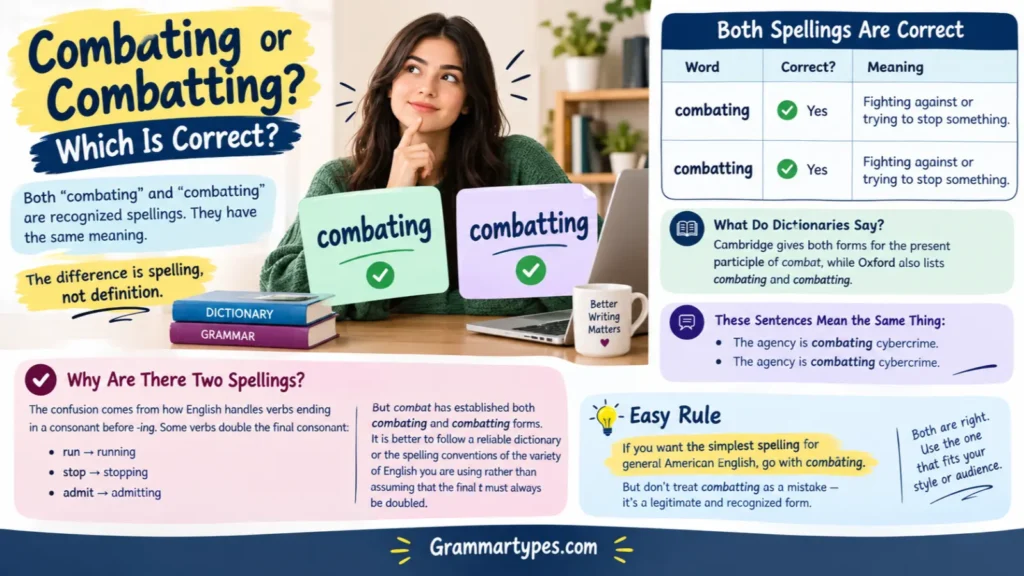
Combating or Combatting: Which Is Correct?
Both “combating” and “combatting” are recognized spellings. They have the same meaning.
The difference is spelling, not definition.
| Word | Correct? | Meaning |
|---|---|---|
| combating | ✅ Yes | Fighting against or trying to stop something |
| combatting | ✅ Yes | Fighting against or trying to stop something |
Cambridge gives both forms for the present participle of combat, while Oxford also lists combating and combatting.
So these sentences mean the same thing:
The agency is combating cybercrime.
The agency is combatting cybercrime.
For a general American-English audience, combating is a straightforward choice and is especially common in professional and informational writing. However, combatting should not automatically be treated as a spelling error because authoritative dictionaries recognize it as a legitimate form.
Why Are There Two Spellings?
The confusion comes from how English handles verbs ending in a consonant before -ing.
Some verbs double the final consonant:
- run → running
- stop → stopping
- admit → admitting
But combat has established both combating meaning and combatting forms. It is therefore better to follow a reliable dictionary or the spelling conventions of the variety of English you are using rather than assuming that the final t must always be doubled.
Easy rule: If you want the simplest spelling for general American English, use combating.
How Do You Pronounce Combating?
Combating is commonly pronounced approximately as:
kuhm-BAT-ing
The stress falls on the second syllable of the verb:
com-BAT-ing
Cambridge gives the verb combat as /kəmˈbæt/ in British English and /kəmˈbæt/ or /ˈkɑːm.bæt/ in American English, depending on the pronunciation used.
The pronunciation of combating follows the pronunciation of the verb combat plus the -ing ending.
Combating Synonyms
The best synonym depends on the context. Combating can mean fighting, opposing, resisting, tackling, or working to reduce a problem.
| Synonym | Nuance | Example |
|---|---|---|
| Fighting | General opposition or struggle | They are fighting crime. |
| Opposing | Acting against something | The group is opposing the proposal. |
| Resisting | Refusing to accept or yield to something | She is resisting pressure. |
| Battling | Strong or determined struggle | They are battling poverty. |
| Tackling | Taking practical action to deal with a problem | The city is tackling pollution. |
| Confronting | Facing a difficult problem directly | We must confront the issue. |
| Countering | Acting against an opposing force or effect | The campaign is countering misinformation. |
| Preventing | Stopping something before it happens | New measures are preventing fraud. |
Not all of these words are interchangeable in every sentence. For example, tackling a problem often emphasizes practical action, while fighting an enemy can suggest direct conflict.
What Is the Synonym of Combatant?
Combatant is a different word from combating.
A combatant is a person or group that takes part in fighting, especially during a war.
Useful synonyms include:
- fighter
- soldier
- warrior
- belligerent
- fighter
The best synonym depends on context. Soldier specifically refers to a member of an army, while combatant is broader and focuses on participation in fighting.
Do not confuse:
- combat → fight or fight against
- combating → fighting against or trying to stop
- combatant → a person or group involved in fighting
- combative → eager or inclined to fight or argue
Cambridge defines combative as an adjective describing someone who is eager to fight or argue.
Common Uses of Combating
The word combating is especially common when discussing serious problems, public policy, health, safety, or social issues.
Combating Crime
Combating crime means taking action to reduce or prevent criminal activity.
Police are using new technology for combating organized crime.
Fighting Disease
Fighting disease means working to prevent, control, treat, or reduce the effects of disease.
Researchers are developing new strategies for combating infectious diseases.
Tackling Corruption
Tackling corruption means taking measures to prevent or reduce dishonest or illegal behavior involving the abuse of power.
The agency introduced stricter rules for combating corruption.
Combating Climate Change
Combating climate change refers to efforts intended to reduce its causes or limit its harmful effects.
Governments are investing in renewable energy as part of their efforts to combat climate change.
Preventing the Spread of Misinformation
Combating misinformation means taking action to reduce the spread or impact of false or inaccurate information.
Schools can play an important role in combating misinformation online.
These uses illustrate why combat is not limited to military situations. Oxford specifically gives examples involving crime, inflation, unemployment, and disease.
Combating in Military Contexts
The word can have a literal military meaning as well.
In a military context, combating can refer to actively fighting an enemy or opposing force.
For example:
The soldiers were combating enemy forces in the region.
However, the noun combat is particularly common in military English:
The troops were sent into combat.
He had extensive experience in armed combat.
Cambridge defines combat as fighting, especially during war, while its verb form refers to trying to stop something harmful from happening or increasing.
Combating in Medical Contexts
In medical and public-health writing, combating usually refers to efforts to control or reduce a disease, infection, health problem, or harmful condition.
For example:
Researchers are combating antibiotic-resistant infections.
Public-health campaigns focus on combating the spread of disease.
Here, combating does not mean physically fighting. It means working against a health threat through research, treatment, prevention, education, or other measures.
This is why phrases such as combat disease and combat infection are common in health-related discussions.
What Is the Difference Between Combat, Combating, and Combatant?
Although these words share the same root, they have different grammatical roles and meanings.
- Combat (verb): To fight against or try to stop something harmful.
Example: We must combat climate change. - Combating (verb form): Actively fighting against or trying to reduce a problem.
Example: The organization is combating poverty. - Combat (noun): Fighting, especially during a war.
Example: The soldiers entered combat. - Combatant (noun): A person who takes part in armed fighting.
Example: The combatants agreed to discuss a ceasefire.
Understanding these differences helps you use each word correctly. Remember, combating describes an action, while combatant refers to a participant in a fight.e combat can describe physical fighting as well as efforts to control an abstract problem.
Combating Meaning in Other Languages
Searchers may also encounter translations of the word in several languages. The important point is that the underlying English meaning remains fighting against, opposing, or trying to stop something.
For language learners, combating meaning in Hindi, Marathi, Tamil, Bengali, Telugu, Malayalam, Kannada, Punjabi, Gujarati, or Nepali generally requires choosing the translation that best fits the surrounding sentence rather than translating the English word mechanically.
For example, a sentence about combating disease should be translated using a phrase meaning fighting, controlling, or preventing disease, rather than necessarily using a word associated with physical battle.
Common Mistakes With Combating
Mistake 1: Treating Combatting as Always Wrong
❌ Combatting is an incorrect spelling.
✅ Combatting is a recognized spelling of the present participle of combat.
Both combating and combatting are supported by major dictionaries.
Mistake 2: Assuming Combating Always Means Physical Fighting
❌ Combating can only be used for soldiers fighting in a war.
✅ The government is combating inflation.
The modern verb is frequently used figuratively for efforts to stop or reduce harmful conditions.
Mistake 3: Confusing Combatant With Combating
❌ The organization is a combatant poverty.
✅ The organization is combating poverty.
Combatant is a noun or adjective related to someone involved in fighting, whereas combating is an -ing form of the verb combat.
Mistake 4: Using a Synonym Without Checking Its Nuance
❌ Combating and preventing always mean exactly the same thing.
They can overlap, but preventing emphasizes stopping something before it occurs, while combating can describe an ongoing effort against something that already exists.
Is Combating Formal or Informal?
Combating is neutral to formal in tone and is especially common in professional, academic, governmental, medical, and news writing.
Examples include:
The report examines strategies for combating unemployment.
The researchers are combating the spread of infectious disease.
The policy focuses on combating financial fraud.
In casual conversation, people may choose simpler words such as fighting, dealing with, or trying to stop.
For example:
We need to combat the problem. — more formal
We need to fight the problem. — more conversational
Neither is inherently wrong. The best choice depends on tone and context.
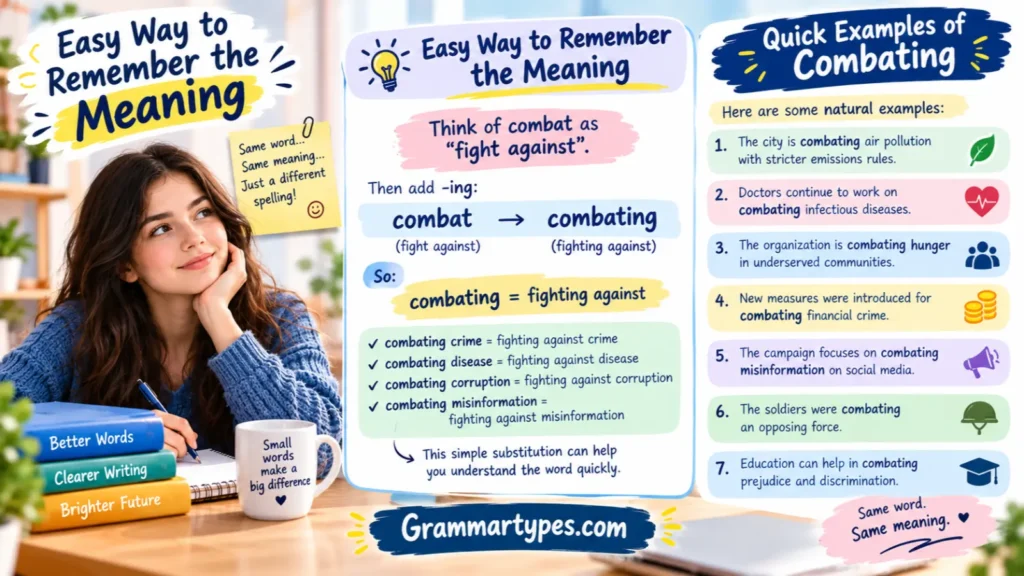
Easy Way to Remember the Meaning
Think of combat as fight against.
Then add -ing:
combat → combating = fighting against
So:
- combating crime = fighting against crime
- combating disease = fighting against disease
- combating corruption = fighting against corruption
- combating misinformation = fighting against misinformation
This simple substitution can help you understand the word quickly.
Quick Examples of Combating
Here are some natural examples:
- The city is combating air pollution with stricter emissions rules.
- Doctors continue to work on combating infectious diseases.
- The organization is combating hunger in underserved communities.
- New measures were introduced for combating financial crime.
- The campaign focuses on combating misinformation on social media.
- The soldiers were combating an opposing force.
- Education can help in combating prejudice and discrimination.
Notice that the word works with both concrete threats and abstract problems.
Final Thoughts
Combating means fighting against, opposing, or trying to stop or reduce something harmful or unwanted. It is the -ing form of combat and is commonly used with words such as crime, disease, corruption, poverty, pollution, and misinformation.
If you are wondering about combating or combatting, both spellings are recognized and carry the same meaning. Combating is a clear, widely used choice, while combatting is also an established form.
The easiest way to remember the word is combat = fight against → combating = fighting against. Choose the form that fits your preferred spelling standard, and keep your usage consistent.
FAQs About Combating
Both are correct and have the same meaning. Combating uses one t, while combatting uses two. Major dictionaries recognize both forms.
Common synonyms include fighting, opposing, resisting, battling, tackling, confronting, and countering. The best choice depends on the context.
Combat means to fight against something or someone. As a verb, it can also mean to try to stop or reduce something harmful, such as crime, disease, or inflation.
In “The organization is combating poverty,” combating means actively working to fight, reduce, or overcome poverty.
Yes. Combating is a present participle of combat. It can also function as a gerund when the -ing form acts as a noun.
Combatting is used in British English, but it is not exclusively a UK spelling. Major dictionaries recognize both combating and combatting, so it is better to think of them as alternative accepted forms rather than a simple US-versus-UK rule.
Depending on the context, possible opposites include supporting, allowing, accepting, encouraging, cooperating, or surrendering. There is no single antonym that works in every sentence.
Explore More Grammar Guides:
ASL Meaning in Text: What Does ASL Mean in Texting and Slang?
What Does DC Mean in Text? Meanings, Slang, TikTok & Gaming
No Avail Meaning: What Does “To No Avail” Mean in English?
What Does PG Mean? Texting, Movies, TV, Slang & More
