
If you have ever typed “grately” and paused to wonder whether it should actually be “greatly,” you are not alone. If you have searched for “grately or greatly,” the confusion is understandable because the two forms look remarkably similar, and the difference is only one letter. The question becomes especially common in phrases such as “greatly appreciated,” “greatly improved,” and “greatly missed.”
The key issue is that greatly is the standard English spelling, while grately is not the standard form when you mean “very much” or “to a great extent.” Understanding how the correct word is formed makes the spelling easier to remember.
This article explains the difference between greatly and grately, defines greatly, answers common questions about “greatly appreciated,” and clears up the related confusion between grateful and greatful.
What Is the Correct Spelling: Greatly or Grately?
The correct spelling is greatly.
- ✅ greatly
- ❌ grately
Greatly is an adverb meaning “very much,” “to a great extent,” or “to a considerable degree.” Cambridge Dictionary lists it as an adverb and gives examples such as “greatly improved” and “greatly appreciated.”
The spelling is:
G-R-E-A-T-L-Y
A simple way to see the formation is:
great + -ly = greatly
The word great remains intact when -ly is added.
By contrast, grately is not the standard spelling for this meaning.
| Form | Status | Meaning |
|---|---|---|
| greatly | ✅ Correct | Very much; to a great extent |
| grately | ❌ Incorrect | Misspelling of greatly |
So, if you are writing an email, essay, article, report, or message, use greatly.
What Does “Greatly” Mean?
Greatly means very much, considerably, or to a large degree. It is an adverb used to show the degree or extent of an action, feeling, change, or effect. Cambridge Dictionary classifies it as an adverb and defines it as “very much.”
For example:
- We greatly appreciate your help.
- The new system has greatly improved efficiency.
- She was greatly affected by the experience.
- I greatly admire your dedication.
- We will greatly miss our colleagues.
In each sentence, greatly adds emphasis to the action or feeling.
Compare:
I appreciate your help.
with:
I greatly appreciate your help.
The second sentence communicates a stronger degree of appreciation.
Merriam-Webster’s thesaurus likewise gives highly, considerably, much, and significantly among words related to greatly in the sense of degree or extent.
Why Is “Grately” Incorrect?
The most useful way to remember the spelling is to identify the base word.
The base word is:
great
Add the adverbial ending:
great + ly = greatly
It is not:
grate + ly = grately
The word grate does exist in English, but it has different meanings. It can refer to a framework of bars, or it can function as a verb meaning to shred something or to irritate. It is not the base word for the adverb meaning “very much.”
This distinction is important because grately can look plausible at first glance. Someone who writes according to pronunciation may also accidentally leave out the e in great.
The easiest spelling check is therefore:
great → greatly
If you mean “very much” or “to a great extent,” choose greatly.
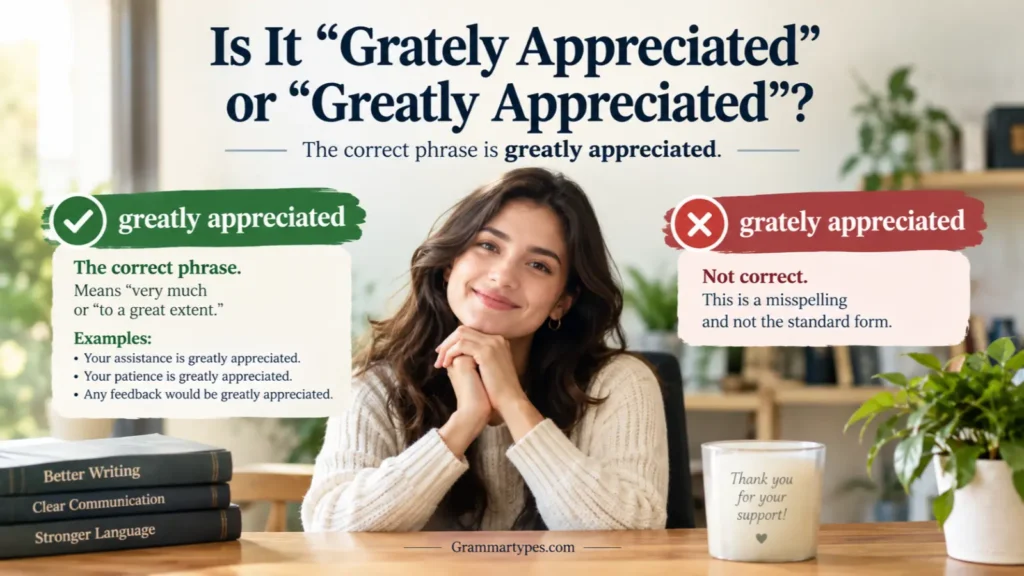
Is It “Grately Appreciated” or “Greatly Appreciated”?
The correct phrase is:
✅ greatly appreciated
Not:
❌ grately appreciated
For example:
Your assistance is greatly appreciated.
Your patience is greatly appreciated.
Any feedback would be greatly appreciated.
Your continued support is greatly appreciated.
The expression means that people appreciate something very much. Cambridge specifically includes “it would be greatly appreci
“Greatly Appreciate” vs. “Greatly Appreciated”
Both forms are correct, but they have different grammatical structures.
Greatly appreciate is active:
I greatly appreciate your assistance.
Here, I am doing the appreciating.
Greatly appreciated is usually part of a passive construction:
Your assistance is greatly appreciated.
Here, the assistance is receiving the appreciation.
Another example:
We greatly appreciate your patience.
Your patience is greatly appreciated.
Both communicate appreciation, but the sentence structure is different.
How Do You Spell “Greatly”?
The correct spelling is:
greatly
Break it down as:
GREAT + LY
The spelling contains the complete word great:
great → greatly
Do not remove the e:
❌ grately
✅ greatly
People may find the spelling less obvious when they hear the word spoken quickly. Cambridge gives the pronunciation as /ˈɡreɪt.li/ in both British and American English.
A useful spelling habit is to connect the adverb back to its base adjective:
great → greatly
complete → completely
immediate → immediately
For greatly, however, the main point is simply to remember that great stays intact.
6 Common Uses of “Greatly”
Because greatly expresses a high degree, it frequently appears with verbs describing change, emotion, effect, appreciation, or influence.
1. Greatly Appreciate
I greatly appreciate your help with the project.
Here, greatly emphasizes the speaker’s appreciation.
2. Greatly Improve
The revised training program greatly improved employee performance.
The adverb indicates that the improvement was substantial.
3. Greatly Affect
The weather can greatly affect travel plans.
The meaning is that the effect can be significant.
4. Greatly Increase
Regular practice can greatly increase your confidence.
Here, greatly describes the degree of increase.
5. Greatly Miss
We will greatly miss our former teacher.
The word emphasizes the strength of the feeling.
6. Greatly Admire
I greatly admire her commitment to teaching.
In this sentence, greatly strengthens the expression of admiration.
People use these expressions naturally in everyday, professional, and formal English. Cambridge’s examples include greatly improved, greatly benefited, greatly appreciated, and greatly reduced, illustrating how broadly people can use the adverb.
Greatly or Grately: Common Mistakes
The mistake is usually straightforward: grately is written where greatly is required.
Mistake 1: Grately Appreciated
❌ Your support is grately appreciated.
✅ Your support is greatly appreciated.
Why: The correct adverb is greatly, formed from great + -ly.
Mistake 2: Grately Improved
❌ The service has grately improved.
✅ The service has greatly improved.
Why: Greatly means “to a considerable degree,” which fits the sentence.
Mistake 3: Grately Missed
❌ She will be grately missed.
✅ She will be greatly missed.
Why: The standard spelling is greatly, even when it is followed by a past participle such as missed.
Mistake 4: Grately Appreciate
❌ We grately appreciate your patience.
✅ We greatly appreciate your patience.
Why: Greatly is the adverb modifying appreciate.
Is “Grately” Ever Correct?
For the meaning “very much” or “to a great extent,” use greatly, not grately.
You may encounter grately online because people make spelling mistakes, particularly when typing quickly or when trying to reproduce the pronunciation of a word. Its appearance in a message does not make it an accepted alternative spelling.
For standard English writing, the practical rule is simple:
If you mean very much, write greatly.
This applies to professional emails, academic writing, business documents, articles, school assignments, and ordinary messages.
Greatly vs. Grately: Quick Comparison
| Feature | Greatly | Grately |
|---|---|---|
| Standard spelling | ✅ Yes | ❌ No |
| Part of speech | Adverb | — |
| Meaning | Very much; to a great extent | No standard meaning in this usage |
| Base form | Great | — |
| Correct phrase | Greatly appreciated | Grately appreciated ❌ |
| Example | We greatly value your help. | We grately value your help. ❌ |
The distinction is therefore not a difference in meaning between two valid words. It is primarily a correct-spelling versus misspelling issue.
Greatly and Grateful Are Not the Same Word
One reason people may hesitate over greatly is that it looks similar to grateful.
The words are related in appearance but serve different grammatical purposes.
Greatly is an adverb meaning very much or to a great extent.
Grateful is an adjective meaning showing or expressing thanks, according to Cambridge Dictionary.
Compare:
I greatly appreciate your help.
I am grateful for your help.
Both sentences express appreciation, but the words perform different grammatical jobs.
| Word | Part of Speech | Basic Meaning | Example |
|---|---|---|---|
| greatly | Adverb | Very much; to a great extent | I greatly appreciate it. |
| grateful | Adjective | Thankful; appreciative | I am grateful for your help. |
Why Is “Grateful” Not Spelled “Greatful”?
The correct spelling is:
✅ grateful
Not:
❌ greatful
The confusion is understandable because great is a familiar English word. However, grateful is not simply the modern word great plus -ful.
Historically, grateful comes from an older adjective grate, meaning agreeable or pleasing, and ultimately traces back to Latin gratus, meaning pleasing. The word has been used in English since the 16th century.
So the spelling is:
grateful
rather than:
greatful
A helpful distinction is:
great → greatly
grate → grateful
Although this is only a memory aid rather than a complete explanation of English word formation, it helps separate two commonly confused spellings.

“Greatly” vs. “Gratefully”
Another easily confused pair is greatly and gratefully.
They are different words.
Greatly means:
very much; to a great extent
Example:
We greatly appreciate your support.
Gratefully means:
in a grateful or appreciative manner
Example:
She gratefully accepted the award.
Notice the different meanings:
I greatly appreciate your help.
I gratefully accepted your help.
The first emphasizes degree. The second describes the manner in which an action was performed.
Easy Way to Remember the Correct Spelling
When you mean “very much” or “to a great extent,” remember:
GREAT + LY = GREATLY
Keep the entire word great before adding -ly.
So:
- great → greatly ✅
- grately → ❌
For appreciation:
- greatly appreciated ✅
- grately appreciated ❌
For gratitude:
- grateful ✅
- greatful ❌
Keeping these word families separate makes the spelling much easier:
great → greatly
grate → grateful
grateful → gratefully
Mini Quiz: Greatly or Grately?
Question 1
Which sentence is correct?
A. I grately appreciate your help.
B. I greatly appreciate your help.
Answer: B.
Greatly is the correct spelling.
Question 2
Choose the correct phrase:
A. Your assistance is grately appreciated.
B. Your assistance is greatly appreciated.
Answer: B.
The standard phrase is greatly appreciated.
Question 3
Complete the sentence:
The changes have ______ improved the service.
A. grately
B. greatly
Answer: B.
Greatly means “to a significant degree” in this context.
Question 4
Which spelling is correct?
A. grateful
B. greatful
Answer: A.
Grateful is the standard spelling for expressing thanks.
Final Thought
When choosing between greatly or grately, the correct spelling is greatly. It is an adverb meaning “very much,” “considerably,” or “to a great extent,” and it is commonly used in phrases such as greatly appreciated, greatly improved, greatly affected, and greatly missed.
The easiest spelling reminder is great + -ly = greatly. Do not replace it with grately. Also keep greatly separate from grateful: greatly expresses degree, while grateful describes someone who feels or expresses thanks.
So, when writing “greatly appreciated,” use the spelling with the complete word great: greatly appreciated.
FAQs
People greatly appreciate it. Greatly is the standard adverb, and Cambridge Dictionary gives “it would be greatly appreciated” as an example of its use.
Grateful has a different historical formation from the word great. It comes from the older adjective grate, meaning agreeable or pleasing, and ultimately from Latin gratus. Therefore, the standard spelling is grateful, not greatful.
If you mean “very much” or “to a great extent,” the correct spelling is greatly:
G-R-E-A-T-L-Y
Grately is not the standa
Grateful is correct.
✅ I am grateful for your help.
❌ I am greatful for your help.
Cambridge defines g
Yes. I greatly appreciate it is grammatically correct. Here, greatly modifies the verb appreciate and means “very much.”
I greatly appreciate your assistance.
Yes. Greatly appreciated is natural in professional and formal communication, although it can also be used in everyday writing.
For example:
Your cooperation is greatly appreciated.
For a more conversational alternative, you could simply say:
Thanks for your help.
Explore More Grammar Guides:
Fulness or Fullness: Which Is Correct? Meaning & Examples
Defence or Defense: Which Spelling Is Correct?(2026 Guides)
Wracking or Racking: What’s the Difference and Which Spelling Is Correct?
Jobsite or Job Site: What Is the Difference & Which Is Correct?

Pingback: puting vs putting: Correct Spelling, Meaning and Examples
Pingback: Indure vs Endure: Which Spelling Is Correct?