
Have you ever paused while writing because you could not remember whether it was good morning or goodmorning, weather or whether, than or then, or as well or aswell? These are examples of commonly confused words in English that can make even simple writing feel uncertain. English contains many words and phrases that look alike, sound similar, or follow spelling patterns that are easy to mix up.
The confusion is not always about spelling. Sometimes two words have different meanings, grammatical roles, regional spellings, or usage rules. This is why commonly confused words in English can be tricky to understand and use correctly. For example, defense and defence can both be correct, while lable is simply a misspelling of label.
This guide brings together 25 commonly confused words in English and forms, including spelling mistakes, word-choice problems, British and American differences, and frequently searched expressions. You will see what is correct, what each word means, how to use it, and examples that make the distinction easier to remember.
What Are Commonly Confused Words in English?
Commonly confused words are words or expressions that people frequently mix up because they have similar spellings, similar sounds, related meanings, or different forms that are easy to overlook.
For example:
- weather refers to atmospheric conditions.
- whether introduces alternatives or uncertainty.
- than is generally used for comparisons.
- then usually refers to time, sequence, or consequence.
- label is the correct spelling; lable is a common misspelling.
Cambridge Dictionary explains that easily confused words can have similar spellings or related but different meanings. Merriam-Webster likewise maintains a broad reference list of words that look or sound similar but have different meanings or uses.
The important point is that not every confusing pair has one “correct” word. Some pairs, such as flyer and flier, are legitimate variants.
25 Commonly Confused Words in English
The following list focuses on practical mistakes people encounter in everyday, academic, professional, and online writing.
1. Flyer or Flier
Both flyer and flier are accepted spellings.
A flyer commonly means a small piece of paper used to advertise or provide information. Flier is also used for this meaning, particularly in American English. Cambridge lists flier as mainly a U.S. spelling of flyer, while flyer is widely used in both British and American English. This is a useful example of commonly confused words in English, where both forms can be correct depending on usage and regional preference.
Example:
✅ We handed out flyers for the school event.
✅ She is a frequent flier who travels every month.
Easy rule: For an advertisement, flyer is a safe general choice. For a person who travels by air, both flyer and flier can be used.
2. You Too
People normally write “You too” as two words.
Too can mean “also” or “as well.”
✅ “Have a great weekend!”
“You too!“
❌ “Youtoo!”
Do not combine the words simply because they are pronounced closely together.
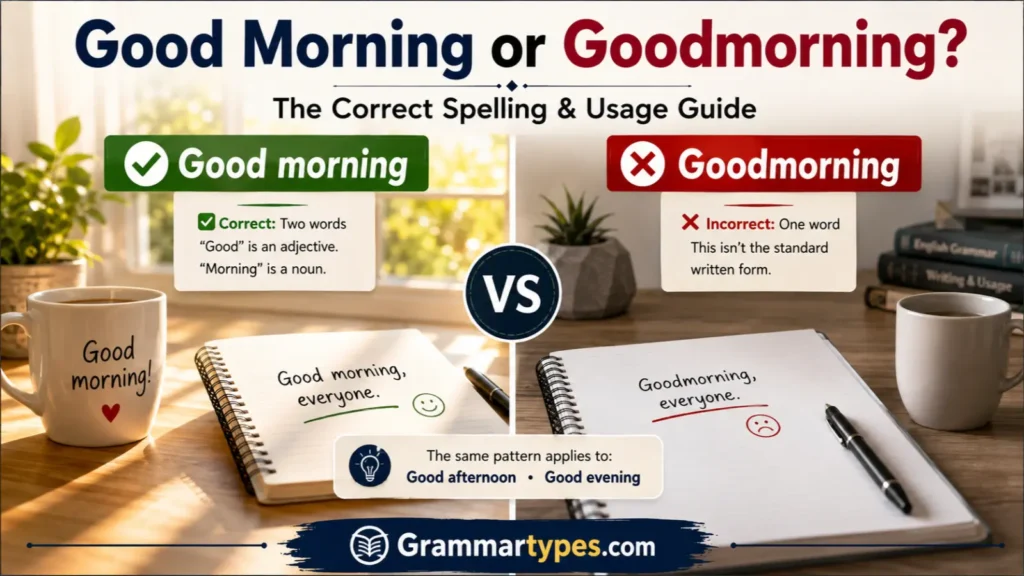
3. Good Morning or Goodmorning
The standard form is good morning, written as two words.
Good functions as an adjective and morning is a noun.
✅ Good morning, everyone.
❌ Goodmorning, everyone.
The same general pattern appears in good afternoon and good evening. The competitor article also correctly identifies “good morning” as the standard written form, but you should not treat its discussion of unsupported search trends and an invented personal case study as evidence.
4. In-Person or In Person
Both forms can be correct, but their grammatical roles differ.
In person is an adverbial phrase meaning physically present rather than communicating remotely.
✅ I would rather discuss the issue in person.
In-person is a compound adjective that comes before a noun.
✅ We scheduled an in-person meeting.
A simple test is to look at what follows the expression. Before a noun, in-person is often appropriate; after a verb, in person is generally used.
5. Puddy
Puddy is not normally the word people intend when they are looking for the material used to fill holes or repair surfaces. Depending on the intended meaning, the word may be putty.
Putty is a soft substance used for filling, sealing, or repairing.
✅ He used putty to fill the small hole in the wall.
If you encountered puddy in a particular sentence, its meaning may depend on context, including whether it is a name or a specialized term.
6. Weather and Whether
These words sound alike but have different meanings.
Weather means atmospheric conditions such as rain, wind, temperature, or sunshine.
✅ The weather is beautiful today.
Whether introduces alternatives or expresses uncertainty.
✅ I don’t know whether she will attend.
Memory trick: If you are talking about rain, temperature, storms, or sunshine, use weather.
7. Defence or Defense
Both defence and defense are correct, but they reflect different English varieties.
- Defense is the standard American English spelling.
- Defence is standard in British English and several other varieties.
✅ The team played strong defense.
✅ The team played strong defence.
Do not automatically mark defence as wrong. Regional spelling differences are a normal part of English.
8. Attornies or Attorneys
The correct plural of attorney is attorneys.
❌ attornies
✅ attorneys
The word keeps the ey before adding the plural -s.
Example:
✅ The company consulted two attorneys before signing the agreement.
9. Combatting or Combating
Both combating and combatting occur in English.
Combating is widely used, especially in American English, while combatting is also an established spelling, particularly in British English.
✅ The organization is combating misinformation.
Depending on your intended variety of English and house style, either spelling may be appropriate. This is a good example of why a spelling variation should not automatically be treated as a mistake.
10. Of Course or Ofcourse
The standard expression is of course, written as two words.
It means “certainly,” “naturally,” or “as expected.”
✅ Of course, I can help you.
❌ Ofcourse, I can help you.
Of course can be used in both casual and formal communication, although its exact tone depends on context.
11. Long Term or Long-Term
The form depends on how the phrase is used.
When it functions as an adjective before a noun, long-term is commonly hyphenated.
✅ We need a long-term strategy.
When it functions as a noun phrase after a preposition, long term is generally written without a hyphen.
✅ We are thinking about the long term.
The hyphen helps show that long and term work together as a compound modifier.
12. Other Then or Other Than
The correct expression for making a comparison or referring to an exception is other than.
❌ other then
✅ other than
Than is commonly used in comparisons or expressions of difference.
✅ I have no choice other than to wait.
Then normally relates to time, sequence, or consequence.
✅ We finished dinner, and then we went home.
13. Courtesy Meaning
Courtesy means polite behavior, respect, or a considerate act toward another person.
It can also refer to something provided as a gesture of politeness.
✅ She thanked him for the courtesy he showed during the meeting.
A useful distinction is:
- courtesy = polite or considerate behavior
- curtsy = a formal gesture made by bending the knees
If you searched for curtesy meaning, you may actually mean courtesy or curtsy, so context matters.
14. Winer
Winer is a real word in some contexts, but if you mean a person or thing that wins, the standard spelling is winner.
❌ She was the competition’s winer.
✅ She was the competition’s winner.
Winner comes from win + -er and refers to someone or something that wins.
15. Ola Meaning
Ola does not have one universal English meaning. Its meaning depends heavily on context and language.
If you encountered ola in a message, name, slang expression, or another language, the surrounding sentence is necessary to identify the intended meaning accurately.
This is an important lesson with vocabulary searches: a short word may have several meanings rather than one fixed English definition.
16. Challange or Challenge
The correct spelling is challenge.
❌ challange
✅ challenge
Challenge can be a noun or a verb.
Noun:
✅ Learning a new language can be a challenge.
Verb:
✅ The lawyer decided to challenge the decision.
17. Cacoon or Cocoon
The correct spelling is cocoon.
❌ cacoon
✅ cocoon
A cocoon is a protective covering made by some insects during a stage of development.
✅ The caterpillar formed a cocoon on the branch.
A useful visual reminder is co-coon, not ca-coon.
18. Totalling or Totaling
Both totalling and totaling are accepted depending on the variety of English.
- Totaling is standard in American English.
- Totalling is standard in British English and other varieties that commonly double the final consonant before -ing.
✅ The expenses were totaling $500.
✅ The expenses were totalling £500.
Choose one spelling consistently according to your publication’s preferred English variety.
19. Different Type of
The phrase different type of can be grammatical, but it usually needs an appropriate noun afterward.
For example:
✅ This is a different type of problem.
When referring to multiple categories, different types of may be more appropriate.
✅ We studied different types of sentences.
The choice between singular and plural depends on whether you mean one distinct category or multiple categories.
20. Weiner Meaning
Weiner may be encountered as a surname, but people sometimes type it when they mean wiener.
Wiener can refer to a type of sausage or, in some contexts, an informal word for a person. Because the term can have different meanings depending on context, it is important to check the intended word before correcting it.
If you are asking about a particular sentence containing weiner, context is essential.
21. Carrer or Career
The correct spelling is career.
❌ carrer
✅ career
A career is a person’s occupation or professional path, especially over a period of time.
✅ She hopes to build a successful career in teaching.
22. Any Time
Any time is normally written as two words when it functions as a noun phrase.
✅ You can call me at any time.
Anytime is also widely used, especially as an adverb in American English.
✅ You can anytime call me.
However, when any time follows a preposition such as at, the two-word form is the clear traditional choice:
✅ Contact us at any time.
23. Appreciate It
Appreciate it is a natural expression meaning “I am grateful for it” or “I value your help.”
✅ Thanks for your help. I appreciate it.
It is common in conversational and professional communication. It is not necessary to add an object if the context already makes clear what you appreciate.
24. Comit vs Commit
The correct spelling is commit.
❌ comit
✅ commit
The verb commit can mean to carry out an action, dedicate oneself to something, or officially assign something.
✅ She decided to commit to the project.
When adding certain endings, the spelling changes:
- commit
- committed
- committing
The final consonant is doubled in committed and committing.
25. Lable vs Label
The correct spelling is label.
❌ lable
✅ label
A label can be a piece of material attached to something or a word used to describe a category.
✅ Read the label before opening the package.
The spelling contains -bel, not -ble.
More Frequently Confused Spellings and Usage Questions
Some searches do not fit neatly into a simple word-versus-word category, but they are still useful to know.
Accommodation Spelling
The correct spelling is accommodation.
A helpful spelling pattern is:
ac + com + mod + ation
Remember that accommodation contains:
- double c
- double m
✅ The hotel provided comfortable accommodation.
Is It Called…?
The phrase is it called is not a spelling problem. It is a question pattern used when someone wants to identify the name of something.
✅ What is it called?
This wording is often more natural when asking for the name of an object, concept, expression, or grammatical feature.
Stripping Meaning
Stripping is the present participle of strip.
Depending on context, it can mean removing something, taking something off, or removing a covering or layer.
✅ The workers are stripping the old paint from the wall.
Do not confuse stripping with striping, which relates to adding or forming stripes.
As Well or Aswell
The standard expression is as well, written as two words.
❌ I would like to come aswell.
✅ I would like to come as well.
As well commonly means “also” or “too.”
Girly
Girly is a standard informal adjective meaning associated with qualities, styles, or interests traditionally associated with girls or femininity.
✅ She chose a girly pink design.
Because it is informal, a more neutral term may be preferable in formal writing when the context calls for one.
Recurring vs. Reoccurring
Both words exist, but they are not always interchangeable.
Recurring generally means happening repeatedly.
✅ She has recurring meetings every Monday.
Reoccurring means occurring again and emphasizes that something happens again after occurring previously.
In many ordinary contexts, recurring is the more natural choice when describing something that happens repeatedly.
Pre and Post Meaning in Hindi
The prefixes pre- and post- generally refer to time or sequence.
- pre- = before
- post- = after
For example:
- pretest = a test before the main test
- posttest = a test after the main test
In Hindi, these ideas can often be understood as पहले / पूर्व for pre- and बाद / पश्चात for post-, although the exact translation depends on the sentence.
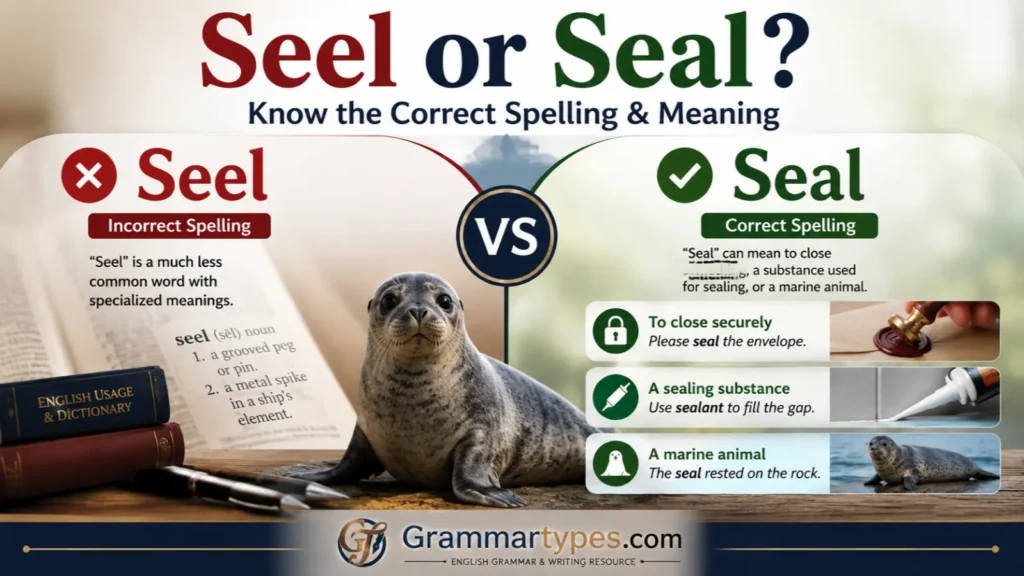
Seel or Seal
The correct word depends on the intended meaning.
Seal can mean to close something securely, a substance used for closing a gap, or a marine animal.
✅ Please seal the envelope.
Seel is a much less common word with specialized meanings, so it should not automatically be treated as an alternative spelling of seal.
How Do You Spell Suing?
The correct spelling is suing.
❌ sueing
✅ suing
It comes from the verb sue.
✅ The company is suing the contractor.
The final e in sue is not retained before -ing.
Nominator
Nominator is a correctly formed English noun referring to someone who nominates a person or thing.
✅ The nominator explained why she deserved the award.
Do not confuse nominator with nominee. The nominator makes the nomination; the nominee is the person or thing being nominated.
Transferred or Transfered
The correct spelling is transferred.
❌ transfered
✅ transferred
The verb transfer doubles the final consonant before -ed:
transfer → transferred
It also doubles the consonant in:
transfer → transferring
Submit Spelling
The correct spelling is submit.
❌ submitt
❌ submmit
✅ submit
However, the final consonant is doubled in some forms:
- submit
- submitted
- submitting
This follows the spelling pattern used when adding certain suffixes to submit.
Pursue Spelling
The correct spelling is pursue.
❌ persue
❌ pursu
✅ pursue
Pursue means to follow, seek, or work toward something.
✅ She plans to pursue a career in medicine.
Took Affect or Took Effect?
The correct expression is took effect.
❌ The new policy took affect on Monday.
✅ The new policy took effect on Monday.
Effect is the noun used in the expression take effect, meaning to begin operating or producing a result.
Affect is most commonly used as a verb meaning to influence.
Compare:
✅ The weather affected our plans.
✅ The new rule took effect immediately.
How Can You Remember Commonly Confused Words in English?
The best strategy is not to memorize every spelling as an isolated item. Instead, connect the word to its meaning and grammatical function.
1. Identify the Meaning
Ask what you are actually trying to say.
For example:
- atmospheric conditions → weather
- alternatives or uncertainty → whether
- comparison → than
- sequence or time → then
2. Look at the Word’s Role
Ask whether the word is acting as a noun, verb, adjective, or adverb.
This can immediately eliminate several possibilities.
For example:
long-term strategy uses the hyphenated compound as an adjective, while in the long term uses the two-word phrase.
3. Watch for Regional Spelling
Some differences are not mistakes.
Defense and defence, as well as totaling and totalling, can reflect American and British English conventions.
Similarly, flyer and flier can both be legitimate forms. Cambridge lists flier as mainly a U.S. spelling of flyer.
4. Learn the Word in a Sentence
Instead of memorizing:
weather = rain
learn:
I checked the weather before leaving home.
Instead of memorizing:
whether = choice
learn:
I don’t know whether he will come.
A sentence gives your brain both the meaning and the grammatical pattern.
Quick Reference: Commonly Confused Words in English and Mistakes
| Incorrect or Questionable Form | Preferred/Correct Form | Main Issue |
|---|---|---|
| goodmorning | good morning | Spacing |
| ofcourse | of course | Spacing |
| other then | other than | Word choice |
| challange | challenge | Spelling |
| cacoon | cocoon | Spelling |
| carrer | career | Spelling |
| lable | label | Spelling |
| attornies | attorneys | Plural spelling |
| transfered | transferred | Consonant doubling |
| comit | commit | Spelling |
| sueing | suing | Verb spelling |
| aswell | as well | Spacing |
| took affect | took effect | Word choice |
| weather | whether | Meaning |
| defence | defense | Regional spelling |
| totaling | totalling | Regional spelling |
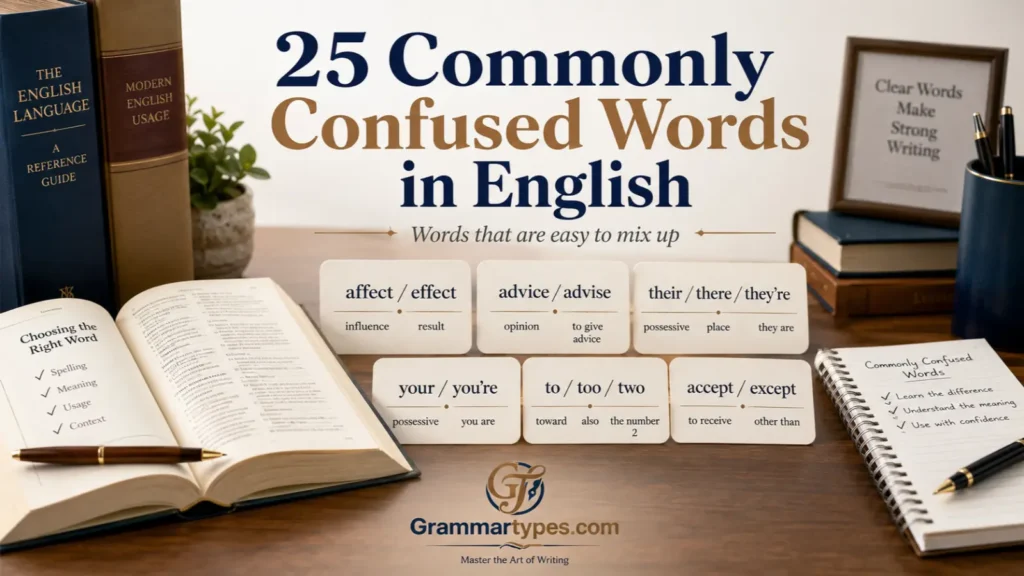
Can You Provide a List of 20 or 25 Commonly Confused Words In English?
Yes. A useful list of 25 includes:
- affect / effect
- advice / advise
- than / then
- weather / whether
- their / there / they’re
- your / you’re
- its / it’s
- to / too / two
- accept / except
- lose / loose
- principle / principal
- compliment / complement
- stationary / stationery
- farther / further
- lie / lay
- who / whom
- fewer / less
- allusion / illusion
- imply / infer
- discreet / discrete
- cite / site / sight
- assure / ensure / insure
- advice / advise
- breath / breathe
- desert / dessert
The exact selection can vary because there is no single universal list of “the” 25 most confused words. Established language resources organize confusing words differently. Cambridge, for example, provides a large collection of easily confused words rather than limiting the topic to one fixed number.
Mini Quiz: Can You Choose the Correct Word?
1. I don’t know ___ she will attend.
A. weather
B. whether
Answer: B. whether
2. The new policy has ___ effect.
A. took
B. taken
Answer: B. taken — as in “has taken effect.”
3. Please ___ the envelope securely.
A. seal
B. seel
Answer: A. seal
4. She wants to ___ a career in science.
A. pursue
B. persue
Answer: A. pursue
5. Which is correct?
A. Goodmorning, everyone.
B. Good morning, everyone.
Answer: B. Good morning, everyone.
FAQs
Some frequently confused pairs include affect/effect, than/then, weather/whether, your/you’re, their/there/they’re, its/it’s, accept/except, lose/loose, and advice/advise. The exact list varies by language resource and audience.
Twenty useful examples are affect/effect, advice/advise, than/then, weather/whether, your/you’re, their/there/they’re, its/it’s, to/too/two, accept/except, lose/loose, principle/principal, compliment/complement, stationary/stationery, farther/further, lie/lay, who/whom, fewer/less, imply/infer, discreet/discrete, and cite/site/sight.
A practical set of 25 includes the pairs above plus assure/ensure/insure, breath/breathe, and desert/dessert. These are useful because the words are similar in spelling, sound, or meaning but differ in usage.
Both flyer and flier are accepted. Flyer is widely used, while flier is particularly associated with American English in some dictionary entries.
Both are correct regional spellings. Defense is standard American English, while defence is standard British English and several other varieties. They are common examples of commonly confused words in English.
Weather refers to atmospheric conditions. Whether is used when discussing alternatives or uncertainty.
Recurring generally describes something that happens repeatedly. Reoccurring emphasizes that something occurs again. In many everyday contexts, recurring is the more natural choice.
Final Thought
Commonly confused words are easier to master when you learn both their spelling and their meaning. Some mistakes are straightforward, such as lable → label, carrer → career, cacoon → cocoon, and goodmorning → good morning. Others require more attention to context, such as weather/whether, than/then, and took effect/took affect.
It is also important to recognize legitimate variations. Defense/defence, totaling/totalling, and flyer/flier can reflect accepted differences rather than errors. When you are unsure, identify the meaning, grammatical role, and variety of English you are using. These are common examples of commonly confused words in English that can vary by regional usage.
The best way to remember commonly confused words is to study them in real sentences rather than memorizing isolated spellings. When in doubt, check a reliable dictionary and choose the form that matches your intended meaning and context.
[authorbox]

Pingback: Patriot vs Patriotic: Which Word Is Right for Patriot Day?
Pingback: Black Heart Meaning 🖤: What Does the Emoji Really Mean?
Pingback: Flyer or Flier: Which Spelling Is Correct? Meaning & Examples