
Have you ever wondered whether to call someone a patriot or describe them as patriotic? If you’re confused about patriot vs patriotic, you’re not alone. The two words are closely related, so it is easy to use one when the other is grammatically appropriate. The key difference is simple: patriot is a noun for a person, while patriotic is an adjective that describes someone or something connected with love or devotion to a country.
Understanding that distinction makes word choice much easier. This article explains the meanings, parts of speech, examples, common mistakes, and practical differences between patriot vs patriotic. It also addresses questions about political affiliation, the meaning of patriotism, and whether the word patriotic applies only to America.
Patriot vs Patriotic: The Quick Answer
Patriot and patriotic come from the same idea, but they perform different grammatical jobs.
| Word | Part of speech | Meaning | Example |
|---|---|---|---|
| patriot | Noun | A person who loves or supports their country | Maria is a patriot. |
| patriotic | Adjective | Showing or expressing love for one’s country | Maria made a patriotic speech. |
| patriotism | Noun | Love or devotion to one’s country | Her patriotism is sincere. |
| patriotically | Adverb | In a way that shows patriotism | They decorated the hall patriotically. |
The easiest rule is:
A patriot is a person. Patriotic describes a person, action, feeling, object, or idea.
For example:
- He is a patriot.
- He is patriotic.
- His patriotism is obvious.
- He spoke patriotically about his country.
These sentences are related, but the words have different grammatical functions.
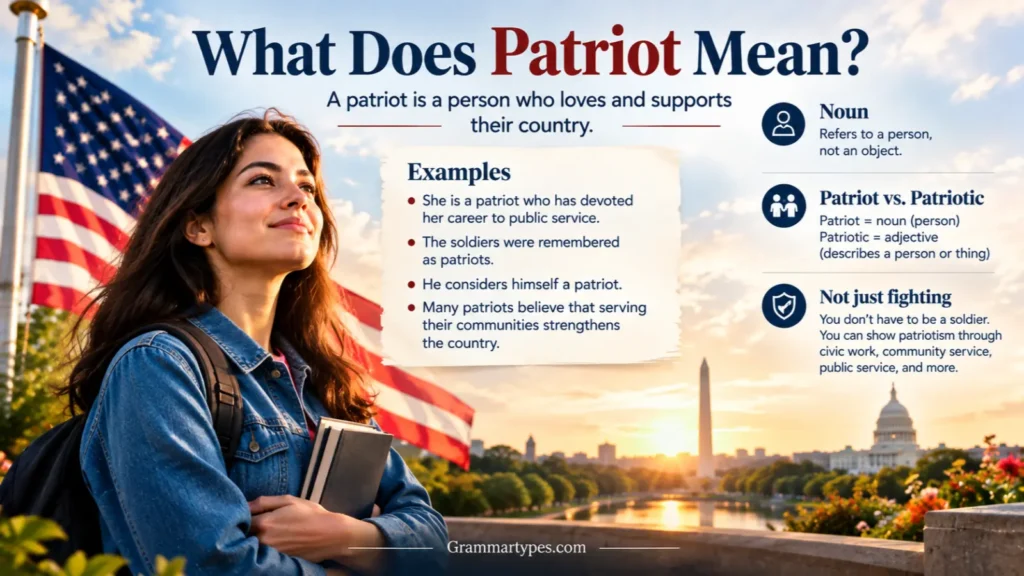
What Does Patriot Mean?
Patriot is a noun. It refers to a person who loves and supports their country. Dictionaries define the word in terms of love, support, loyalty, or defense of one’s country.
For example:
- She is a patriot who has devoted her career to public service.
- The soldiers were remembered as patriots.
- He considers himself a patriot.
- Many patriots believe that serving their communities strengthens the country.
Because patriot is a noun, it normally refers to a person rather than describing an object directly.
Patriot as a Person
Consider this sentence:
Daniel is a patriot.
Here, patriot identifies Daniel as a person who loves or supports his country.
You could also say:
Daniel is patriotic.
The meaning is similar, but the grammar changes. In the second sentence, patriotic is an adjective describing Daniel.
Does Being a Patriot Mean Fighting?
Not necessarily.
The modern meaning of patriot does not require someone to fight in a war or serve in the military. A person can express love or devotion to their country through civic participation, community service, public service, cultural involvement, or other forms of support. Merriam-Webster specifically notes that active fighting or resistance is not required by the modern meaning of patriot.
For example:
A teacher who works to improve her community may consider herself a patriot.
The sentence does not suggest that she is a soldier. It simply describes her relationship with her country and community.
What Does Patriotic Mean?
Patriotic is an adjective. It describes someone or something that shows, expresses, or is associated with love for one’s country.
Cambridge defines patriotic as showing love for one’s country and being proud of it, while Merriam-Webster defines it as being inspired by or characteristic of patriotism.
Examples include:
- The crowd sang a patriotic song.
- She gave a patriotic speech.
- The ceremony included patriotic music.
- He felt patriotic during the national celebration.
- The museum displayed several patriotic symbols.
Notice that patriotic does not name the person. Instead, it describes the person, behavior, object, feeling, or event.
What Can Patriotic Describe?
The adjective can modify many different nouns:
- patriotic person
- patriotic speech
- patriotic song
- patriotic gesture
- patriotic feeling
- patriotic celebration
- patriotic duty
- patriotic symbol
- patriotic organization
For example:
The students performed a patriotic song at the ceremony.
Here, patriotic describes the song.
You would not normally replace it with patriot:
❌ The students performed a patriot song.
If you mean a song expressing love for a country, patriotic song is the appropriate phrase.
Patriot vs Patriotic in Sentences
The difference becomes clearer when the two words appear in similar sentences.
Using Patriot
Use patriot when you are naming or referring to a person.
- James is a patriot.
- The country honored several patriots.
- She described her grandfather as a lifelong patriot.
- A patriot does not necessarily agree with every government policy.
Using Patriotic
Use patriotic when you are describing something.
- James is patriotic.
- The ceremony had a patriotic atmosphere.
- She wore a patriotic badge during the celebration.
- The speech contained several patriotic themes.
A useful way to remember the distinction is to ask:
Am I naming the person?
Use patriot.
Am I describing the person or something associated with love of country?
Use patriotic.
Patriot, Patriotic, and Patriotism
A third word often appears alongside these two: patriotism.
Patriotism is a noun meaning love for or devotion to one’s country.
The three words form a useful word family:
- Patriot = a person
- Patriotic = describing someone or something
- Patriotism = the feeling or quality
Compare:
Lena is a patriot.
This identifies Lena as a person.
Lena is patriotic.
This describes Lena.
Lena’s patriotism is strong.
This refers to her feeling of devotion to her country.
This pattern is useful when writing essays, articles, speeches, and other formal English.

Is a Patriot a Trump Supporter?
No. The word patriot does not specifically mean a supporter of Donald Trump or any other political leader.
A patriot is generally someone who loves or supports their country. Political affiliation is not part of the basic dictionary definition of the word.
Therefore, someone can be a patriot while supporting Trump, opposing Trump, or holding no strong opinion about him.
The same principle applies to patriotic. Calling a speech, action, or person patriotic does not automatically identify that person or action with a particular political party, politician, or ideology.
Political contexts can influence how people interpret these words, but the basic vocabulary meaning remains broader.
Does Patriotic Only Apply to America?
No.
Patriotic can describe love or pride associated with any country, not only the United States.
For example:
- She is patriotic about Canada.
- The ceremony included patriotic songs from India.
- He gave a patriotic speech about Australia.
- The stadium was decorated with patriotic symbols for the national celebration.
The word itself is not limited to American English or American identity. Cambridge’s definition refers generally to love for and pride in your country.
The noun patriot works the same way:
- a British patriot
- an Indian patriot
- a Canadian patriot
- an American patriot
- a Japanese patriot
The specific country comes from the context, not from the word patriot itself.
Patriot vs Patriotic vs Nationalist
These words are related, but they should not automatically be treated as synonyms.
Patriot: describes a person who loves or supports their country.
Patriotic: describes something that shows or expresses that feeling.
Nationalist: has a more specific political and ideological meaning, although everyday usage sometimes overlaps with patriot. The relationship between patriotism and nationalism is complex, and scholars do not use a single universally accepted distinction.
For ordinary English usage, it is safest not to assume that calling someone a patriot means calling them a nationalist.
For example:
She is a patriot.
This simply communicates that she has strong attachment to or support for her country.
If you are discussing political ideology, nationalist may communicate something more specific and should be chosen based on the intended meaning.
What Does It Mean If Someone Is Patriotic?
If someone is patriotic, they show love, pride, loyalty, or devotion toward their country.
That can appear in different ways. Someone might celebrate national traditions, participate in civic life, serve their community, display national symbols, or express pride in their country’s history or culture.
However, being patriotic does not necessarily mean agreeing with every decision made by a government.
The idea of patriotism can include criticism of one’s government or political leaders. Philosophical discussions of patriotism distinguish attachment to a country from automatic support for a particular government.
This distinction is also reflected in a famous statement associated with Mark Twain.

What Did Mark Twain Say About Being a Patriot?
Mark Twain is widely associated with the statement:
“Patriotism is supporting your country all the time, and your government when it deserves it.”
The wording commonly quoted today is a shortened form of an idea Twain expressed in his 1905 essay “The Czar’s Soliloquy.” The longer passage distinguishes loyalty to the nation from loyalty to a government only when it deserves that loyalty.
The quotation is useful in understanding why patriotism and support for a government are not necessarily identical concepts.
In simple terms, the idea is that caring about one’s country does not require unconditional agreement with every government decision.
Common Mistakes With Patriot and Patriotic
Because the words share the same root, learners sometimes use them interchangeably. Here are some common errors.
Mistake 1: Using Patriot as an Adjective
❌ She is a patriot woman.
This is not the normal way to describe a woman who loves her country.
✅ She is a patriotic woman.
Here, patriotic correctly functions as an adjective.
You can also say:
✅ She is a patriot.
The first sentence uses an adjective; the second uses a noun.
Mistake 2: Using Patriotic as a Noun for a Person
❌ He is a patriotic.
The adjective needs a noun to describe, or it needs to be used in a different grammatical structure.
✅ He is patriotic.
Or:
✅ He is a patriot.
Mistake 3: Confusing Patriotism With a Political Party
❌ Only people who support this political party are patriots.
This statement gives patriot a political restriction that is not part of its basic meaning.
Better:
✅ People with different political views can consider themselves patriots.
The word describes attachment to one’s country, not automatic membership in a particular political movement.
Mistake 4: Assuming Patriotic Means American
❌ Patriotic always means American.
✅ Patriotic can describe love or pride associated with any country.
Context tells the reader which country is being discussed.
Easy Way to Remember the Difference
Use this simple three-word pattern:
Patriot = person
Patriotic = describes
Patriotism = feeling
For example:
The patriot felt patriotic because of his strong patriotism.
The sentence is grammatically possible, although it is repetitive. Each word has a different role:
- patriot → person
- patriotic → adjective
- patriotism → feeling or devotion
A more natural sentence would be:
The patriot expressed his patriotism through community service.
FAQs: Patriot vs Patriotic
Yes. Patriot is a noun referring to a person who loves or supports their country.
Yes. Patriotic is an adjective used to describe someone or something that shows or expresses love or pride toward a country.
In ordinary usage, the two descriptions overlap considerably. Someone described as patriotic is showing qualities associated with patriotism, while patriot labels the person as one who loves or supports their country.
The related noun is patriotism, meaning love for or devotion to one’s country.
The related adjective is patriotic.
For example:
He is a patriot.
He is patriotic.
Usually, patriot is a positive or approving term meaning someone who loves or supports their country. However, words connected with patriotism can acquire different connotations depending on political, historical, or social context.
Not necessarily. The words are related, and their meanings can overlap in some contexts, but nationalist can refer to a more specific political or ideological position. The distinction between patriotism and nationalism is debated and depends partly on how the terms are defined.
Final Thought
The main difference in patriot vs patriotic is grammatical as well as semantic. A patriot is a person who loves or supports their country, while patriotic is an adjective describing someone or something that shows or expresses love, pride, or devotion toward a country.
Remember the simple rule: patriot = person, patriotic = describing word, patriotism = feeling or devotion. Neither patriot nor patriotic is limited to America, and being a patriot does not automatically mean supporting a particular political leader or party.
When choosing between the words, ask whether you are naming the person or describing the person or their actions. That small distinction will help you use both words naturally and accurately.
Discover More Grammar Tips:
Commonly Confused Words: Spelling, Meaning & Usage Guide
[authorbox]
