
Have you ever wanted to wish someone a great trip but paused because you were unsure whether “enjoy your vacation” sounded natural? Perhaps you wondered whether to say “enjoy your vacation,” “have a great vacation,” or “enjoy your trip” instead.
The good news is that “enjoy your vacation” is grammatically correct and completely natural in English. It is a friendly expression used to wish someone a pleasant, relaxing, or enjoyable time away from work or school.
In this article, you’ll learn what the phrase means, how to use it correctly, when it sounds formal or casual, and how to say it in different ways. You’ll also find examples, vacation wishes, common mistakes, and answers to related questions.
What Does “Enjoy Your Vacation” Mean?
“Enjoy your vacation” means “I hope you have a pleasant and enjoyable vacation.” It is a friendly way to express good wishes to someone who is about to take time off, travel, or spend time relaxing.
The verb enjoy means to get pleasure from something, while vacation refers, particularly in American English, to a period away from work or school for relaxation or travel.
For example:
- Enjoy your vacation!
- I hope you enjoy your vacation in Florida.
- Have fun and enjoy your vacation!
- Enjoy your vacation, and I’ll see you when you get back.
The phrase can be used with friends, family members, coworkers, classmates, or other people. Its tone depends mainly on the surrounding words and the relationship between the speakers.
Is “Enjoy Your Vacation” Grammatically Correct?
Yes. “Enjoy your vacation” is grammatically correct.
The basic structure is:
Enjoy + possessive determiner + noun
- Enjoy = verb
- your = possessive determiner
- vacation = noun
The sentence uses the imperative form of enjoy. An imperative sentence gives a command, instruction, invitation, or in this case a friendly wish.
Compare:
- Enjoy your vacation!
- Enjoy your meal!
- Enjoy your weekend!
- Enjoy the show!
These expressions are all natural because enjoy can take something as its object. Cambridge also gives examples such as “Enjoy your weekend” and explains that enjoy normally takes an object.
How to Use the Phrase Naturally
You can use “enjoy your vacation” when someone is already planning, starting, or about to take a vacation.
Before Someone Leaves
This is probably the most common situation.
You: Have a safe flight, and enjoy your vacation!
Friend: Thanks! I really need the break.
Here, the phrase works as a farewell or good wish.
In a Text Message
The expression is perfectly natural in casual messaging:
Have a great time in Hawaii! Enjoy your vacation!
You can also make it warmer:
Enjoy your vacation! Take lots of pictures and have fun.
With a Coworker
It works well in workplace conversations:
Enjoy your vacation, Sarah. You’ve definitely earned some time off.
For a professional email, you could write:
I hope you enjoy your vacation and have a relaxing break.
The phrase itself is not too informal for professional communication. The level of formality comes from the complete message.

“Enjoy Your Vacation” vs. “Enjoy Your Trip”
These expressions are similar, but they are not always identical.
| Expression | Main idea | Best used for |
|---|---|---|
| Enjoy your vacation | Enjoy your time away from normal responsibilities | A holiday or extended break |
| Enjoy your trip | Have a pleasant journey or visit | Travel to a destination |
| Have a great vacation | Have a very enjoyable vacation | General vacation wishes |
| Have a great trip | Have an enjoyable journey | Short or long travel |
| Enjoy your time off | Make the most of your break | Work or school break |
| Have a wonderful holiday | Have a pleasant holiday | Common especially in British English |
A trip focuses more strongly on the travel or journey, while a vacation commonly refers to time away for relaxation or pleasure.
For example:
Enjoy your trip to Paris!
This emphasizes the travel experience.
Enjoy your vacation!
This emphasizes the person’s entire break, which may include travel, relaxation, sightseeing, or simply time away from work.
Best Ways to Say “Enjoy Your Vacation”
You do not have to use the same expression every time. The best alternative depends on your relationship with the person and the tone you want.
Friendly and Casual
Use these with friends, relatives, classmates, or people you know well:
- Have a great vacation!
- Have an amazing vacation!
- Have a fantastic trip!
- Have fun on your vacation!
- Enjoy every minute!
- Have a blast!
- Make the most of your vacation!
- Hope you have an amazing time!
Examples:
Have a blast on your vacation!
Hope you have an amazing time and come back refreshed.
Have fun and enjoy every moment!
Warm and Thoughtful
If you want your message to sound more personal:
- I hope you have a relaxing vacation.
- Wishing you a wonderful vacation filled with great memories.
- I hope you enjoy every moment of your time away.
- Have a peaceful and refreshing vacation.
- Enjoy your well-deserved break!
- I hope your vacation is everything you’ve been looking forward to.
These work particularly well when someone has been working or studying hard.
Professional
For a coworker, manager, client, or other professional contact, try:
- I hope you have a wonderful vacation.
- Wishing you a relaxing vacation.
- Have a great vacation and enjoy your time off.
- I hope you have a pleasant and restful break.
- Enjoy your time away, and I look forward to seeing you when you return.
For example:
Wishing you a relaxing vacation. I hope you enjoy your time away from the office.
“Enjoy Your Vacation” Wishes and Messages
If you’re looking for ready-to-use enjoy your vacation wishes, these examples cover different situations.
Friends
Enjoy your vacation! Relax, have fun, and make some unforgettable memories.
Family
Have a wonderful vacation! Enjoy every moment and come home with plenty of happy memories.
Coworker
Enjoy your vacation! I hope you have a relaxing and well-deserved break.
Best Friend
Enjoy your vacation! Forget about work, have an amazing time, and enjoy every second.
Short Message
Enjoy your vacation and have an amazing time!
Funny Message
Enjoy your vacation! May your alarm stay silent and your inbox stay empty.
Warm Message
I hope you enjoy your vacation, get plenty of rest, and return with lots of wonderful memories.
Is “Enjoy Your Vacation” Formal or Informal?
“Enjoy your vacation” can be both formal and informal.
The expression itself is neutral and polite. What makes the overall communication formal or casual is usually the additional wording.
Compare these:
Casual:
Enjoy your vacation! Have tons of fun!
Neutral:
Enjoy your vacation! Hope you have a great time.
Professional:
I hope you enjoy your vacation and have a relaxing break.
You do not need to avoid “enjoy your vacation” in professional settings. It is a perfectly acceptable good wish. If you’re writing to a client or senior colleague, however, adding “I hope” or “wishing you” can make the message sound more polished.
How Do You Wish Someone to Enjoy a Trip?
There are several natural ways to wish someone well before they travel.
Some of the most common are:
- Have a great trip!
- Enjoy your trip!
- Have a safe trip!
- Have a wonderful time!
- Enjoy your vacation!
- Hope you have an amazing trip!
- Have a safe and enjoyable journey!
- Make the most of your trip!
If safety is especially important, combine the ideas:
Have a safe trip and enjoy your vacation!
This is a natural way to express both concern for the person’s journey and happiness about their vacation.
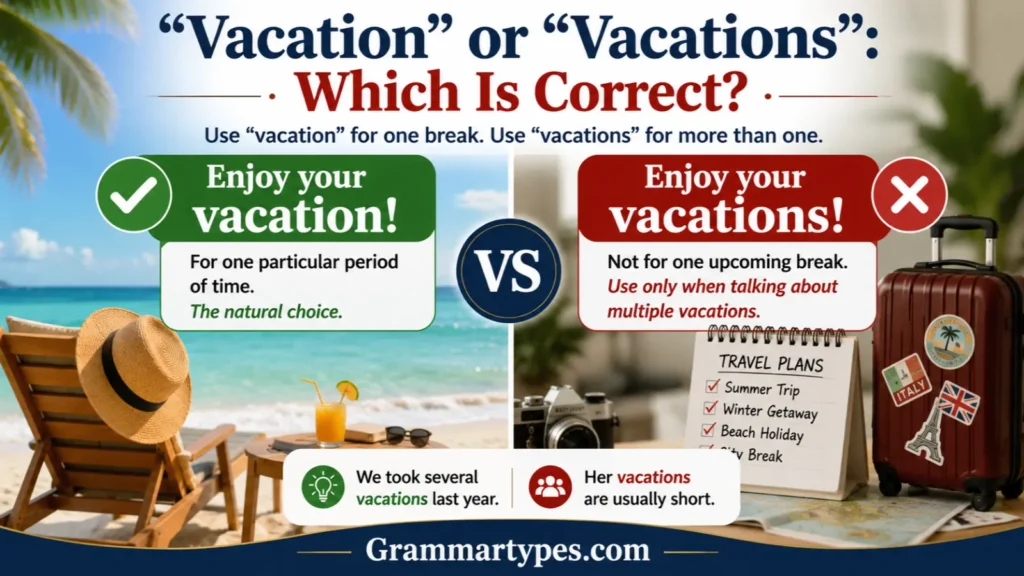
“Vacation” or “Vacations”: Which Is Correct?
For one particular period of time, vacation is normally the natural choice.
Enjoy your vacation! ✅
You generally would not say:
Enjoy your vacations! ❌
when referring to one upcoming break.
The plural vacations is possible when discussing multiple vacations:
We took several vacations last year.
Her vacations are usually short.
So if someone is leaving for one holiday, “Enjoy your vacation!” is the standard choice.
Cambridge lists vacation as both a countable and uncountable noun and gives examples such as “on vacation,” “go on vacation,” and “take a vacation.”
American English vs. British English
There is a regional vocabulary difference worth knowing.
In American English, vacation is the usual word for time away from work or school for relaxation or travel.
In British English, holiday is generally used for this meaning.
So an American might say:
Enjoy your vacation!
A British speaker might naturally say:
Enjoy your holiday!
Both expressions are correct in their respective varieties of English. Cambridge specifically identifies vacation as the US term corresponding to holiday in this sense.
Be careful, though: in American English, holiday often refers to a special day such as Thanksgiving or Christmas rather than a general vacation.
How to Say “Enjoy Your Vacation” in Spanish
A common translation is “¡Felices vacaciones!”
Depending on the situation and who you are addressing, Spanish can also use forms such as “que disfrutes de las vacaciones” for an informal singular addressee and “que disfrute de las vacaciones” in a formal singular context.
The exact translation can vary with the relationship between the speakers and the variety of Spanish being used.
Common Mistakes to Avoid
Mistake 1: Using “in” Instead of “on”
When talking about being away for vacation, English commonly uses on vacation.
❌ I am in vacation.
✅ I am on vacation.
For example:
My parents are on vacation in California.
Mistake 2: Saying “Enjoy on Your Vacation”
The verb enjoy does not need on before the object.
❌ Enjoy on your vacation!
✅ Enjoy your vacation!
You can use on vacation in a different sentence:
I hope you have fun on your vacation.
But after enjoy, the object comes directly:
Enjoy your vacation.
Mistake 3: Using “Enjoy to Your Vacation”
This is also incorrect.
❌ Enjoy to your vacation.
✅ Enjoy your vacation.
The phrase does not require to.
Mistake 4: Confusing “Enjoy Your Vacation” With a Question
“Enjoy your vacation!” is a wish or imperative expression, not a question.
If the vacation has already happened, ask:
Did you enjoy your vacation?
If the person is currently away, you could ask:
Are you enjoying your vacation?
These sentences have different meanings and tenses.
What Is the Difference Between “Enjoy Your Vacation” and “Did You Enjoy Your Vacation?”
The difference is mainly time and purpose.
Enjoy your vacation!
→ A wish for someone who is about to have or is beginning a vacation.
Did you enjoy your vacation?
→ A question about a vacation that has already happened.
Are you enjoying your vacation?
→ A question about a vacation that is happening now.
For example:
Before leaving: “Enjoy your vacation!”
During the vacation: “Are you enjoying your vacation?”
After returning: “Did you enjoy your vacation?”
Understanding this distinction makes it much easier to choose the right expression.
Quick Guide: Which Expression Should You Use?
| Situation | Natural expression |
|---|---|
| Friend leaving for vacation | Enjoy your vacation! |
| Coworker taking time off | Have a great vacation! |
| Someone traveling | Have a great trip! |
| You want to mention safety | Have a safe trip! |
| Someone returning from vacation | Did you enjoy your vacation? |
| Someone currently traveling | Are you enjoying your vacation? |
| British English | Enjoy your holiday! |
| Professional email | I hope you enjoy your vacation. |
Easy Way to Remember
Think of enjoy as a verb that can take the thing someone is supposed to enjoy directly:
Enjoy + thing
- Enjoy your vacation.
- Enjoy your meal.
- Enjoy the show.
- Enjoy your weekend.
- Enjoy the trip.
You don’t need to or on between enjoy and the thing being enjoyed.
FAQs
The simplest and most natural expression is “Enjoy your vacation!” You can also say “Have a great vacation,” “Have a wonderful trip,” “Enjoy your time off,” or “Hope you have an amazing time.”
Yes. “Enjoy your vacation” is grammatically correct and natural English. It uses the imperative form of enjoy followed by the possessive determiner your and the noun vacation.
Natural alternatives include “Have a great trip,” “Have a wonderful journey,” “Have a safe trip,” “Hope you have an amazing time,” and “Make the most of your trip.”
Yes. It is a friendly, polite, and versatile vacation wish. You can use it with friends, family, coworkers, and other people. Add words such as “safe,” “wonderful,” “relaxing,” or “well-deserved” when you want to make the message more personal.
Yes. The phrase is appropriate for coworkers. For a more professional tone, you can say “I hope you have a relaxing vacation” or “Wishing you a wonderful vacation.”
Final Thought
“Enjoy your vacation” is grammatically correct, natural, and widely useful English. It is a friendly way to wish someone pleasure and relaxation during their time away from work or school. You can use it before a friend leaves, in a message to a coworker, or as part of a longer vacation wish.
If you want variety, try “Have a great vacation,” “Enjoy your trip,” “Have a wonderful time,” or “Enjoy your well-deserved break.” Remember that vacation is especially common in American English, while British English generally uses holiday for the same meaning.
The simplest rule is also the easiest: when someone is about to take a break, “Enjoy your vacation!” is a perfectly natural thing to say.
Discover More Grammar Tips:
Texting Abbreviations, Chat Slang & Emoji Meanings Guide
[authorbox]

Pingback: Greetings and Wishes: The Ultimate Guide to Everyday Messages