
Planning to send someone a friendly trip message but wondering whether “have a great vacation” sounds natural or grammatically correct? You are not alone. English learners and native speakers often hesitate over simple phrases when they want their message to sound warm, polite, and appropriate.
The good news is that “have a wonderful trip” is correct, natural, and widely used, especially in American English. It is a friendly way to wish someone an enjoyable time away from work, school, or their normal routine.
In this guide, you’ll learn what the phrase means, why it is grammatically correct, when to use it, how it differs from “enjoy your vacation,” and how to make your vacation wishes sound casual, warm, or professional.
Is “Have a Great Vacation” Correct?
Yes. “Have a great trip” is grammatically correct and natural English.
You can use it when someone is about to leave for a trip or is beginning a period away from their normal routine.
For example:
- have a wonderful travel!
- Have a great trip with your family.
- I hope you enjoy your trip in California.
- enjoy your trip, and I’ll see you when you get back.
The phrase works particularly well in American English, where trip commonly refers to time away from work or school for relaxation or travel. Cambridge Dictionary identifies trip as the American English term, with holiday commonly used in British English for the same general idea.
Quick Answer
“have a great time away” is correct. It is a friendly expression used to wish someone an enjoyable, relaxing, or memorable time away. You can use it in conversation, text messages, cards, emails, and many workplace situations.
What Does “Have a Great Vacation” Mean?
“have a wonderful trip” means “I hope you enjoy your trip” or “I hope you have a wonderful time while you are away.”
The expression communicates a positive wish rather than giving someone a literal command.
For example:
enjoy your vacation! I hope you get plenty of rest.
The speaker is not ordering the other person to have a great time away. Instead, the sentence expresses goodwill and hopes that the person’s trip will be enjoyable.
The noun trip refers to a period when someone is free from work or school and can travel, relax, or spend time doing other activities.
What Does “Great” Add to the Expression?
The adjective great makes the wish more enthusiastic than simply saying:
Have a vacation.
Compare these:
| Expression | Tone | Meaning |
|---|---|---|
| Have a vacation. | Neutral | Take time away from your normal routine. |
| Have a good vacation! | Friendly | I hope your vacation is good. |
| have a wonderful vacation | Warm and enthusiastic | I hope your vacation is especially enjoyable. |
| Have an amazing vacation! | Very enthusiastic | I hope your vacation is memorable and exciting. |
All of these can work in the right context, but “Have a great time away!” is one of the most natural choices for an everyday good wish.
How Is “Have a Great Vacation” Grammatically Structured?
The phrase follows a simple pattern:
Have + a + adjective + noun
In this case:
- Have = verb
- a = indefinite article
- great = adjective
- trip = noun
So:
Have a great vacation!
The article a is necessary because holiday is being used as a singular countable noun in this construction.
Compare:
❌ Have great vacation!
✅ Have a great vacation!
The second sentence is the standard form.
The same pattern appears in many familiar expressions:
- Have a great day!
- Have a good weekend!
- Have a wonderful evening!
- Have a safe trip!
- Have a nice holiday!
Why Is “Have” Used?
Here, have appears in an imperative construction. English commonly uses the base form of a verb to give a command, instruction, invitation, or good wish.
For example:
Have a great vacation!
Have a wonderful weekend!
Have a safe trip!
In these expressions, the intended subject is you, but English normally leaves that subject unstated in an imperative.
When Should You Say “Have a Great Vacation”?
You can say it before or at the beginning of someone’s holiday.
It works especially well when:
Someone Is About to Travel
You’re leaving tomorrow?enjoy your time away!
A Coworker Is Taking Time Off
Enjoy your time off, and have a wonderful vacation!
A Friend Is Going Away
enjoy your vacation in Italy! Send me some pictures.
A Family Member Is Traveling
Have a great vacation with the kids!
Someone Is Taking a Break Without Traveling
A break does not necessarily require international travel. Someone might spend their travel destination at home, visit relatives, or take a short local trip.
I hope you have a great vacation and get some much-needed rest.
This flexibility makes the expression useful in many everyday situations.
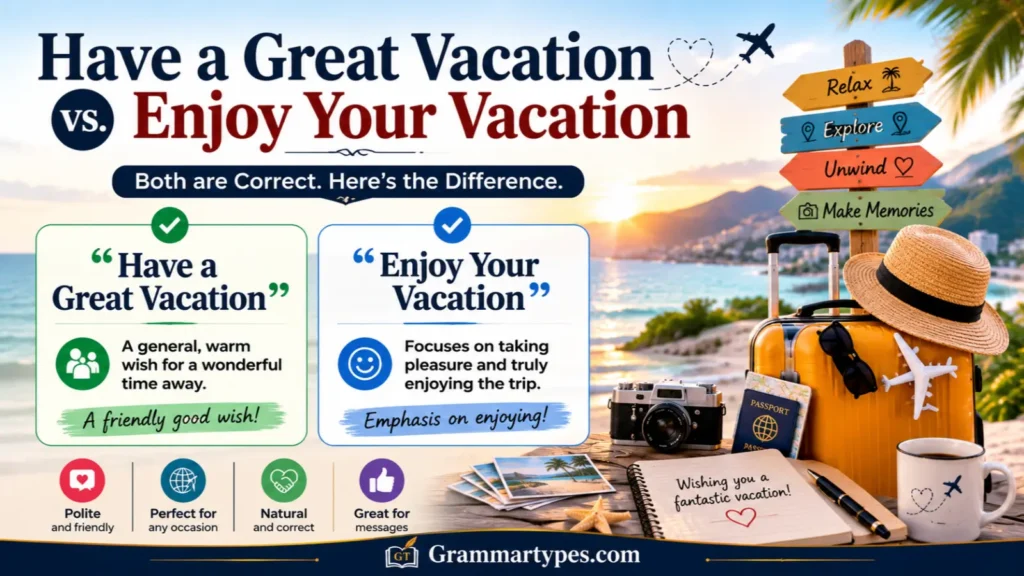
“Have a Great Vacation” vs. “Enjoy Your Vacation”
Both expressions are correct, but they have a slightly different focus.
“enjoy your time away” emphasizes the overall experience you hope the person has.
“Enjoy your travel destination” directly tells the person to take pleasure in their time away.
For example:
Have a great vacation!
This sounds like a general good wish.
Enjoy your vacation!
This places more emphasis on enjoying the actual travel destination.
The verb enjoy normally takes an object, which is why “Enjoy your getaway” is complete and natural. Cambridge specifically gives constructions such as “Enjoy your holiday” and explains that enjoy generally has an object.
| Phrase | Meaning | Tone |
|---|---|---|
| enjoy your time away | I hope your vacation is wonderful. | Friendly |
| Enjoy your vacation! | I hope you enjoy your time away. | Friendly |
| Have a wonderful vacation! | I hope your vacation is wonderful. | Warm |
| Have a fantastic trip! | I hope your trip is excellent. | Enthusiastic |
| Wishing you a relaxing vacation. | I hope your time away is restful. | Polished |
| Enjoy your time off! | I hope you enjoy your break. | Friendly/professional |
Neither “have a travel experience” nor “enjoy your trip” is grammatically superior. Choose the one that fits the context and your relationship with the person.
What Are Other Ways to Say “Have a Great Vacation”?
You do not need to repeat the same expression every time. Small changes can make your message more personal.
Friendly Alternatives
Use these with friends, classmates, relatives, or coworkers you know well:
- Have an amazing break!
- Enjoy your trip!
- Have a wonderful time!
- Have a fantastic trip!
- Enjoy every moment!
- Have an awesome travel destination!
- Hope you have a great time!
- Have fun and relax!
Examples:
Have an amazing vacation! I hope you get to see everything on your list.
Enjoy your trip and make some great memories!
Have a fantastic time with your family!
Warm and Thoughtful Alternatives
When you want your message to sound more caring, try:
- Wishing you a relaxing travel destination.
- I hope you have a wonderful time away.
- I hope your is everything you hoped for.
- Wishing you a peaceful and enjoyable break.
- I hope you come back feeling refreshed.
For example:
Wishing you a relaxing vacation and plenty of time to enjoy yourself.
These expressions work particularly well in written messages because they sound more personal than a very short farewell.
How Do You Wish Someone a Good trip Professionally?
“Have a wonderful travel destination” is generally appropriate in friendly workplace communication, particularly when speaking to a colleague you know well.
However, a more polished expression may work better when writing to a client, senior executive, customer, or someone with whom you have a formal relationship.
Professional Examples
Wishing you a relaxing and enjoyable vacation.
I hope you have a wonderful vacation and a safe journey.
Enjoy your time off, and I look forward to speaking with you when you return.
Wishing you a pleasant vacation and a safe trip.
You can still use “travel experience!” in a professional setting when the relationship is relatively relaxed. The important point is to match the tone to the situation rather than treating the phrase as either strictly formal or strictly informal.
How Do You Respond to “Have a Great Vacation”?
If someone tells you:
Have a great vacation!
You can respond simply and naturally.
Short Responses
- Thank you!
- Thanks!
- Thank you, I will!
- Thanks so much!
- I appreciate it!
Friendly Responses
Thanks! I’m really looking forward to it.
Thank you! I can’t wait to get away for a few days.
Thanks! I’ll definitely try to enjoy every minute.
Professional Responses
Thank you! I really appreciate that.
Thanks very much. I’m looking forward to the break.
Thank you. I’ll see you when I return.
A simple “Thank you!” is completely sufficient. You do not need to create a long response to a short travel experience wish.
How Do You Say “Have a Great Vacation” in American and British English?
The expression “Have a great vacation” is especially natural in American English.
In British English, holiday is commonly used where American English uses travel experience. Cambridge labels travel experience as US English and gives holiday as the UK equivalent.
So you may hear:
American English:
Have a great vacation!
British English:
Have a great holiday!
Both are correct within their respective varieties of English.
This does not mean that British speakers never use enjoy your time away. It simply means that holiday is the more usual everyday choice for this meaning in British English.
Common Mistakes With Vacation Wishes
1. Leaving Out “a”
❌ Have great vacation!
✅ Have a great vacation!
Because enjoy your time away is singular and countable in this construction, it normally needs the article a.
2. Using “Enjoy” With “to”
❌ Enjoy to your vacation!
✅ Enjoy your vacation!
The verb enjoy normally takes a direct object, such as your getaway. Cambridge’s grammar guidance specifically illustrates “Enjoy your holiday” and explains that enjoy normally has an object.
You can also say:
Enjoy yourself!
But do not insert to between enjoy and its object.
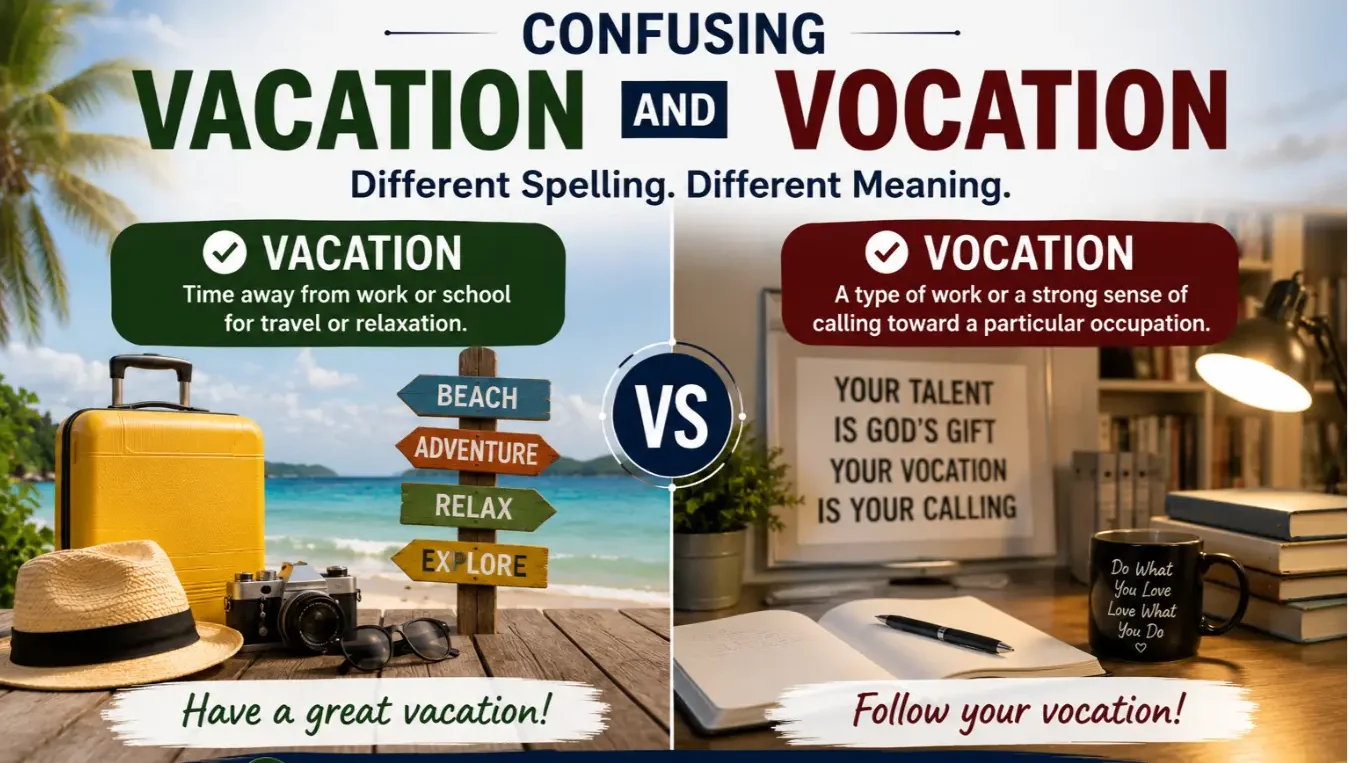
3. Confusing “Vacation” and “Vocation”
These words look and sound somewhat similar, but they have different meanings.
Vacation = time away from work or school, often for travel or relaxation.
Vocation = a type of work or a strong sense of calling toward a particular occupation or activity.
So:
❌ Have a great vocation!
is not the intended travel plans wish.
4. Making the Message Too Formal
A phrase such as:
I extend my sincerest wishes for an exceptionally pleasurable period of recreational absence.
may be grammatically possible, but it sounds unnatural in ordinary communication.
A simple:
Have a wonderful vacation!
usually sounds much more natural.
Good English is not always about choosing the longest or most formal expression. The best phrase is the one that fits the situation.
How to Make Your Vacation Wish More Personal
Instead of repeating the same sentence pattern, try these natural examples:
enjoy your break in Florida!
I hope you have a wonderful vacation with your family!
Enjoy your vacation, and I hope you get plenty of time to relax.
Wishing you a wonderful vacation! Enjoy the beach and take lots of pictures.
Example
Enjoy the beach and take lots of pictures.
Adding a destination, mentioning the people traveling with them, or referring to their plans can make the message feel more genuine without making it unnecessarily long.
How to Say “Enjoy Your Trip”
“Enjoy your trip!” is another natural way to wish someone well before traveling.
The distinction is small:
- Vacation focuses on the period of time away from normal work or school.
- Trip focuses more on the journey or travel experience.
For example:
Have a great vacation!
The person may be taking a week away from work.
Enjoy your trip to Spain!
The emphasis is on the person’s travel to Spain.
You can also combine the ideas:
Have a great vacation, and enjoy your trip!
Or:
Enjoy your trip and have a wonderful vacation!
How to Say “Have a Great Vacation” in Spanish
A common Spanish translation is “Que pases buenas vacaciones” when addressing one person informally. Formal and plural forms vary according to the person being addressed. SpanishDictionary lists these distinctions and translates the phrase in this context.
For English learners, the important point is that translations do not always follow the exact English structure word for word. A natural translation should reflect how people actually express travel plans wishes in the target language.
How to Say It in Italian and French
If you are learning languages, you may also search for equivalents such as:
- Have a great things to do in Italian
- enjoy your time away in French
- How do you say have a great travel plans in Spanish?
The exact translation depends on the language, level of formality, and whether you are addressing one person or several people.
For English communication, however, “Have a great getaway!” remains a completely natural expression.
“Have a Great Vacation” Examples To a friend:
You can use this expression in many everyday situations:
A Casual Message for Work
Enjoy the break! I hope you return feeling refreshed and ready for whatever comes next.
A Warm Family Wish
May your time away bring plenty of laughter, quality time, and wonderful memories with the people you love.
A Message for an International Trip
Safe travels on your journey to Italy. Take in the sights, enjoy the local culture, and make the most of every moment.
In a professional message:
Wishing you a wonderful vacation and a relaxing break.
When someone leaves tomorrow:
I hope you have a great vacation tomorrow and that everything goes smoothly.
When someone is already away:
I hope you’re having a great vacation!
Notice the tense difference. Before the vacation begins, you can say “enjoy your time away!” Once the vacation has started, “I hope you’re having a great vacation” is often more natural.
FAQs
Yes. “travel destination” is correct, natural English. It is a friendly expression used to wish enjoy your time away.
It is best described as friendly and neutral rather than strictly formal or informal. It works in everyday conversation and can also work in relaxed professional communication. More polished alternatives may suit highly formal situations.
You can say “enjoy your time away,” “enjoy your time away,” “Enjoy your time off,” “Have a fantastic trip,” or “Wishing you a relaxing travel destination.” Choose based on the relationship and tone.
You can simply say “Have a great vacation!” Other natural options include “Enjoy your vacation!”, “Have a wonderful time!”, and “enjoy your time away”
Yes. It is a natural choice for a coworker, especially in a friendly workplace. For a more formal relationship, “Wishing you a relaxing vacation” may sound more polished.
Both are correct. “Have a great vacation” expresses a general good wish, while “enjoy your vacation” directly emphasizes getting pleasure from the vacation.
Yes. “Have a great holiday” is especially common in British English, while “enjoy your time away” is especially common in American English. The choice depends largely on regional usage.
Yes. “Hope you have a great vacation” is natural and common, particularly in conversational English and messages.
For example:
Hope you have a enjoy your time away! We’ll catch up when you get back.
Final Thought
“Have a great vacation” is completely correct and natural English. It is a friendly way to wish someone an enjoyable and relaxing period away from work, school, or their normal routine. The phrase is particularly common in American English, while British English often uses “Have a great holiday.”
You can use the expression with friends, family members, classmates, and coworkers. In more formal situations, alternatives such as “Wishing you a relaxing break” or “I hope you have a wonderful getaway” may sound more polished.If you want a simple, warm, and natural things to do wish, you can confidently say: “Have a great trip!”
Discover More Grammar Tips:
Enjoy Your Vacation: Meaning, Wishes, Examples & Better Ways to Say It
[authorbox]

Pingback: Greetings and Wishes: The Ultimate Guide to Everyday Messages
Pingback: Flyer or Flier: Which Spelling Is Correct? Meaning & Examples