
Have you ever written a sentence and paused because you were unsure whether to use weather or whether? You are not alone. These two words look and sound remarkably similar, but they perform completely different jobs in English.
The confusion mainly comes from pronunciation. In many varieties of English, weather and whether are pronounced the same or very similarly, so the distinction is usually much easier to see in writing than to hear.
The good news is that the difference is straightforward once you connect each word with its meaning. This guide explains weather and whether, shows how to use each one correctly, covers common mistakes, pronunciation, the related word wether, and gives practical examples you can use in everyday English.
Weather and Whether: The Quick Difference
The simplest distinction is:
- Weather refers to conditions in the atmosphere, such as rain, wind, temperature, snow, or sunshine.
- Whether is a conjunction used to introduce uncertainty, an indirect question, or a choice between possibilities.
| Word | Part of Speech | Main Meaning | Example |
|---|---|---|---|
| weather | Noun / verb | Atmospheric conditions; to endure or withstand | The weather is cold today. |
| whether | Conjunction | A choice, possibility, or uncertainty | I don’t know whether he will come. |
Cambridge Dictionary defines weather as the conditions in the air over the Earth, including things such as wind, rain, and temperature. It also lists weather as a verb meaning to deal successfully with a difficult situation or to change because of exposure to weather conditions.
Whether, by contrast, is a conjunction used especially when reporting questions, expressing doubt, or presenting possibilities.
A useful shortcut is:
Weather = conditions outside
Whether = choice or uncertainty
What Does “Weather” Mean?
Weather is primarily an uncountable noun referring to the condition of the atmosphere at a particular time and place. It includes things such as temperature, rain, wind, clouds, and other atmospheric conditions.
For example:
- The weather is beautiful today.
- We canceled the picnic because of bad weather.
- The weather forecast predicts heavy rain.
- Cold weather can make driving more difficult.
- What is the weather like tomorrow?
Notice that all these examples are connected with conditions in the air or outdoors.
Weather as a Verb
Although weather is commonly used as a noun, it can also function as a verb.
As a verb, weather can mean to successfully deal with or survive a difficult situation:
- The company weathered the economic downturn.
- She weathered several difficult challenges.
- The team weathered a difficult season.
It can also describe physical change caused by exposure to the elements:
- The wooden fence has weathered over the years.
- The stone was weathered by wind and rain.
These verb uses are also documented by Cambridge Dictionary.
What Does “Whether” Mean?
Whether is a conjunction. It is commonly used to express uncertainty, introduce an indirect question, or present two or more possibilities.
For example:
- I don’t know whether she is coming.
- We need to decide whether to stay or leave.
- He asked whether I wanted coffee.
- I’m not sure whether this is the right answer.
Cambridge describes whether as a word used for reporting questions and expressing doubt, as well as for introducing two or more possibilities.
One particularly useful structure is whether + to + verb:
- I can’t decide whether to go.
- She is considering whether to apply.
- We need to determine whether to continue.
In standard English, whether, rather than if, is used before a to-infinitive in this structure.
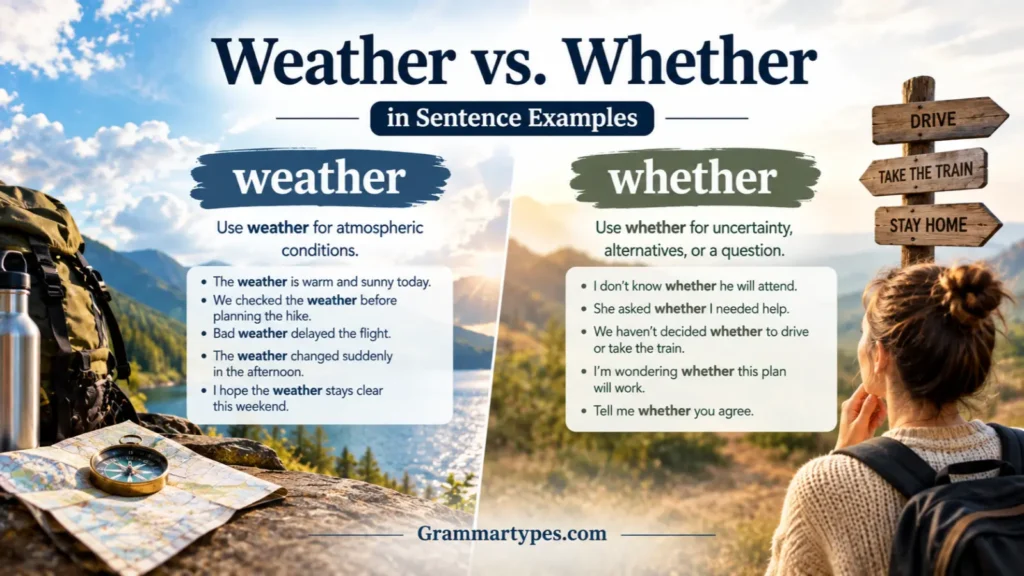
Weather vs. Whether in Sentence Examples
Seeing the words side by side makes their difference easier to recognize.
Examples With “Weather”
Use weather when you are talking about atmospheric conditions:
- The weather is warm and sunny today.
- We checked the weather before planning the hike.
- Bad weather delayed the flight.
- The weather changed suddenly in the afternoon.
- I hope the weather stays clear this weekend.
Examples With “Whether”
Use whether when you are talking about uncertainty, alternatives, or a question:
- I don’t know whether he will attend.
- She asked whether I needed help.
- We haven’t decided whether to drive or take the train.
- I’m wondering whether this plan will work.
- Tell me whether you agree.
The key is not the spelling or sound. Look at the meaning and grammatical role of the word.
Can Weather and Whether Appear in the Same Sentence?
Yes. In fact, using both words in one sentence is an excellent way to understand the distinction.
Consider:
I don’t know whether the weather will improve.
Here, whether introduces uncertainty about a possibility. Weather refers to the atmospheric conditions.
More examples:
- We will decide whether to go after checking the weather.
- I’m not sure whether the weather will be warm enough for a picnic.
- Whether we travel tomorrow depends on the weather.
- She wondered whether the bad weather would continue.
This is a useful test because the two words have clearly different functions even though they sound similar.
Weather and Whether Pronunciation
One reason these words cause so many spelling mistakes is that their pronunciation is the same or nearly the same for many English speakers.
Cambridge gives the common US pronunciation of weather as /ˈweð.ɚ/ and whether as /ˈweð.ɚ/.
Some varieties of English preserve a distinction in the initial sound of whether, while many speakers do not. This means you should not rely entirely on pronunciation when deciding which spelling to use.
Instead, ask what the word means.
If the sentence concerns rain, wind, temperature, sunshine, or atmospheric conditions, choose weather.
If it expresses uncertainty, a question, or alternatives, choose whether.
How to Remember the Difference Between Weather and Whether
A simple memory trick is:
Weather = the world outside.
Whether = which possibility.
You can also use the following two-question test:
1. Is the sentence about the conditions outside?
If yes, use weather.
The weather looks terrible today.
2. Is the sentence about a choice, possibility, or uncertainty?
If yes, use whether.
I don’t know whether the event will be canceled.
Another helpful clue is the structure whether … or:
I can’t decide whether to stay or leave.
The word whether frequently introduces alternatives, although it can also be used when only one possibility is explicitly stated:
I don’t know whether she is available.
The second possibility—she may not be available—is understood from the context.
“Whether or Not” vs. “Weather or Not”
One of the most common mistakes is writing weather or not when the intended phrase is whether or not.
Correct:
you agree, we need to make a decision.
Incorrect:
Weather or not you agree, we need to make a decision.
The phrase whether or not means that it does not matter which of two possibilities is true. Cambridge specifically recognizes this construction.
For example:
- Whether or not it rains, the event will continue.
- I’ll go whether or not you come.
- She will finish the project whether or not she receives additional help.
However, weather or not could occur intentionally as a wordplay or pun when the subject is actually the weather. In ordinary writing, though, the choice between alternatives is spelled whether or not.
Common Mistakes With These Words
Mistake 1: Using “weather” for uncertainty
❌ I don’t know weather she will come.
✅ I don’t know whether she will come.
Why? The sentence expresses uncertainty about someone’s arrival, so whether is required.
Mistake 2: Using “whether” for atmospheric conditions
❌ The whether is beautiful today.
✅ The weather is beautiful today.
Why? The sentence describes outdoor conditions, so the correct word is weather.
Mistake 3: Confusing “whether” with “weather” before “to”
❌ I can’t decide weather to stay.
✅ I can’t decide whether to stay.
Why? Whether is used before a to-infinitive when expressing a choice. Cambridge specifically identifies whether, rather than if, as the appropriate form in this structure.
Mistake 4: Writing “weather or not”
❌ Weather or not you agree, we are leaving.
✅ Whether or not you agree, we are leaving.
Why? The phrase expresses an alternative or lack of concern about which possibility is true. It has nothing to do with atmospheric conditions.
Is “Wether” a Proper Word?
Yes, wether is a real English word, but it has a completely different meaning and is uncommon in everyday vocabulary.
A wether is a male sheep that has been castrated.
So the three spellings have three distinct meanings:
| Word | Meaning |
|---|---|
| weather | Atmospheric conditions; also a verb meaning to endure or withstand |
| whether | Introduces uncertainty, alternatives, or an indirect question |
| wether | A castrated male sheep |
For example:
- The weather is getting colder.
- I don’t know whether it will snow.
- The farmer checked the wether in the field.
This distinction is especially useful because wether is not simply a misspelling of weather or whether. It is a legitimate dictionary word with its own specialized meaning.
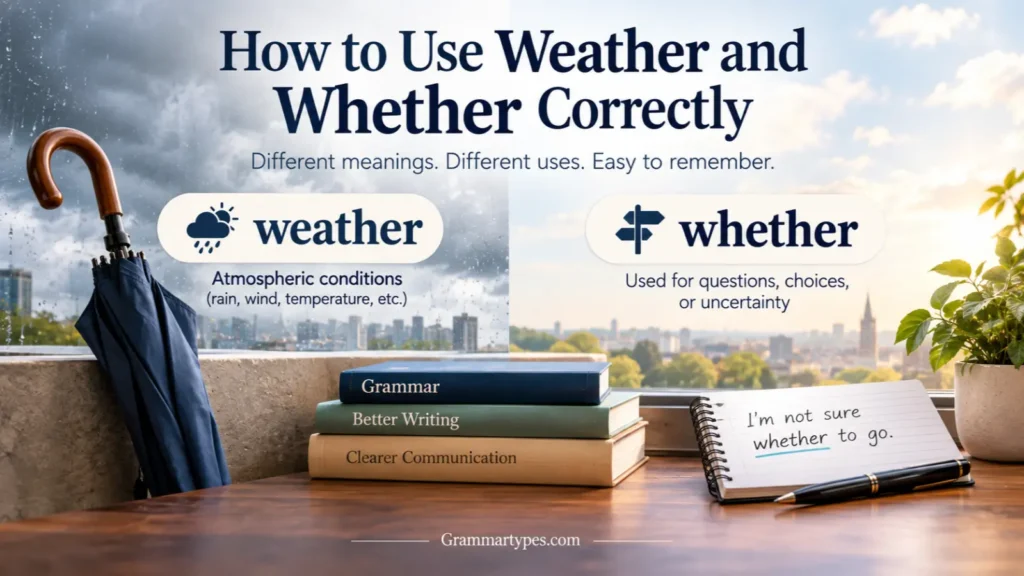
How to Use Weather and Whether Correctly
When you are unsure which spelling to choose, follow these steps:
Step 1: Identify the meaning.
Ask whether you are discussing atmospheric conditions or uncertainty.
Step 2: Check the sentence structure.
If the word introduces a question, choice, or alternatives, whether is likely correct.
Step 3: Look for “or.”
Structures such as whether A or B strongly indicate whether.
Step 4: Look for weather-related vocabulary.
Words such as rain, wind, temperature, storm, sunny, forecast, and snow usually point to weather.
Step 5: Check for “whether to.”
The pattern whether to + verb is a strong grammatical clue.
For example:
I can’t decide ___ to take an umbrella.
Because the sentence expresses a decision about an action, the correct answer is whether:
I can’t decide whether to take an umbrella.
But:
I checked the ___ before leaving.
Here, the intended meaning is atmospheric conditions:
I checked the weather before leaving.
Quick Practice: Weather or Whether?
Try choosing the correct word in each sentence.
1. I don’t know ___ the store is open.
Answer: whether
2. The ___ forecast says it will rain tonight.
Answer: weather
3. We need to decide ___ to leave now or later.
Answer: whether
4. The bad ___ canceled the outdoor event.
Answer: weather
5. She asked ___ I wanted tea or coffee.
Answer: whether
The pattern becomes easier when you focus on meaning rather than sound.
Weather and Whether: Easy Reference
Keep this quick reference in mind:
Weather
- Atmospheric conditions
- Usually a noun
- Can also be a verb
- Connected with rain, wind, temperature, storms, and sunshine
- Example: The weather is pleasant today.
Whether
- Conjunction
- Expresses uncertainty or alternatives
- Often appears in indirect questions
- Common in structures such as whether to, whether … or, and whether or not
- Example: I don’t know whether she will come.
Wether
- Noun
- A castrated male sheep
- Rare in ordinary conversation
- Example: The farmer raised several wethers.
Final Thoughts
The difference between weather and whether becomes much easier when you focus on meaning. Weather refers to atmospheric conditions such as rain, wind, temperature, sunshine, and storms. It can also be used as a verb for enduring a difficult situation. Whether is a conjunction that introduces uncertainty, indirect questions, or alternatives, especially in structures such as whether to, whether … or, and whether or not.
Remember the simplest rule: weather is about conditions outside, while whether is about possibilities or choices. And although wether is a real word, it has a specialized meaning referring to a castrated male sheep.
When pronunciation causes confusion, let context decide. If you are talking about the sky, use weather; if you are weighing a possibility or choice, use whether.
FAQs
Whether is a conjunction used to express uncertainty, introduce an indirect question, or present two or more possibilities. For example, I don’t know whether she is coming expresses uncertainty. It can also introduce alternatives, as in I can’t decide whether to stay or leave.
Weather refers to the conditions in the atmosphere at a particular time and place, including things such as temperature, wind, rain, and other conditions. It can also be a verb meaning to endure a difficult situation.
Yes. Wether is a legitimate English noun referring to a castrated male sheep. It is different from both weather and whether.
Use weather for atmospheric conditions: The weather is cold today. Use whether for uncertainty or alternatives: I don’t know whether she will come. A useful shortcut is weather = conditions outside; whether = choice or uncertainty.
For many English speakers, yes. They have the same or nearly the same pronunciation, although some accents distinguish the initial sound of whether. Because pronunciation varies, spelling and context are more reliable ways to distinguish them.
Sometimes. If and whether can both introduce many indirect yes-or-no questions, such as I don’t know if/whether he is coming. However, whether is required in some structures, including before a to-infinitive, as in I don’t know whether to go.
Weather refers to atmospheric conditions or, as a verb, enduring something. Whether is a conjunction used for uncertainty, indirect questions, and alternatives. They may sound alike, but they have different meanings and grammatical functions.
Explore More Grammar Guides:
Natzi or Nazi: Which Spelling Is Correct? Meaning & Usage
Wracking or Racking: What’s the Difference and Which Spelling Is Correct?
Jobsite or Job Site: What Is the Difference & Which Is Correct?
Flyer or Flier: Which Spelling Is Correct?
In-Person or In Person: Which Is Correct?
