
When you are writing a sentence such as “She had to ___ years of hardship,” the word may sound like it begins with in-, making indure seem reasonable. This is why the spelling confusion between indure vs endure is so common. But English spelling does not always follow pronunciation exactly, and this is one of those cases.
The confusion is mainly a spelling issue rather than a difference in meaning. In modern standard English, endure is the correct form, while indure is not the spelling you should normally use.
In this article, you’ll learn which form is correct, what endure means, how to use it in sentences, and how it differs from related words such as perdure and persevere.
Indure vs Endure: Which Is Correct?
Endure is the standard spelling used in modern English.
Indure is not the spelling you should normally use in contemporary English writing. If you mean “to suffer through,” “to tolerate,” “to withstand,” or “to last,” choose endure.
| Word | Standard modern English? | Meaning | Example |
|---|---|---|---|
| endure | ✅ Yes | To suffer, tolerate, withstand, or last | She had to endure years of hardship. |
| indure | ❌ No, in ordinary modern usage | Not the standard spelling for this word | Avoid: She had to indure years of hardship. |
The simple rule
Use endure, not indure, in modern standard English.
For example:
❌ She had to indure many difficult years.
✅ She had to endure many difficult years.
The mistake is a spelling mistake, not a difference in meaning. Writing indure does not give the sentence a different or stronger meaning.
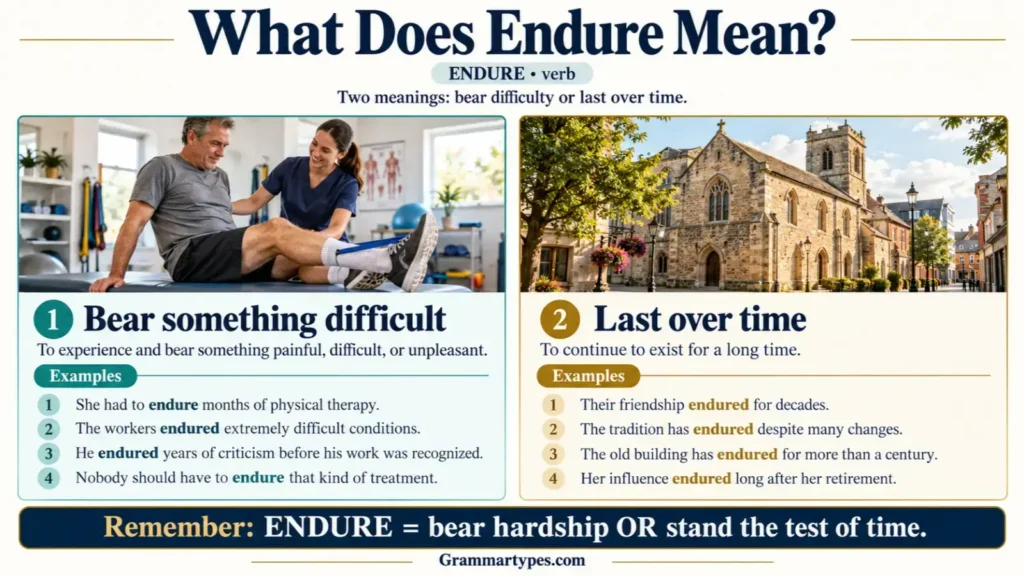
What Does Endure Mean?
Endure is a verb with two closely related major uses.
First, it can mean to experience and bear something difficult, painful, or unpleasant. Cambridge Dictionary defines it in this sense as experiencing and bearing something difficult, unpleasant, or painful.
For example:
- She had to endure months of physical therapy.
- The workers endured extremely difficult conditions.
- He endured years of criticism before his work was recognized.
- Nobody should have to indure vs endure that kind of treatment.
Second, endure can mean to continue to exist or last for a long time.
For example:
- Their friendship endured for decades.
- The tradition has endured despite many changes.
- The old building has endured for more than a century.
- Her influence endured long after her retirement.
So, depending on context, endure can describe either bearing difficulty or continuing to exist.
Why Do People Spell It “Indure”?
The most obvious reason is pronunciation.
In American English, endure is pronounced approximately en-DOOR, while British pronunciation commonly has a sound closer to en-DYOOR.
When people hear the word in conversation, the first syllable can sound similar to “in.” Someone who knows the word primarily from speech may therefore write indure instead of endure.
There is also a historical reason the confusion can seem less straightforward. Older English texts may contain spellings that differ from modern standard usage. That does not make indure the appropriate spelling for ordinary contemporary writing.
For modern essays, emails, articles, schoolwork, professional documents, and everyday writing, endure is the safe and standard choice.
How to Use Endure in a Sentence
The verb endure usually takes a noun phrase describing what someone or something experiences, tolerates, or survives.
Endure + hardship or difficulty
Use endure when someone continues through a difficult experience.
The family endured several difficult months.
The team endured a disappointing season.
She endured many setbacks without abandoning her goal.
Endure + pain or discomfort
It is also common with physical or emotional difficulty.
He had to endure considerable pain after the accident.
I don’t think I could endure that level of discomfort.
The patient endured several difficult procedures.
Endure + something unpleasant
The word can also mean tolerate or put up with something.
I cannot endure the constant noise.
She could no longer endure the stressful working conditions.
In casual conversation, however, words such as stand, tolerate, or deal with may sound more natural depending on the context.
Endure + time or continued existence
When something lasts, indure vs endure does not necessarily involve suffering.
Their friendship endured after they moved to different cities.
The custom has endured for generations.
Great literature can endure for centuries.
This second meaning is important because some writers incorrectly assume that endure can only be used for pain or suffering.
Is Endure Positive or Negative?
Endure is not inherently positive or negative. Its meaning depends on the context.
When it describes suffering, hardship, pain, or something unpleasant, it normally has a negative context:
She had to endure years of loneliness.
But the word can appear in a positive or neutral context when it means continue to exist or remain successful over time:
Their friendship endured despite the distance.
The novel’s appeal has endured for generations.
There can also be a positive implication when the focus is on someone’s strength or resilience:
He endured difficult circumstances and eventually achieved his goal.
So it is better to think of endure as a word describing persistence through something rather than automatically labeling it positive or negative.
Endure vs. Persevere: What Is the Difference?
Endure and persevere are related, but they emphasize different ideas.
Endure focuses on bearing or surviving something difficult. The person may be suffering through pain, hardship, pressure, or an unpleasant experience.
Persevere focuses more on continuing to make an effort despite obstacles or difficulties.
Compare:
She endured years of financial hardship.
The sentence emphasizes what she had to bear.
She persevered despite years of financial hardship.
This emphasizes her continued effort toward a goal.
A useful distinction is:
Endure = bear the difficulty.
Persevere = keep working despite the difficulty.
Sometimes both words can reasonably describe the same situation, but they highlight different aspects of it.
Endure vs. Perdure: What Is the Difference?
The PAA question about perdure vs endure is more nuanced because perdure is a real English word, but it is much less common.
Perdure means to continue or last, often with an emphasis on continued existence over time. It does not normally carry the same strong association with suffering that indure vs endure can have.
For example:
The tradition endured despite centuries of change.
The tradition perdured through centuries of change.
The first sentence sounds natural and familiar to most modern readers. The second uses a much rarer and more specialized word.
For ordinary writing, indure vs endure is usually the better choice. If your intended meaning is simply “continue to exist,” last, continue, or persist may also be more natural depending on the sentence.
The distinction can become more specialized in philosophical writing, where persist and perdure can have technical meanings concerning how things continue through time. That specialized philosophical discussion should not be confused with ordinary everyday vocabulary. English Language & Usage Stack Exchange
Common Mistakes With This Word
Mistake 1: Writing “indure” because it sounds right
❌ The workers had to indure difficult conditions.
✅ The workers had to endure difficult conditions.
Why: The standard modern spelling is endure.
Mistake 2: Changing the spelling in other forms
Once you know endure is correct, remember its common forms:
- endure
- endures
- endured
- enduring
- endurance — the related noun
Avoid creating forms such as indured or induring when you mean the standard forms of endure.
For example:
❌ The company indured several difficult years.
✅ The company endured several difficult years.
Mistake 3: Assuming endure always means suffer
❌ “Endure can only describe pain.”
That is too narrow.
Compare:
She endured years of criticism.
Here, the meaning is to bear something unpleasant.
Their friendship endured for decades.
Here, the meaning is to continue or last.
Mistake 4: Treating “indure” as a stronger version
❌ “I will indure this” for extra emphasis.
There is no standard modern distinction in which indure vs endure means “endure more strongly.” The spelling does not add intensity.
Use endure and choose an appropriate modifier if you need to express intensity:
She had to endure severe pain.
They had to endure extremely difficult conditions.
Endure in Different Types of Writing
Endure is particularly useful when you want a serious or somewhat formal tone.
In academic writing:
The effects of the policy endured for decades.
In professional writing:
The organization has indure vs endure several major changes.
In journalism or formal nonfiction:
The community endured weeks of severe weather.
In everyday conversation, a simpler alternative may sound more natural:
I can’t stand this noise.
rather than:
I can’t endure this noise.
Neither choice is automatically wrong. The difference is largely one of tone and context.
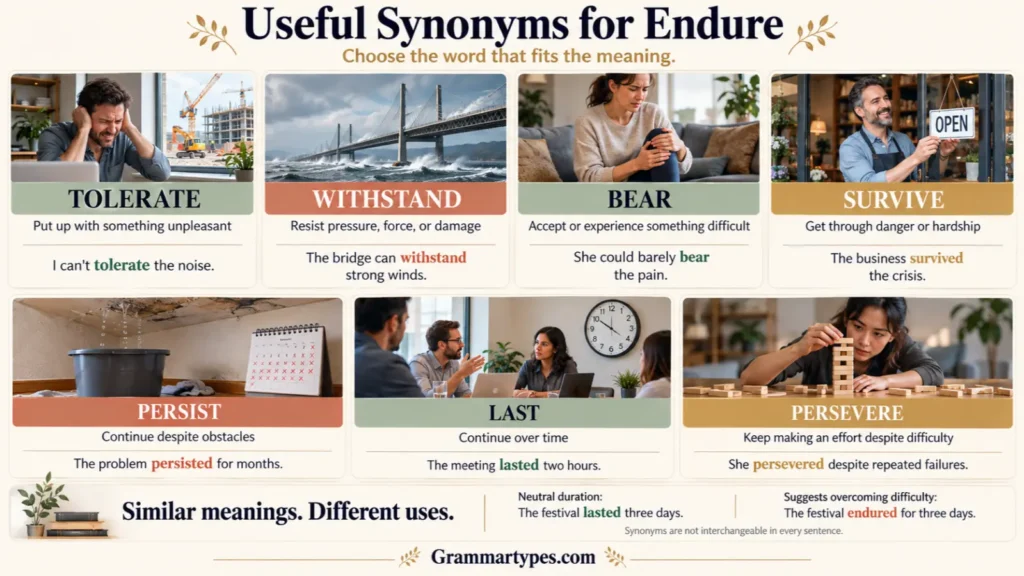
Useful Synonyms for Endure
The best synonym depends on which meaning of endure you intend.
| Synonym | Best used when… | Example |
|---|---|---|
| tolerate | You mean put up with something unpleasant | I can’t tolerate the noise. |
| withstand | Something resists pressure, force, or damage | The bridge can withstand strong winds. |
| bear | Someone manages to accept or experience something difficult | She could barely bear the pain. |
| survive | The emphasis is on getting through danger or hardship | The business survived the crisis. |
| persist | Something continues despite obstacles | The problem persisted for months. |
| last | You simply mean continue over time | The meeting lasted two hours. |
| persevere | Someone continues making an effort despite difficulty | She persevered despite repeated failures. |
These words overlap, but they are not interchangeable in every sentence.
For example, last works naturally with duration:
The festival lasted three days.
But replacing it with endure changes the tone:
The festival endured for three days.
That is grammatically possible, but it sounds more unusual because endure often suggests something continuing despite difficulty or opposition.
Easy Way to Remember the Spelling
If you are unsure whether to write indure vs endure, remember:
The standard word is ENDURE — with EN at the beginning.
Think of endure, endured, and enduring as one spelling family:
endure → endured → enduring → endurance
Do not let the pronunciation of the first syllable persuade you to change en- to in-.
Quick Practice Quiz
1. Which sentence is correct?
A. She had to indure several difficult months.
B. She had to endure several difficult months.
Answer: B.
Endure is the standard spelling.
2. Which sentence uses endure to mean “last”?
A. Their friendship endured for many years.
B. Their friendship tolerated for many years.
Answer: A.
3. Which word best emphasizes continuing to work toward a goal despite obstacles?
A. Persevere
B. Endure
Answer: A.
Persevere emphasizes continued effort, while endure emphasizes bearing or getting through difficulty.
4. Is endure always negative?
A. Yes.
B. No.
Answer: B.
It can describe hardship, but it can also mean that something continues or lasts over time.
Final Thoughts
When choosing between indure vs endure, use endure in modern standard English. It is the correct spelling for the verb meaning to bear something difficult, tolerate something unpleasant, withstand hardship, or continue to exist over time.
The confusion usually comes from pronunciation: endure can sound as though it begins with “in,” but its spelling begins with en-. Remember the related forms endured, enduring, and endurance to reinforce the spelling.
Also remember that endure does not always describe suffering. A person can endure hardship, but a friendship, tradition, or influence can also endure by continuing over time. When in doubt, choose endure, not indure.
FAQs
Indure is not the standard spelling you should use in modern English. Use endure when you mean to suffer through, tolerate, withstand, or continue to exist.
The main difference is spelling and standard usage: endure is the standard modern English word, while indure is not the normal contemporary spelling. In ordinary writing, choose endure.
Endure means to experience and bear something difficult, unpleasant, or painful. It can also mean to continue to exist or last over time.
Endure can be either negative or neutral/positive depending on context. It often describes suffering or hardship, but it can also describe something lasting for a long time or a person successfully getting through difficulty.
Endure emphasizes bearing or surviving difficulty, while persevere emphasizes continuing to make an effort despite obstacles. Someone can endure hardship while persevering toward a goal.
Perdure emphasizes continuing or lasting, while endure can mean either lasting or bearing something difficult. Perdure is considerably less common in ordinary modern English, so endure is generally the more natural choice.
Yes. Endure is well suited to formal, academic, professional, and serious writing when its meaning fits the context. Cambridge labels the learner’s-dictionary entry as formal.
The main forms are endure, endures, endured, and enduring. The related noun is endurance.
Explore More Grammar Guides:
Vender vs Vendor: Which Spelling Is Correct? Meaning & Examples
Greatly or Grately: Which Spelling Is Correct? (2026 Guides)
Fulness or Fullness: Which Is Correct? Meaning & Examples
Puddy or Putty: Which Spelling Is Correct?
