
“Looking forward to working with you” is a polite and professional way to show that you are positive about a future collaboration. You can use it when starting a new job, joining a project, working with a client, meeting a new colleague, or beginning a business partnership.
Although the phrase is natural and correct, using the same wording repeatedly can make professional emails sound routine. Choosing another expression can help you match your message to the situation and show a little more enthusiasm, appreciation, or confidence.
In this guide, you’ll find 30 other ways to say “I look forward to working with you,” along with examples, tones, and situations where each alternative works best.
Is “Looking Forward to Working With You” Correct?
Yes. “Looking forward to working with you” is a natural and commonly used expression in professional communication. It shows that you feel positive about a future collaboration, project, meeting, or working relationship.
For a complete sentence, you can write:
I look forward to working with you.
You can also say:
I am looking forward to working with you.
In email closings and shorter professional messages, the shortened form is also common:
Looking forward to working with you.
The important grammar point is that look forward to is followed by a noun, pronoun, or -ing form, so working is correct.
Correct:
I look forward to working with you.
Incorrect:
I look forward to work with you.
So, if you are wondering, “Is it okay to say ‘looking forward to working with you’?”, the answer is yes. The complete sentence is often preferable in more formal writing, while the shorter version works naturally in many professional emails and messages.
What Does “Looking Forward to Working With You” Mean?
The phrase “looking forward to working with you” means that you are positive about a future opportunity to work, collaborate, or communicate with someone.
Depending on the context, it can express:
- enthusiasm about a new project
- appreciation for a professional opportunity
- willingness to collaborate
- positive expectations about working together
- excitement about joining a team or starting a partnership
For example:
I’m looking forward to working with you on the new project.
This tells the other person that you are positive about the upcoming collaboration.
Is “Looking Forward to Working With You” the Same as “I Look Forward to Working With You”?
The meaning is essentially the same, but the sentence structure is different.
“I look forward to working with you” is a complete sentence with a subject and verb.
“Looking forward to working with you” is a shortened form commonly used in emails and messages where the subject “I” is understood.
For formal correspondence, the complete version can sound more polished:
I look forward to working with you.
For a friendly professional email, the shorter version can work naturally:
Looking forward to working with you.
When Should You Use This Phrase?
You can use “I look forward to working with you” when:
- You begin a new professional relationship.
- You accept a new project or assignment.
- You start working with a client.
- You join a new team.
- You finish a business email.
- You want to show enthusiasm about future collaboration.
- You respond to someone who has invited you to work together.
The phrase works in both formal and friendly professional settings. However, you may want a different expression when you want to sound more enthusiastic, personal, formal, or specific.
How Do You Say “Looking Forward to Working With You”?
There are several natural ways to say “looking forward to working with you,” depending on how formal, friendly, or enthusiastic you want to sound.
Professional
I look forward to working with you.
Warm and professional
I’m looking forward to working with you.
Friendly
I’m glad we’ll be working together.
Enthusiastic
I’m excited to work with you.
Collaborative
I’m looking forward to collaborating with you.
More formal
I look forward to a productive collaboration.
Appreciative
I’m pleased to have the opportunity to work with you.
The best choice depends on your relationship with the person and the type of message you are writing.

30 Other Ways to Say “Looking forward to working with you”
If you are looking for another way to say “looking forward to working with you,” you can choose an expression based on the tone of your message. Some alternatives sound more formal, while others are warmer, friendlier, or more enthusiastic.
These phrases can also work in professional emails, workplace messages, client communication, introductions, and project updates.
1. I’m excited to collaborate with you.
This alternative sounds enthusiastic while remaining professional. It works particularly well when you are starting a creative or business project.
Example:
I’m excited to collaborate with you on the website redesign.
Best for: New projects, creative work, and professional partnerships
Tone: Enthusiastic and professional
2. I look forward to our collaboration.
This version sounds polished and slightly more formal than the original phrase. It focuses on the collaboration itself rather than the act of working together.
Example:
Thank you for the opportunity. I look forward to our collaboration.
Best for: Business emails, clients, and formal communication
Tone: Professional and respectful
3. I’m glad we’ll be working together.
Use this when you want your message to sound warm and approachable.
Example:
I’m glad we’ll be working together on the upcoming training program.
Best for: New colleagues, team projects, and workplace communication
Tone: Friendly and positive
4. I’m eager to get started.
This phrase emphasizes your readiness to begin rather than simply your anticipation of working with someone.
Example:
The project details look great, and I’m eager to get started.
Best for: Project kickoffs and new assignments
Tone: Motivated and confident
5. I’m pleased to have the opportunity to work with you.
This is a more formal alternative that expresses appreciation for the opportunity.
Example:
I’m pleased to have the opportunity to work with you on this important initiative.
Best for: Clients, senior professionals, and formal emails
Tone: Formal and appreciative
6. I’m excited about our work together.
This expression sounds natural without repeating the exact wording of the original phrase.
Example:
I’m excited about our work together and the ideas we can bring to the project.
Best for: Team projects and collaborative work
Tone: Warm and enthusiastic
7. I’m looking forward to collaborating with you.
This is one of the closest alternatives to the original phrase. It replaces “working with you” with “collaborating with you.”
Example:
I’m looking forward to collaborating with you on the upcoming campaign.
Best for: Business emails and project communication
Tone: Professional and positive
8. I’m happy we’ll be working together.
This version feels warm and straightforward.
Example:
I’m happy we’ll be working together to improve the customer experience.
Best for: Friendly workplace communication
Tone: Warm and approachable
9. I’m eager to begin our collaboration.
This phrase combines enthusiasm with a clear focus on starting the partnership.
Example:
I’m eager to begin our collaboration and move the project forward.
Best for: New partnerships and business projects
Tone: Professional and enthusiastic
10. I’m pleased to be working with you.
This expression can work when the collaboration has already started or is about to begin.
Example:
I’m pleased to be working with you on this year’s marketing strategy.
Best for: Professional introductions and ongoing projects
Tone: Polite and formal
11. I’m excited to partner with you on this project.
This option highlights the idea of partnership and shared responsibility.
Example:
I’m excited to partner with you on this project and develop a strong solution for our clients.
Best for: Business partnerships and major projects
Tone: Confident and enthusiastic
12. I look forward to building a strong working relationship.
This is useful when you want to emphasize a long-term professional relationship.
Example:
Thank you for the introduction. I look forward to building a strong working relationship with you.
Best for: New clients, colleagues, and business relationships
Tone: Professional and thoughtful
13. I’m glad we have the opportunity to work together.
This version expresses appreciation while keeping the message natural.
Example:
I’m glad we have the opportunity to work together on such an exciting project.
Best for: First-time collaborations
Tone: Warm and appreciative
14. I’m excited about what we can accomplish together.
Instead of focusing only on the collaboration, this phrase highlights future results.
Example:
I’m excited about what we can accomplish together during the next phase of the project.
Best for: Team projects, leadership, and business communication
Tone: Optimistic and motivating
15. I’m looking forward to working closely with you.
This alternative suggests active communication and cooperation.
Example:
I’m looking forward to working closely with you as we finalize the new strategy.
Best for: Projects that require teamwork
Tone: Cooperative and professional
16. I’m pleased to collaborate with you.
This is concise, polished, and suitable for formal professional communication.
Example:
I’m pleased to collaborate with you on this research project.
Best for: Formal emails, academic work, and business communication
Tone: Formal and respectful
17. I’m happy to work alongside you.
This sounds more conversational while remaining appropriate for the workplace.
Example:
I’m happy to work alongside you as we prepare for the upcoming launch.
Best for: Colleagues and team projects
Tone: Friendly and cooperative
18. I’m eager to contribute to the project with you.
This option focuses on your willingness to take an active role.
Example:
I’m eager to contribute to the project with you and help us meet our goals.
Best for: Team projects and professional assignments
Tone: Motivated and collaborative
19. I look forward to a productive collaboration.
This phrase works particularly well in formal business communication.
Example:
Thank you for your time today. I look forward to a productive collaboration.
Best for: Clients, vendors, partnerships, and formal emails
Tone: Formal and professional
20. I’m excited to get started on this project.
Use this when the project has already been discussed and you are ready to begin.
Example:
Everything is in place, and I’m excited to get started on this project.
Best for: Project launches and team communication
Tone: Energetic and confident
21. I’m glad to be part of the team.
This works best when you are joining an existing team rather than beginning a one-on-one partnership.
Example:
Thank you for the warm welcome. I’m glad to be part of the team.
Best for: New jobs, departments, and team introductions
Tone: Friendly and appreciative
22. I’m looking forward to our work together.
This is a simple variation that keeps the positive meaning of the original.
Example:
Thanks for sharing the project details. I’m looking forward to our work together.
Best for: Professional emails and new projects
Tone: Neutral and professional
23. I’m excited to partner with your team.
This alternative is especially useful when you are working with an organization or department rather than one individual.
Example:
I’m excited to partner with your team on the upcoming product launch.
Best for: Client relationships and business partnerships
Tone: Professional and enthusiastic
24. I’m pleased we’ll be working together.
This is a polished alternative that sounds professional without being overly formal.
Example:
I’m pleased we’ll be working together on the new content strategy.
Best for: Business emails and professional introductions
Tone: Polite and positive
25. I’m eager to see what we can achieve together.
This phrase focuses on future results and shared goals.
Example:
I’m eager to see what we can achieve together with this new campaign.
Best for: Goal-oriented projects and team communication
Tone: Motivated and optimistic
26. I’m happy to have the chance to work with you.
This expression shows appreciation for the opportunity.
Example:
I’m happy to have the chance to work with you on this important assignment.
Best for: New professional relationships
Tone: Warm and appreciative
27. looking forward to working closely with you.
This phrase emphasizes cooperation and ongoing communication.
Example:
I look forward to working closely with you throughout the implementation process.
Best for: Long-term projects and close teamwork
Tone: Professional and collaborative
28. I’m excited to begin this collaboration.
This is a direct and energetic way to signal that you are ready to start.
Example:
The agreement is finalized, and I’m excited to begin this collaboration.
Best for: Business partnerships and project launches
Tone: Enthusiastic and professional
29. I’m grateful for the opportunity to work with you.
This alternative adds appreciation and sounds more personal than the standard phrase.
Example:
I’m grateful for the opportunity to work with you and your team.
Best for: Clients, mentors, important projects, and professional introductions
Tone: Appreciative and respectful
30. looking forward to a successful partnership.
This phrase works especially well when the relationship involves a longer-term business arrangement.
Example:
Thank you for choosing our services. I look forward to a successful partnership.
Best for: Clients, vendors, and business relationships
Tone: Formal and confident
Which Alternative Should You Use?
The best alternative depends on the relationship, context, and tone you want to create.
| Alternative | Tone | Best Use |
|---|---|---|
| I’m excited to collaborate with you. | Enthusiastic | New projects |
| I look forward to our collaboration. | Formal | Business emails |
| I’m glad we’ll be working together. | Friendly | New colleagues |
| I’m eager to get started. | Motivated | Project kickoffs |
| I’m pleased to have the opportunity to work with you. | Formal | Clients and senior professionals |
| I’m excited about what we can accomplish together. | Optimistic | Team projects |
| I look forward to a productive collaboration. | Professional | Business partnerships |
| I’m happy to work alongside you. | Friendly | Coworkers |
| I’m grateful for the opportunity to work with you. | Appreciative | Important professional relationships |
| I look forward to a successful partnership. | Formal | Long-term business relationships |
“Looking Forward to Working With You” Email Examples
You can use “looking forward to working with you” in several types of professional emails. The wording can change depending on the situation.
1. New Client
Thank you for choosing our services. I’m looking forward to working with you and helping you achieve your goals.
2. New Colleague
Thank you for the warm welcome. I’m looking forward to working with you and the rest of the team.
3. New Project
Thank you for sharing the project details. I look forward to working with you on the next phase.
4. Business Partnership
We appreciate the opportunity to work together and look forward to a successful partnership.
5. After a Meeting
It was great speaking with you today. I look forward to working with you on the project.
6. Starting a New Job
Thank you for the opportunity. I’m excited to join the team and look forward to working with you.
7. Formal Email
Thank you for your time and consideration. I look forward to working with you.
These examples show how the phrase can be adapted to different professional situations without sounding repetitive.
Is It “Looking Forward to Work” or “Looking Forward to Working”?
The correct expression is “looking forward to working with you.”
Correct: I look forward to working with you.
Incorrect: I look forward to work with you.
The reason is that to in “look forward to” functions as a preposition. It is followed by a noun or an -ing form, such as “working.”
This same pattern appears in other expressions:
I look forward to meeting you.
We look forward to hearing from you.
She looks forward to starting the project.
Is “Looking forward to working with you” Professional?
Yes. “looking forward to working with you” is a professional and widely appropriate expression. You can use it in business emails, client communication, workplace messages, project discussions, and professional introductions.
For example:
Thank you for confirming the details. I look forward to working with you on the project.
If you use the phrase frequently, however, choosing a more specific alternative can make your writing feel less repetitive. For example, “I’m excited to collaborate with you” highlights enthusiasm, while “I look forward to a productive collaboration” creates a more formal tone.
“Looking Forward to Working With You” vs. “I Look Forward to Working With You”
Both expressions communicate positive anticipation about future collaboration, but they are used slightly differently.
| Expression | Use | Example |
|---|---|---|
| I look forward to working with you. | Complete, professional sentence | I look forward to working with you on the project. |
| I am looking forward to working with you. | Complete sentence, slightly warmer | I am looking forward to working with you next week. |
| Looking forward to working with you. | Shortened email or message form | Thanks for the update. Looking forward to working with you. |
| I look forward to work with you. | Incorrect | Use “working,” not “work.” |
The key grammar rule is simple: look forward to + noun or -ing form.
That is why we say:
I look forward to working with you.
Not:
I look forward to work with you.
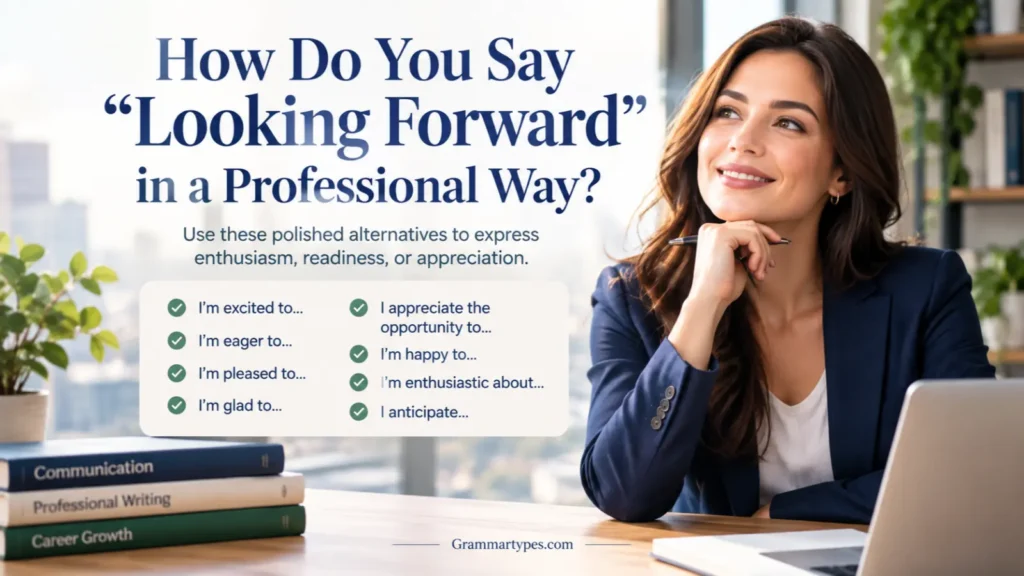
How Do You Say “Looking Forward” in a Professional Way?
You can replace “looking forward” with expressions such as:
- I’m excited to…
- I’m eager to…
- I’m pleased to…
- I’m glad to…
- I appreciate the opportunity to…
- I’m happy to…
- I’m enthusiastic about…
- I anticipate…
The best choice depends on what you want to communicate. “I’m eager to begin” emphasizes readiness, while “I’m pleased to have the opportunity” emphasizes appreciation.
What Is Another Way to Say “Working With You”?
Instead of “working with you,” you can use:
- collaborating with you
- partnering with you
- working alongside you
- working closely with you
- joining you on the project
- contributing to the project with you
- working together
- building a partnership with you
For example:
I’m excited to collaborate with you on this project.
This sounds natural in professional communication while avoiding repetition.
How to Reply When Someone Says “Looking forward to working with you”
You can respond in several natural ways depending on the situation.
Professional:
Thank you. I look forward to working with you as well.
Warm and friendly:
Thank you! I’m looking forward to working together too.
Enthusiastic:
Thanks! I’m excited to get started and see what we can accomplish together.
Formal:
Thank you for the opportunity. I look forward to a productive collaboration.
Short and simple:
Likewise. I’m looking forward to working together.
What Is a Good Reply to “Looking Forward to Working With You”?
A good reply can be short and natural. You do not need to repeat the exact same phrase.
For example:
Thank you! I’m looking forward to working with you too.
Or:
Likewise. I’m excited to get started.
For a more formal response:
Thank you. I look forward to working with you as well.
A friendly response:
Thanks! I’m looking forward to working together too.
For a client or business relationship:
Thank you for the opportunity. I look forward to working together and achieving great results.
Common Variations of “Looking Forward to Working With You”
The phrase can be adapted depending on the situation.
Looking forward to working with you soon
Use “looking forward to working with you soon” when you expect the collaboration to begin in the near future.
I’m looking forward to working with you soon.
Looking forward to working with you again
Use “looking forward to working with you again” when you have worked with the person before.
It was great working with you last year. I’m looking forward to working with you again.
Looking forward to working with you in the future
This version is useful when the timing of the future collaboration is not specific.
I hope we have another opportunity to work together. I’m looking forward to working with you in the future.
Looking forward to working with you all
When speaking to a group, you can say:
I’m looking forward to working with you all.
You can also use:
We’re looking forward to working with everyone on the project.
Common Mistakes to Avoid
When using alternatives to “looking forward to working with you,” avoid phrases that sound unnatural or overly exaggerated.
1. Using “to work” after “look forward to”
Do not write:
I look forward to work with you.
Write:
I look forward to working with you.
The verb after look forward to should use the -ing form.
2. Using overly enthusiastic wording in formal situations
A phrase such as “I can’t wait to work with you!” may sound friendly, but it can be too casual for some business situations. In a formal email, “I look forward to our collaboration” may fit better.
3. Choosing an alternative that does not match the situation
For example, “I’m glad to be part of the team” makes sense when you are joining a team, but it does not always fit a client partnership.
Choose the phrase based on the relationship and purpose of your message.
4. Repeating the same expression in every email
Even a professional phrase can become repetitive when you use it constantly. Small changes can make your communication sound more natural while preserving a professional tone.
Final Thoughts
“looking forward to working with you” is a correct, polite, and professional expression for showing positive anticipation about future collaboration. However, you do not have to use the same phrase every time.
Depending on your situation, you can say “I’m excited to collaborate with you,” “I look forward to our collaboration,” “I’m eager to get started,” or “I’m pleased to have the opportunity to work with you.”
The key is to choose an expression that matches your relationship, purpose, and desired tone. A well-chosen alternative can make your email or message sound more natural, specific, and genuine while keeping the professional meaning clear.
FAQs
Yes. “I look forward to working with you” is grammatically correct and appropriate for professional communication. The construction look forward to + -ing verb is standard English.
You can say “I look forward to our collaboration,” “I look forward to a productive collaboration,” or “I’m pleased to have the opportunity to work with you.” The most suitable choice depends on the level of formality.
Yes. “I’m excited to work with you” is natural and professional in many workplace settings. It communicates more enthusiasm than the standard “I look forward to working with you.”
You can say “I’m glad we’ll be working together,” “I’m happy we’ll be working together,” or “I’m excited to get started.” These options sound warm without being overly formal.
A simple response is:
Thank you. I look forward to working with you as well.
You can also make your reply warmer by saying:
Thank you! I’m excited to work together and get started.
It is primarily professional and works well in formal and semi-formal communication. You can use it with clients, coworkers, managers, business partners, and new professional contacts.
Explore More Grammar Guides:
Professional Writing Guide: Email Phrases, Synonyms & Better Word Choices
Have a Great Vacation: Meaning, Correct Usage & Better Ways to Say It
