
A professional writing guide can help you communicate clearly, confidently, and appropriately in emails, workplace messages, and other formal situations. Writing professionally is not only about avoiding grammar mistakes. The words you choose can change how clear, respectful, confident, and helpful your message sounds. A phrase that works in casual conversation may feel too vague, too direct, or too informal in a workplace email.
That is why professional writers often need more than basic grammar rules. They need reliable email phrases, useful synonyms, polite alternatives, and a clear understanding of tone and context. This guide brings those skills together so you can write emails and professional messages with greater confidence.
Whether you need to write a formal email, improve a sentence, find a better synonym, or choose a more polished workplace phrase, the examples below give you practical language you can adapt.
What Is professional writing guide?
professional writing guide is clear, purposeful communication used in workplaces, academic settings, business communication, and other formal or semi-formal situations. It includes emails, reports, proposals, applications, letters, notices, presentations, and workplace messages.
Good professional writing guide usually has four qualities:
- Clarity: The reader can understand your meaning easily.
- Conciseness: You avoid unnecessary words and repetition.
- Courtesy: Your wording respects the reader.
- Purpose: The message makes its goal or requested action clear.
professional writing guide does not always mean extremely formal. A message to a close colleague can be friendly and conversational, while an email to a new client or senior executive may require a more formal tone.
The best approach is to match your language to the audience, relationship, purpose, and situation.
How to Write an Email Professionally
A professional writing guide email usually works best when it follows a simple structure: a specific subject line, appropriate greeting, clear opening, focused body, action or next step, and professional closing. Current guidance from Grammarly and Adobe emphasizes clarity, concise organization, appropriate tone, and proofreading.
1. Write a clear subject line
Your subject line should tell the recipient what the email concerns.
Weak:
Question
Better:
Question About Friday’s Project Meeting
Better:
Request for Approval: Updated Project Proposal
A specific subject makes the purpose easier to understand before the recipient opens the message.
2. Choose an appropriate greeting
Your greeting should reflect your relationship with the recipient.
Formal:
- Dear Ms. Johnson,
- Dear Professor Lee,
- Dear Hiring Manager,
Professional but friendly:
- Hello Sarah,
- Hi Michael,
- Hello Team,
Avoid choosing a greeting simply because it sounds formal. The right greeting depends on context and the recipient’s expectations.
3. State your purpose early
Do not make the reader search through several paragraphs to discover why you are writing.
Instead of:
I hope you are doing well. I wanted to reach out because there have been several developments regarding the project…
Try:
I am writing to request your feedback on the revised project proposal.
The second version immediately tells the reader what the email is about.
4. Make the next step clear
If you need something from the recipient, say exactly what you need.
Example:
Could you please review the attached document and share your feedback by Thursday?
A clear request is easier to answer than a vague statement such as:
Please let me know what you think when you get a chance.
5. Close professionally
Common professional closings include:
- Best regards,
- Kind regards,
- Sincerely,
- Thank you,
- Best,
Choose the closing according to the relationship and tone of the email.

Professional Email Phrases You Can Use
Having a collection of useful phrases can makeprofessional writing guide faster without making your emails sound repetitive.
Starting an email
Instead of always writing “I am writing to…”, consider:
- I am reaching out regarding…
- I am contacting you about…
- I would like to ask about…
- I am following up on…
- I wanted to provide an update regarding…
- I am writing to request…
For a warm professional opening, you might use:
I hope everything is well with you.
This phrase is polite and common, although you do not need to include a personal opening in every business email.
Thanking someone
Useful alternatives include:
- Thank you for reaching out to me.
- Thank you for your message.
- Thank you for the update.
- Thanks for the reminder.
- I appreciate your help.
- I appreciate your time and consideration.
“Thank you for reaching out to me” works particularly well when responding to an inquiry or initial contact.
Showing understanding
If someone has explained a problem or concern, you can write:
- I understand your concern.
- Thank you for bringing this to my attention.
- I appreciate you explaining the situation.
- I understand the situation.
- I have taken note of your comments.
“Well noted” is understandable, but it can sound abrupt or formulaic in some professional contexts. Depending on the situation, “Thank you for pointing this out” or “I have taken note of this” may sound more natural.
Asking for information
Try these phrases:
- Could you please provide…?
- Would you mind sharing…?
- Could you clarify…?
- I would appreciate it if you could…
- Please let me know whether…
- May I ask for further information about…?
These expressions help you make requests without sounding unnecessarily demanding.
Following up
When you need to check on an earlier message, use:
- I am following up on my previous email.
- I wanted to check whether you had a chance to review…
- I am writing to follow up regarding…
- Have you had an opportunity to review…?
- I would appreciate an update when convenient.
Better Alternatives to Common Professional Phrases
professional writing guide becomes stronger when you replace repetitive or vague wording with precise alternatives.
| Common phrase | Useful alternative | Best use |
|---|---|---|
| I want to ask | I would like to ask | Polite requests |
| Tell me | Please let me know | Professional requests |
| I think | I believe / I suggest | Opinions or recommendations |
| Get back to me | Please respond when convenient | Formal communication |
| Thanks for the heads-up | Thank you for the update | Workplace communication |
| Sorry for the late reply | Thank you for your patience | Delayed responses |
| I don’t know | I am not certain / I will confirm | Professional uncertainty |
| You need to | Please / You may need to | Softer instructions |
| But | However | Formal writing |
| Also | Additionally / Furthermore | Formal transitions |
These alternatives should not be used mechanically. For example, “furthermore” can be useful when adding a related point in formal writing, but “also” is often more natural in ordinary workplace emails.
Useful Synonyms for Professional Writing
A good synonym is not simply a different word with the same dictionary definition. Tone, context, grammatical function, and strength can change from one word to another.
Fast learner synonyms
Depending on the context, alternatives to fast learner include:
- quick learner
- learns quickly
- adaptable learner
- highly adaptable
- picks up new skills quickly
- quick to understand new concepts
For a résumé or professional profile, this sentence sounds more specific:
I quickly learn new software and adapt to changing project requirements.
That is often stronger than simply writing:
I am a fast learner.
Synonyms for “furthermore”
Useful alternatives include:
- additionally
- moreover
- in addition
- also
- besides
- what is more
Furthermore and moreover tend to sound more formal. Also is simpler and often more natural in everyday professional writing.
Another way to say “even though”
Depending on sentence structure, you can use:
- although
- though
- despite the fact that
- while
- notwithstanding the fact that
For example:
Even though the deadline was short, the team completed the project.
can become:
Although the deadline was short, the team completed the project.
Do not treat despite as a direct replacement for even though in every sentence. Their grammatical structures differ.
How to Use “Looking Forward to Working With You”
“I am looking forward to working with you” is a polite and positive way to express enthusiasm about future cooperation.
Example:
Thank you for the introduction. I am looking forward to working with you.
A more formal variation is:
I look forward to working with you.
The phrase is particularly appropriate after an introduction, agreement, job-related communication, or the beginning of a professional relationship.
Avoid changing the grammar to:
I look forward to work with you. ❌
After look forward to, the word to functions as a preposition, so a gerund is normally used:
I look forward to working with you. ✅
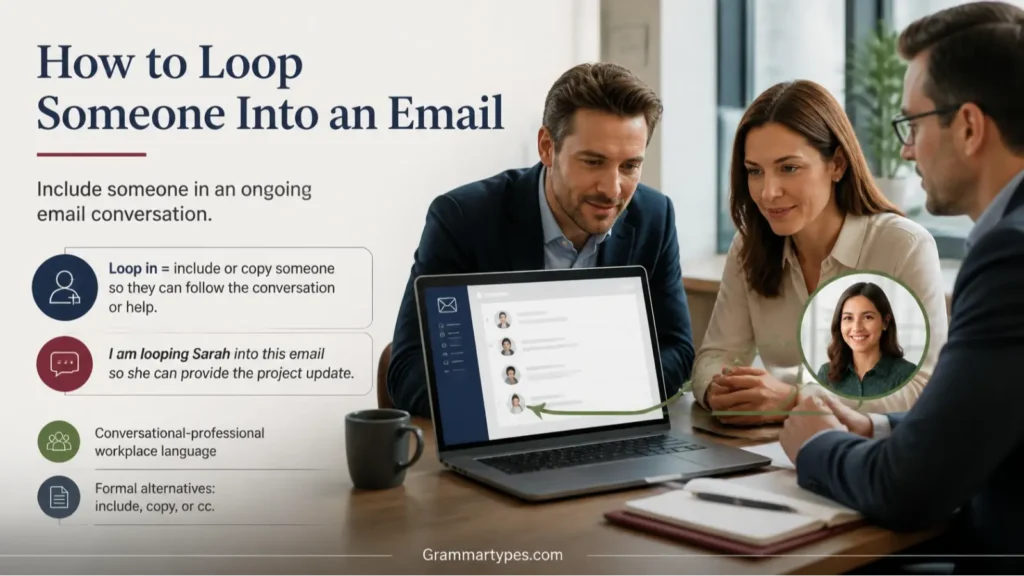
How to Loop Someone Into an Email
To loop someone into an email means to include that person in an ongoing email conversation so they have the relevant information or can participate.
Natural examples include:
I am looping Sarah into this email so she can provide the project update.
Or:
I have copied James on this email so he can help answer your question.
“Loop in” is common workplace language and is generally conversational-professional rather than highly formal.
For more formal communication, include, copy, or cc may be clearer.
Professional Alternatives for Introductions
The phrase “by way of introduction” means that you are introducing yourself or providing introductory information.
Example:
By way of introduction, I am the new project coordinator for the marketing team.
However, you can often make the sentence simpler:
I am the new project coordinator for the marketing team.
Simple wording is usually preferable when the extra phrase does not add meaning.
Ways to Improve Clarity in Professional Writing
Clear communication is more valuable than complicated vocabulary.
Replace vague wording with specific wording
Vague:
We need to deal with this soon.
Clear:
Please send the revised document by 3 p.m. Friday.
Use active voice when it improves clarity
Less direct:
The report was reviewed by the finance team.
More direct:
The finance team reviewed the report.
Passive voice is not grammatically wrong, and it can be useful when the action matters more than the person performing it. The goal is clarity, not eliminating passive voice completely.
Keep one main purpose per email
If an email contains five unrelated requests, the recipient may miss one of them. When possible, group related information and make each requested action easy to identify.
Common professional writing guide Mistakes
Mistake 1: Making every sentence overly formal
Too stiff:
I hereby wish to inform you that I am in receipt of your correspondence.
Natural:
Thank you for your email. I received your message.
professional writing guide should sound polished, not unnecessarily complicated.
Mistake 2: Using “hope you understand” when explaining a refusal
“Hope you understand” is not grammatically wrong, but it can sometimes sound defensive or dismissive.
Instead, explain the reason clearly:
Unfortunately, we cannot approve the request because the deadline has passed. Thank you for your understanding.
Mistake 3: Using “in conclusion” unnecessarily
“In conclusion” is appropriate when formally summarizing an argument, particularly in essays or reports. In a short email, however, it may sound unnecessarily formal.
Instead of:
In conclusion, we recommend proceeding with Option B.
you might write:
Overall, we recommend proceeding with Option B.
Mistake 4: Using “the text states” repeatedly
If you are writing an academic response, alternatives include:
- the text explains
- the author argues
- the passage indicates
- the article suggests
- the writer emphasizes
- the source describes
Choose the verb according to what the text actually does. Do not use argues when the author merely provides information.
Formal vs. Informal Professional writing guide
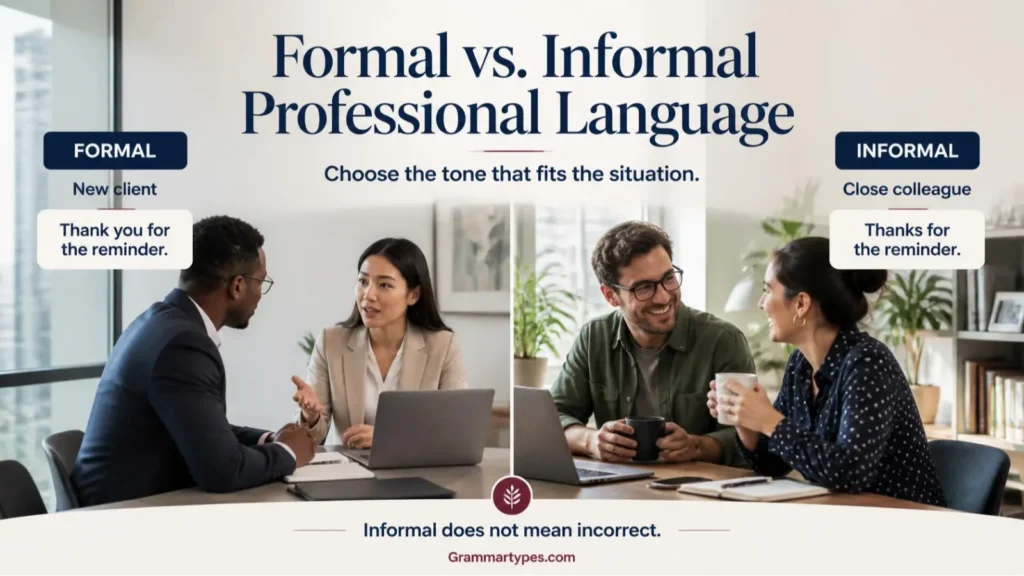
Professional communication does not have to be completely formal.
| Situation | Suitable tone |
|---|---|
| Email to a new client | Formal and courteous |
| Application email | Formal and focused |
| Message to a close colleague | Professional and friendly |
| Internal team update | Clear and conversational |
| Academic request | Respectful and formal |
| Quick workplace chat | Brief and conversational |
For example, “Thanks for the reminder” can work perfectly well with a colleague. In a highly formal letter, “Thank you for the reminder” may be a better choice.
The important distinction is between informal and incorrect. Informal language is not automatically grammatically wrong.
Professional Email Address Examples
professional writing guide begins before the email body. Your email address also contributes to how your communication is perceived.
Common professional formats include:
- firstname.lastname@company.com
- firstname@company.com
- firstinitiallastname@company.com
- firstnameinitial@company.com
- department@company.com
For example:
or:
For businesses, role-based addresses such as sales@, support@, or billing@ can help route messages to the appropriate function. A professional address generally uses a recognizable name or role and a domain associated with the organization.
Avoid addresses built around nicknames, jokes, excessive numbers, or unrelated personal interests when you are communicating professionally.
How to Make professional writing guide More Natural
Before sending an important email, ask yourself five questions:
- Is the purpose obvious?
- Can the recipient quickly see what action is needed?
- Does the tone fit the relationship?
- Have I removed unnecessary words?
- Did I proofread names, dates, attachments, and grammar?
Reading the email once from the recipient’s perspective can reveal problems that a quick proofreading pass misses.
For example, this:
I just wanted to reach out and see if perhaps you might be able to send the information whenever you get a chance.
can become:
Could you please send the information by Thursday?
The second version is shorter, clearer, and easier to act on.
Quick Reference: Professional Phrases
Here are useful phrases to keep available when writing emails:
Opening
- I am reaching out regarding…
- I am following up on…
- I am contacting you about…
Request
- Could you please…?
- Would you mind…?
- I would appreciate it if you could…
Clarification
- Could you clarify…?
- Could you provide further details about…?
Agreement
- That sounds good to me.
- I agree with your recommendation.
- I am happy to proceed.
Disagreement
- I understand your perspective; however…
- I see the situation differently because…
- I would suggest an alternative approach.
Closing
- Thank you for your time.
- I appreciate your assistance.
- I look forward to hearing from you.
- I look forward to working with you.
FAQs
Start with a clear subject line, use an appropriate greeting, state your purpose early, keep the message focused, make your requested action clear, and finish with a suitable closing. Proofread the email before sending it.
A simple formal email can follow this structure:
Subject: Request for Meeting
Dear Ms. Taylor,
I am writing to request a brief meeting to discuss the updated project timeline. Could you please let me know whether you are available Thursday afternoon?
Thank you for your time.
Kind regards,
Alex
Effective professional email writing combines clarity, appropriate tone, concise organization, and a clear purpose. The recipient should understand both the message and any required action without unnecessary effort.
“Well noted” is understandable and appears in professional communication, but it can sound terse or formulaic. Depending on the context, “Thank you, I have taken note of this” or “Thank you for pointing this out” may sound more natural.
You can say:
Thank you for the reminder.
I appreciate the reminder.
Thanks for following up.
Thank you for bringing this to my attention.
Choose the version that matches your relationship with the recipient.
You can write:
Have a wonderful vacation.
I hope you have a relaxing vacation.
Enjoy your time off.
Wishing you a pleasant vacation.
For a colleague or client, “I hope you have a relaxi
Depending on the context, you can use:
Overall,
To summarize,
In summary,
Ultimately,
To conclude,
Final Thought
professional writing guide is most effective when it is clear, purposeful, courteous, and appropriate for its audience. You do not need complicated vocabulary to sound professional. A precise request, natural sentence structure, and well-chosen email phrase can communicate more effectively than overly formal language.
This Professional Writing, Email Phrases & Synonyms Guide provides practical alternatives for common workplace situations, from opening an email and making requests to expressing appreciation, following up, and closing a message. It also shows why synonyms should be selected according to context rather than treated as interchangeable words.
The key takeaway is simple: write for the reader. Choose language that makes your meaning easy to understand, matches the situation, and gives the recipient a clear next step.
[authorbox]
