
Have you ever typed a sentence about sore leg muscles or baby cows and stopped because you were unsure whether to write calfs or calves? English spelling can be confusing, especially when a familiar word does not form its plural in the usual way. Adding an s seems logical, but that approach does not work for every noun.
The word calf is a good example. It can refer to a young animal or the fleshy area at the back of your lower leg. Although these meanings are different, their standard plural spelling is the same.
The correct form is calves. Understanding why the spelling changes will help you avoid this mistake and recognize similar plural patterns in English. Here are the rules, practical examples, common errors, and a few interesting details worth knowing.
Is It Calfs or Calves?
Calves is the standard plural of calf. Use it when referring to multiple young animals or the backs of your lower legs. The spelling calfs is not the usual plural in everyday English.
Consider these examples:
- Correct: The farmer raised six calves.
- Correct: My calves feel tired after running.
- Incorrect in standard usage: The farmer raised six calfs.
- Incorrect in standard usage: My calfs feel tired after running.
The same rule applies regardless of whether you are writing about farming, fitness, anatomy, or wildlife.
| Word | Correct form | Example |
|---|---|---|
| One young animal | Calf | The calf followed its mother. |
| Multiple young animals | Calves | The calves stayed near the barn. |
| One lower-leg area | Calf | My left calf hurts. |
| Both lower-leg areas | Calves | My calves feel sore. |
One small exception is worth knowing: some dictionaries recognize calfs in a specialized sense related to calfskin or calf hide. This is uncommon in ordinary writing. For standard sentences about animals or legs, choose calves. Merriam-Webster’s entry for calf provides further information about the word’s forms.
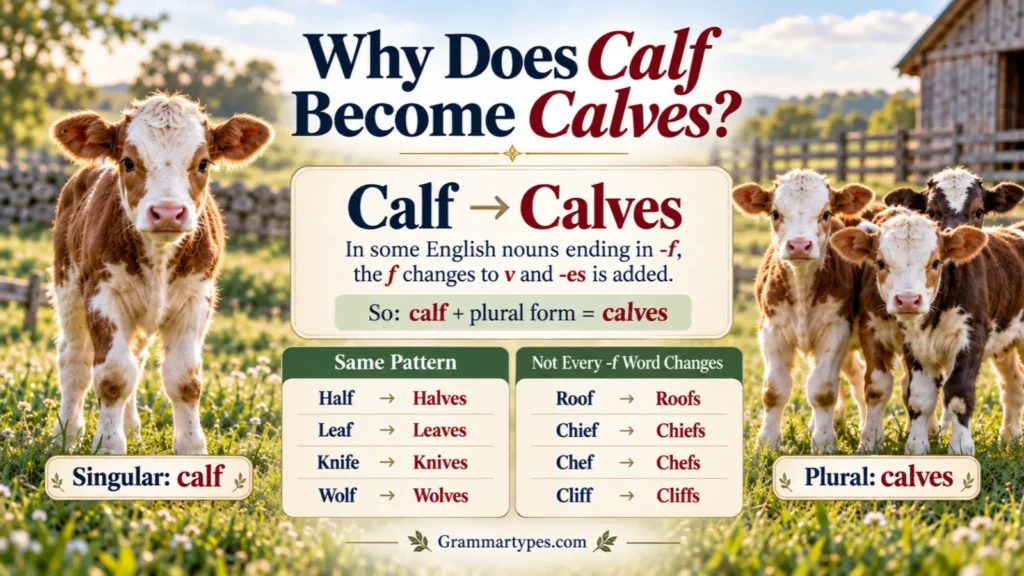
Why Does Calf Become Calves?
Most English nouns form their plurals by adding -s or -es. For instance, car becomes cars, and dish becomes dishes. However, some nouns ending in -f or -fe change their endings when they become plural.
The word calf follows this pattern:
Calf → Calves
The final f changes to v, and –es is added. This is an established plural form rather than a spelling change you can apply automatically to every noun.
Here are some other examples:
| Singular | Plural |
|---|---|
| Calf | Calves |
| Half | Halves |
| Leaf | Leaves |
| Knife | Knives |
| Wolf | Wolves |
| Life | Lives |
| Wife | Wives |
Notice that English also has words that retain their final f when pluralized.
For example:
- Roof → roofs
- Chief → chiefs
- Chef → chefs
- Cliff → cliffs
This means you should learn the plural form of each word instead of assuming that every noun ending in f changes to ves.
Is Calves an Irregular Plural?
Yes. In standard grammar descriptions, calves is considered an irregular plural because it changes the spelling of the singular noun rather than simply adding s.
Compare the following pairs:
- One book, two books.
- One dog, two dogs.
- One calf, two calves.
- One leaf, two leaves.
The first two follow a regular plural pattern. The last two use a different spelling pattern.
The most useful approach is to remember Calfs or Calves as a pair. Once you know the form, you can use it confidently in both animal-related and anatomical contexts.
Calves or Calfs for Leg Muscles?
When discussing the backs of your lower legs, calves is the correct plural. One lower leg has a calf, while the corresponding areas on both legs are called calves.
For example:
- My calves are sore after a long run.
- She stretches her calves before exercising.
- The cyclist has strong calves.
- His right calf feels tighter than his left one.
- Standing on tiptoe engages muscles in your calves.
These sentences show why context matters. When a person mentions a sore calf after exercise, the reference is to the body. When someone describes calves grazing in a field, the word refers to young animals.
What Is the Plural of Calf Muscle?
The standard expressions are calf muscle and calf muscles. You can also use calf or calves when referring to the lower-leg area.
| Expression | Correct? | Explanation |
|---|---|---|
| My calf hurts. | Yes | Refers to one lower-leg area. |
| My calves hurt. | Yes | Refers to both lower-leg areas. |
| I exercise my calf muscles. | Yes | Names the muscles in the lower-leg region. |
| I exercise my calves muscles. | No | Use calf muscles or simply calves. |
| My calfs hurt after training. | No, in standard usage | The normal plural is calves. |
Why does calf remain singular in calf muscles? Here, calf modifies the noun muscles, identifying the type or location of those muscles. English commonly uses a singular noun this way, as in shoe store, car door, and arm muscles.
The plural form calves is appropriate when the word stands on its own as a plural noun. When it modifies muscles, use calf muscles.
Is It Calves or Calfs for Baby Cows?
Calves is the standard plural for baby cows. A single young animal is a calf, and two or more are calves.
Here are some examples:
- The cow gave birth to a healthy calf.
- Three calves were resting beside their mother.
- The farmer feeds the calves every morning.
- The newborn calf stood on its own.
- The calves followed the herd across the pasture.
The term is not limited to cattle. The young of several other large mammals, including elephants and whales, are also called calves.
For example, a wildlife documentary might describe an elephant protecting her calf or a whale swimming with its calf. In the plural, you would write elephant calves or whale calves.
The important point is that the spelling remains calves across these common meanings. You do not need to choose a different plural according to the animal.
What Are Female Calves Called?
A young female bovine can be called a female calf. The word heifer is also used for a young female bovine that has not yet given birth to a calf. The precise terminology can vary with the animal’s age and stage of development.
For example:
- The farmer identified the newborn as a female calf.
- The young heifer stayed close to the other cattle.
A young male bovine may be called a bull calf. Regardless of sex, the ordinary plural of calf remains calves.
This distinction is useful if you are writing about cattle or learning agricultural vocabulary, but it does not change the spelling rule.
What Is the Difference Between Calf, Calves, and Calve?
Although these words look similar, they serve different grammatical purposes. Knowing the distinction helps you avoid mistakes beyond the original spelling question.
| Word | Part of speech | Meaning | Example |
|---|---|---|---|
| Calf | Noun, singular | One young animal or one lower-leg area | The calf followed its mother. |
| Calves | Noun, plural | Multiple young animals or lower-leg areas | The calves are resting. |
| Calve | Verb | To give birth to a calf; also used when ice breaks away from a glacier | The cow may calve tonight. |
The key distinction is that calf and calves are nouns, while calve is a verb.
Compare these sentences:
- Correct: The cow is expected to calve soon.
- Correct: The newborn calf stood beside its mother.
- Incorrect: The cow is expected to calf soon.
In the final example, the writer needs the verb calve, not the noun calf.
The verb can also describe a piece of ice breaking away from a glacier or iceberg. For example, “A large section of the glacier began to calve into the water.”
This is a separate use of the word, but it follows the same distinction between the noun and the verb.
Common Mistakes to Avoid
Even after learning the plural rule, it is easy to make mistakes when using related words. These examples show what to watch for.
1. Adding Only S to Calf
Incorrect: The farmer bought four calfs.
Correct: The farmer bought four calves.
Why: Calf has an established irregular plural. Change the ending to form calves.
2. Using Calves Muscles
Incorrect: These exercises strengthen your calves muscles.
Correct: These exercises strengthen your calf muscles.
Why: In this expression, calf modifies muscles and remains singular. You could also write, “These exercises strengthen your calves.”
3. Using Calf for Multiple Animals
Incorrect: Several calf were standing near the fence.
Correct: Several calves were standing near the fence.
Why: Words such as several, many, and three generally require a plural count noun when referring to more than one animal.
4. Confusing Calf and Calve
Incorrect: The cow will calf in the spring.
Correct: The cow will calve in the spring.
Why: Calve is the verb meaning to give birth to a calf. Calf is the noun.
5. Assuming Every F Changes to VES
Incorrect rule: All nouns ending in f become plural by changing f to ves.
Correct rule: Some nouns follow this pattern, but others simply add s or use a different plural form.
Why: English has several plural patterns. Learning common forms individually is more reliable than applying one rule to every word.
How Do You Pronounce Calf and Calves?
The pronunciation changes along with the spelling, which can help you recognize the singular and plural forms when speaking.
In common American English pronunciation:
- Calf: /kæf/
- Calves: /kævz/
The singular ends with an /f/ sound, while the plural ends with a /vz/ sound. In British English, the vowel in calf and calves may differ from the common American pronunciation.
You can hear the standard pronunciations through Cambridge Dictionary’s entry for calves.
A simple way to practice is to say these pairs aloud:
- One calf; two calves.
- My left calf; both calves.
- One calf in the field; several calves in the field.
Paying attention to the final sound can help reinforce the different spellings.
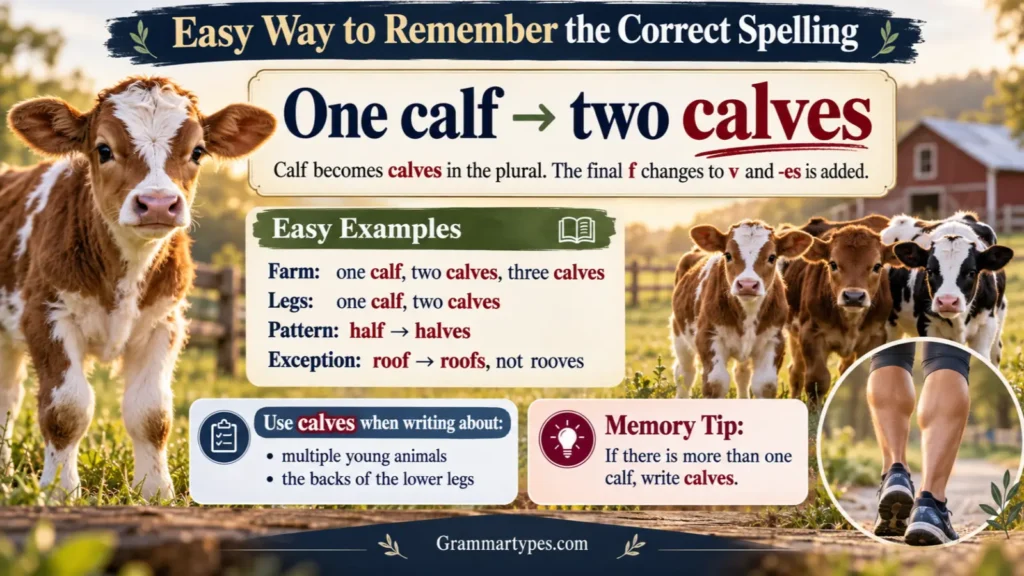
Easy Way to Remember the Correct Spelling
Use this short pattern:
One calf → two calves.
Imagine counting young animals on a farm: one calf, two calves, three calves. Then apply the same rule to your legs: one calf, two calves.
You can also remember the related pattern half → halves. Both words change their final f to v in the standard plural.
However, do not assume that the same change works for every word. For example, roof becomes roofs, not rooves in standard general usage.
If you are uncertain while writing an assignment, work email, article, or social media post, use calves for multiple young animals or the backs of the lower legs. It is the standard choice for these meanings.
Quick Quiz: Test Your Understanding
Try these questions before checking the answers.
1. Which sentence is correct?
A. My calfs hurt after running.
B. My calves hurt after running.
Answer: B. Calves is the standard plural of calf.
2. What is the plural of calf when referring to baby cows?
A. Calves
B. Calfs
Answer: A. More than one young cow is described as calves.
3. Which phrase is correct?
A. Calves muscles
B. Calf muscles
Answer: B. Use calf muscles because calf modifies the noun muscles.
4. Complete the sentence: The cow will _____ next month.
A. calf
B. calve
Answer: B. Calve is the verb meaning to give birth to a calf.
5. Which word is the plural of leaf?
A. Leafs
B. Leaves
Answer: B. Leaves follows a similar plural pattern to calves.
Final Thoughts
When deciding between calfs or calves, choose calves as the standard plural of calf. The same spelling applies whether you mean the backs of your lower legs or young animals such as cows, elephants, and whales. The essential pattern is calf → calves, just as half → halves and leaf → leaves follow a similar change.
Remember that not every noun ending in f forms its plural with ves, so learn each word’s standard form. Also distinguish between calf muscles, calves, and the verb calve to keep your sentences accurate. Although calfs appears in a narrow specialized sense, calves is the clearest choice for everyday, academic, and professional writing. When in doubt, write calves for multiple animals or lower-leg areas.
FAQs
Calves is correct. For example, “My calves are sore after running” refers to the backs of both lower legs.
Calves is the standard plural for baby cows. One young cow is a calf, and multiple young cows are calves.
The word calf names the fleshy back part of the lower leg. It is also used for the muscles in that region. The anatomical term has its own historical development, so its connection to the animal meaning should not be assumed solely from the shared spelling.
They can be called female calves. Heifer is another term for a young female bovine that has not yet had a calf, with exact usage depending on its stage of development.
Calfs appears in some dictionary references as a specialized variant related to calfskin or calf hide. However, it is not the standard plural for ordinary references to young animals or lower legs. Use calves in everyday writing.
The usual expressions are calf muscles and calves. Use calf muscles when naming the muscles and calves when referring to the lower-leg areas. Avoid calves muscles.
Calves is plural. The singular form is calf. For example, “One calf is resting” is singular, while “Two calves are resting” is plural.
Explore More Grammar guides:
Flier vs. Flyer: Meaning, Difference, and Correct Usage
Vender vs Vendor: Which Spelling Is Correct? Meaning & Examples
Onsite or On Site: Which Is Correct? Meaning, Usage & Examples
Discard or Disgard: Meaning, Correct Spelling, and Examples
