
When you write a sentence such as “I’m racking my brain for the answer,” you may suddenly wonder whether racking or wracking is the right spelling. The same uncertainty appears in phrases such as nerve-racking, racking up points, and racking cough.
The confusion is understandable because rack and wrack sound exactly alike, and their meanings overlap in some contexts. However, they are not interchangeable in every expression.
The safest approach is to look at the phrase and meaning. In modern English, racking is the standard choice in several common expressions, while wracking remains a legitimate word with uses connected to ruin, destruction, or severe distress.
Wracking or Racking: The Short Answer
If you are choosing between wracking or racking, use racking in the most common expressions involving intense thought, nervousness, pain, or accumulation.
For example:
- racking my brain — standard
- nerve-racking — standard and more common
- racking up points — standard
- a racking cough — standard
- racked with pain — standard
However, wrack is not simply a misspelling of rack. It is an established word, and wrack and wracked can appear when the meaning suggests destruction, ruin, or severe suffering.
For example:
The storm-wracked coastline suffered extensive damage.
Dictionary.com notes that rack and wrack have historically overlapped in meanings related to torment and destruction, which helps explain why both spellings still appear in some expressions.
Racking vs. Wracking at a Glance
| Expression or meaning | Preferred form | Example |
|---|---|---|
| Thinking very hard | racking | I’m racking my brain. |
| Causing nervousness | nerve-racking | The interview was nerve-racking. |
| Collecting or accumulating | racking | They are racking up points. |
| Severe or painful cough | racking | She has a racking cough. |
| Physical storage framework | rack | The boxes are on a rack. |
| Destruction or damage | wrack/wracked can occur | A storm-wracked coast. |
| Traditional phrase | wrack | Wrack and ruin. |
The important point is that the spelling depends on the expression and intended meaning, not simply on whether one form “looks more correct.”
What Does “Racking” Mean?
Racking is the present participle of rack. The word has several meanings depending on context.
It can refer to putting things on a rack:
The warehouse workers are racking the equipment.
It can also describe causing intense physical or emotional suffering:
The patient experienced a racking pain.
And it appears in several established expressions.
Racking Your Brain
Racking your brain means thinking very hard in an attempt to remember something, solve a problem, or find an answer.
I’ve been racking my brain trying to remember her name.
She racked her brain for a solution to the problem.
This is the standard modern spelling to use when you mean intense mental effort. Dictionary.com specifically identifies racking my brain as the more common and generally more standard form, while noting that wracking my brain also occurs.
Nerve-Racking
Nerve-racking describes something that causes anxiety, tension, or nervousness.
Waiting for the interview results was nerve-racking.
Driving through the storm was a nerve-racking experience.
Nerve-wracking is also widely encountered, so it is not accurate to claim that everyone who writes it has made a simple spelling error. However, nerve-racking is the safer standard choice when you want conventional edited English. Dictionary.com describes nerve-racking as the more common and standard version while acknowledging nerve-wracking as a common variant.
What Does “Wracking” Mean?
Wracking comes from wrack, a word associated with ruin, destruction, or severe damage. The distinction becomes clearer when you see it in context.
For example:
The hurricane left a wracked coastline behind.
Years of conflict had wracked the region.
The related expression wrack and ruin also preserves the older sense of destruction or devastation.
That does not mean wracking is always wrong when discussing pain or distress. English usage has allowed rack and wrack to overlap in some expressions. The important lesson is that you should not treat wrack as a universal substitute for rack, or vice versa.

Is It “Racking My Brain” or “Wracking My Brain”?
The preferred expression is:
Racking my brain
It means trying very hard to remember or figure something out.
Correct
I was racking my brain trying to remember where I had left my keys.
Also encountered
I was wracking my brain trying to remember where I had left my keys.
The second version is used by English speakers and can be found in published writing, but racking my brain is the safer choice for standard modern writing. Dictionary.com explains that both forms are in common use, while identifying racking my brain as the more common choice.
So if you are writing an essay, website article, email, or professional document and want the conventional form, choose racking my brain.
Is It Nerve-Wracking or Nerve-Racking?
The preferred form is:
Nerve-racking
Use it when something makes you nervous, anxious, or tense.
Correct and preferred
Giving my first presentation was nerve-racking.
The final few minutes of the game were nerve-racking.
You will also see nerve-wracking in real-world English. It is a widely used variant rather than a meaningless spelling invented by mistake. Dictionary.com states that nerve-racking is the more common and standard form but recognizes both spellings.
For consistent professional writing, nerve-racking is the better default.
Is It a Racking or Wracking Cough?
The correct expression is:
Racking cough
Here, racking means extremely bad or painful.
He was suffering from a racking cough.
Her racking cough kept everyone awake.
Cambridge Dictionary defines racking as meaning “very bad and very painful” and specifically gives a racking cough as an example.
Collins likewise uses racking for physical suffering and gives “His racking cough was gone” as an example.
Therefore, when the PAA asks “wracking or racking cough?”, choose racking cough.
Is It “Racking Up” or “Wracking Up”?
The correct expression is:
Racking up
The phrasal verb rack up means to accumulate, collect, or achieve a large amount of something.
The team is racking up points.
She has racked up thousands of miles this year.
The company is racking up sales.
Wracking up is not the standard expression for this meaning.
This is an especially easy distinction to remember because rack up has a specific phrasal-verb meaning: to accumulate or achieve something.
So write:
❌ She is wracking up points.
✅ She is racking up points.
Why Are “Rack” and “Wrack” So Confusing?
There are three main reasons.
1. They Sound the Same
Rack and wrack are pronounced the same way in ordinary English. The w in wrack is silent.
That means pronunciation cannot help you decide which spelling belongs in a sentence.
2. Their Meanings Overlap
Both words have developed associations with suffering, strain, torment, and destruction. That historical overlap is one reason phrases such as racking my brain and wracking my brain can both be found.
Dictionary.com explains that rack and wrack have been used interchangeably in contexts involving destruction and torment.
3. Common Expressions Preserve Older Usage
English contains many fixed phrases whose spelling cannot always be predicted from modern definitions.
For example, wrack and ruin preserves wrack, while racking up uses rack. Learning the complete expression is often more useful than trying to apply one spelling to every situation.
Common Mistakes to Avoid
Mistake 1: Writing “Wracking Up”
❌ The team is wracking up points.
✅ The team is racking up points.
Use racking up when you mean accumulating or achieving something.
Mistake 2: Automatically Calling “Nerve-Wracking” Wrong
❌ “Nerve-wracking” is always an incorrect spelling.
That is too absolute.
✅ Nerve-racking is the preferred standard form, but nerve-wracking is also widely used.
The distinction matters because good grammar advice should separate a less-preferred variant from an outright error.
Mistake 3: Writing “Wracking Cough”
❌ He had a wracking cough.
✅ He had a racking cough.
Cambridge specifically lists racking cough for a very bad or painful cough.
Mistake 4: Assuming “Wracking” Is Never Correct
❌ Wracking is always wrong.
That is also inaccurate.
Wrack is a real English word and remains appropriate in contexts associated with ruin, destruction, and devastation.
For example:
The storm-wracked coastline was closed to visitors.
The key is understanding the meaning and expression rather than treating one spelling as universally correct.
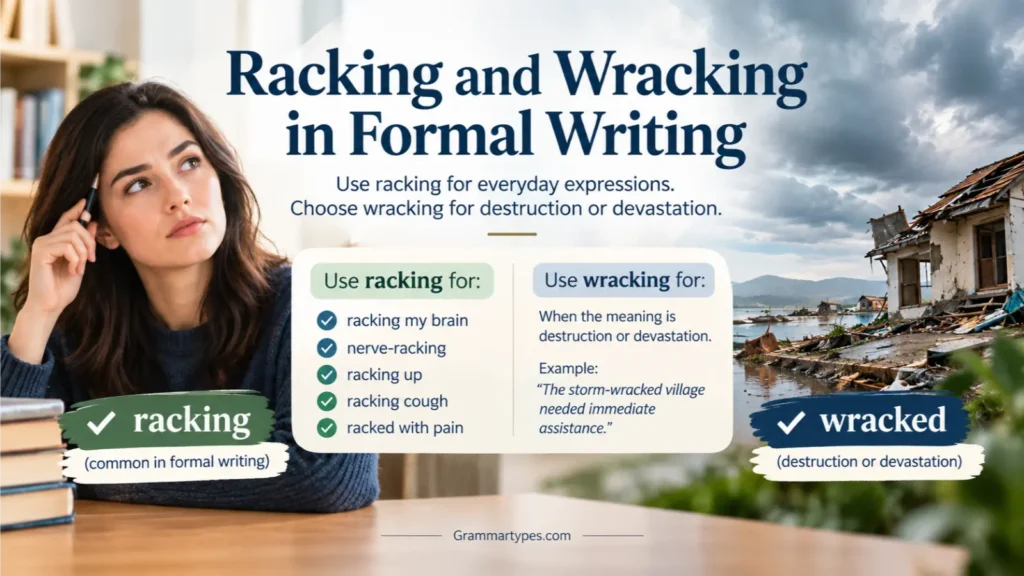
Racking and Wracking in Formal Writing
For school, professional, and general online writing, racking is usually the safest choice in the common expressions discussed here.
Use:
- racking my brain
- nerve-racking
- racking up
- racking cough
- racked with pain
But do not automatically replace every instance of wrack with rack. If the intended meaning is destruction or devastation, wrack may be the appropriate word.
For example:
The storm-wracked village needed immediate assistance.
Here, wracked conveys severe damage or suffering.
The goal is not to eliminate wrack. It is to use each form according to context.
A Simple Way to Remember the Difference
When you are unsure, remember these four common expressions:
Rack your brain.
Nerve-racking experience.
Rack up points.
Racking cough.
For wrack, think more strongly about ruin or destruction:
wrack and ruin
storm-wracked coastline
This is not a perfect rule for every historical or literary use, but it is a useful practical guide for everyday modern English.
Quick Examples
| Sentence | Correct? | Why |
|---|---|---|
| I’m racking my brain for the answer. | ✅ | Standard expression for thinking hard. |
| The interview was nerve-racking. | ✅ | Preferred spelling for something stressful. |
| She is racking up points. | ✅ | Rack up means accumulate. |
| He has a racking cough. | ✅ | Racking can describe severe physical suffering. |
| The storm-wracked coast was evacuated. | ✅ | Wracked conveys severe damage or suffering. |
| She is wracking up awards. | ❌ | The standard phrase is racking up. |
| I’m racking my brain. | ✅ | Preferred modern form. |
| I’m wracking my brain. | ◐ | Used, but less preferred than racking. |
Does American English Prefer “Racking”?
For the common expressions in this article, racking is a safe choice in American English.
This is especially true for:
- racking my brain
- nerve-racking
- racking up
- racking cough
However, the distinction should not be exaggerated into a rule that wracking is forbidden. English dictionaries and real-world usage recognize overlap between the two forms in some contexts.
Final Thought
The choice between wracking or racking depends on the expression and meaning. For the most common modern phrases, racking is the safest choice: racking my brain, nerve-racking, racking up points, and racking cough are all standard uses.
At the same time, wracking is not simply a misspelling. Wrack is an established word associated with ruin, destruction, and severe suffering, and both forms have overlapped historically in some expressions. That is why you may encounter nerve-wracking or wracking my brain even though nerve-racking and racking my brain are the preferred choices.
The easiest practical rule is to learn the common expressions individually: rack your brain, nerve-racking, rack up, and racking cough. When the meaning clearly involves destruction or devastation, wrack/wracked may be appropriate.
FAQs
Nerve-racking is the preferred standard spelling. Nerve-wracking is also widely used, so it is better described as a common variant than simply as a spelling error.
Racking my brain is the preferred form. It means thinking very hard to remember, understand, or solve something. Wracking my brain is also found in published usage, but racking my brain is the safer choice for standard writing.
Racking cough is correct. Cambridge Dictionary defines racking as very bad and painful and specifically gives “a racking cough” as an example.
Use racking up when you mean accumulating, collecting, or achieving something. For example, “The team is racking up wins.” Wracking up is not the standard phrase for this meaning.
Yes. Wracking is a real form of wrack. It can be used in contexts involving severe suffering, destruction, or devastation. It should not automatically be treated as a misspelling of racking.
It is not best described as simply wrong because the expression occurs in established English usage. However, racking my brain is the more standard and safer choice for modern edited writing.
When the expression is about thinking hard, nervousness, accumulation, or a severe cough, racking is generally the safer choice. Use wrack when the context specifically involves ruin, destruction, or a related established expression.
Explore More Grammar Guides:
Jobsite or Job Site: What Is the Difference & Which Is Correct?
You Too or You To: Which Is Correct? Complete Grammar Guide
Flyer or Flier: Which Spelling Is Correct?
