
Have you ever finished a conversation with someone and hesitated before typing “you too or you to“? These phrases sound identical when spoken, but their meanings and grammatical functions are different. Choosing the right one depends on what you want to express and how the words fit into the sentence.
The confusion often comes from the similar pronunciation of too and to, making “you too or you to” a common grammar question. One word commonly means “also,” while the other connects words and helps form grammatical structures. This makes the distinction important in everyday conversations, school assignments, professional writing, and text messages.
In this guide, you’ll learn when to use each form, how to respond to greetings and good wishes, why “I love you too” is correct, and how to avoid common mistakes with “you too or you to.” You’ll also find practical examples, a comparison table, and answers to related grammar questions.
Is It You Too or You To?
“You too” is correct when you mean “you also” or wish the same thing to someone. “You to” is correct when the word “to” belongs to a larger grammatical structure, such as “I need you to help.”
These expressions are not interchangeable. Although they sound alike, they perform different roles in a sentence.
Compare the following examples:
- ✅ You too! — You also, or the same wish applies to you.
- ✅ I want you to come. — “To” introduces the verb “come.”
- ❌ You to! — Incorrect when you mean “you also.”
The key is to identify the meaning before choosing the spelling.
What Is the Difference Between Too and To?
The simplest way to understand these words is to examine their grammatical functions.
| Word | Main function | Meaning | Example |
|---|---|---|---|
| Too | Adverb | Also; in addition | I like tea too. |
| Too | Adverb | More than necessary | It is too cold. |
| To | Preposition | Direction, relationship, or connection | I went to school. |
| To | Infinitive marker | Introduces a base-form verb | I want to learn. |
The word too commonly expresses addition or excess. Cambridge Dictionary identifies both meanings, including its use at the end of a sentence to mean “also.”

English meaning – Cambridge Dictionary
+1
The word to has several grammatical uses. It can indicate direction, as in “go to work,” or introduce an infinitive, as in “to read.” The correct choice depends on the sentence’s structure.
Too Meaning “Also”
When too means “also,” it indicates that something applies to another person or situation.
Examples:
- I enjoy reading, too.
- She wants to join us too.
- He is learning Spanish, too.
- “I am tired.” — “Me too.”
In these sentences, too adds information or shows agreement.
Too Meaning “More Than Necessary”
Too can also describe something that exceeds an appropriate, desired, or sufficient level.
Examples:
- The coffee is too hot to drink.
- This bag is too heavy.
- You are driving too fast.
- The music is too loud.
This meaning is different from “also.” Understanding both meanings helps you avoid confusing too with to in other sentences.
To as a Preposition
The word to often indicates movement, direction, or a relationship between people or things.
Examples:
- We walked to the park.
- She sent a letter to her friend.
- I gave the book to my brother.
- He is going to the office.
Here, to does not mean “also.” It helps connect parts of the sentence.
To Before a Verb
To can introduce the base form of a verb, creating an infinitive.
Examples:
- I want to sleep.
- She needs to study.
- They decided to leave.
- We plan to travel.
In “I need you to help,” the word to introduces the verb “help.” It is not the adverb too.
When Should You Say “You Too”?
Use you too when you want to return a good wish, greeting, or statement to another person. It often means “I wish the same for you” or “the same applies to you.”
This expression is especially common in everyday conversation and informal written communication.
Responding to Good Wishes
Example 1
Person A: Have a great day!
Person B: You too!
The second speaker wishes the first person a great day as well.
Example 2
Person A: Enjoy your weekend!
Person B: Thanks, you too!
Both speakers are exchanging good wishes.
Example 3
Person A: Good luck with your exam!
Person B: You too!
This response works when the same good wish is relevant to the other person. If the other person is not taking an exam, a more suitable response might be “Thanks!” instead.
Cambridge Grammar Today notes that too is particularly common in responses to fixed expressions such as good wishes and salutations.
Cambridge Dictionary
You Too After “Thank You”
The phrase you too can be appropriate after a thank-you exchange when the original statement includes a wish or sentiment that can be returned.
For example:
Person A: Thanks for your help. Have a safe trip!
Person B: You’re welcome. You too!
Here, “you too” refers to the wish for a safe trip, not to the expression of gratitude itself.
If someone simply says “Thank you,” the usual response is “You’re welcome,” “No problem,” or another suitable reply. You should not automatically replace every thank-you response with “you too.”

Is It “I Love You Too” or “I Love You To”?
The correct expression is “I love you too.”
In this sentence, too means “also.” The speaker is expressing love in return.
Correct Examples
- I love you too.
- I miss you too.
- I appreciate you too.
- I am happy to see you too.
Each example uses too to add the speaker’s feeling or response.
Why “I Love You To” Is Incorrect
The phrase “I love you to” is incomplete if you intend to say that you also love someone. The word to generally needs a grammatical role, such as connecting to a destination or introducing a verb.
Compare:
- ✅ I love you too.
- ✅ I want to tell you something.
- ❌ I love you to. (When intended to mean “I love you also.”)
The difference is not about formality. It is about meaning and grammatical function.
“I Need You To” or “I Need You Too”?
Both phrases can be correct, but they express different ideas.
I Need You To
Use I need you to when you want to say that someone is required or expected to perform an action. The structure is:
Subject + need + object + to + base verb
Examples:
- I need you to listen carefully.
- We need you to finish the report.
- She needs you to call her.
- I need you to be honest.
In these sentences, to introduces the verb or verb phrase that describes the required action.
I Need You Too
Use I need you too when you mean that you also need someone.
Examples:
- I need you too.
- She needs your help, and I need you too.
- You helped everyone else, but I need you too.
Here, too means “also.” The sentence does not necessarily request a specific action.
Quick Comparison
| Sentence | Meaning |
|---|---|
| I need you to stay. | I require or want you to stay. |
| I need you too. | I also need you. |
| I need you to help me too. | I need you to help me, and the addition may apply to the action or context. |
The last sentence shows why context matters. Too can add emphasis to different parts of a sentence, and the exact interpretation depends on the surrounding words.
How Do You Use To and Too Correctly?
A useful way to select the right word is to look at the role it plays in the sentence.
Step 1: Ask What You Mean
Are you trying to say “also” or “in addition”?
- If yes, too is often the correct choice.
- Example: I want to go too.
Are you connecting a person or thing to a verb, destination, or relationship?
- If yes, to may be appropriate.
- Example: I want to go to school.
Step 2: Look at the Words Around It
Consider the sentence:
I want you to understand.
The word “to” is followed by the base verb “understand.” This is an infinitive construction.
Now consider:
I want you too.
Here, “too” means “also.” The sentence expresses that the speaker wants the person as well, although the precise meaning depends on context.
Step 3: Read the Sentence Aloud in Meaning
Because to and too usually sound alike, pronunciation alone will not help you choose the spelling. Focus on the intended meaning and the sentence structure.
Ask yourself:
Can I replace this word with “also”?
If the answer is yes, too may be the correct choice.
If the word introduces a verb or indicates direction, to may be needed.
Common Mistakes With You Too and You To
Mistake 1: Writing “You To” as a Reply to Good Wishes
❌ Incorrect:
Friend: Have a nice evening!
You: You to!
✅ Correct:
Friend: Have a nice evening!
You: You too!
Why: The response means “I wish you a nice evening also.” Therefore, the correct word is too.
Mistake 2: Using Too Before a Verb When To Is Required
❌ Incorrect:
I want too learn English.
✅ Correct:
I want to learn English.
Why: The word to introduces the base verb “learn.” The adverb too does not perform that grammatical function.
Mistake 3: Assuming Too Always Means Also
❌ Incorrect reasoning:
Too always means also, so I should use it before every verb.
✅ Correct explanation:
Too can mean “also,” but it can also mean “more than necessary.” It does not replace to in infinitive constructions.
Examples:
- I want to read.
- The water is too cold.
- I want to read too.
Each sentence uses the words differently.
Mistake 4: Using “You Too” Without Considering Context
The expression you too is not appropriate for every response.
For example:
Person A: I have finished my homework.
Person B: You too!
This response may sound confusing unless the speakers have a specific context, such as discussing a shared activity or responding to an implied statement.
Instead, choose a response that clearly communicates your intended meaning.
You Too or You To in Formal and Informal English
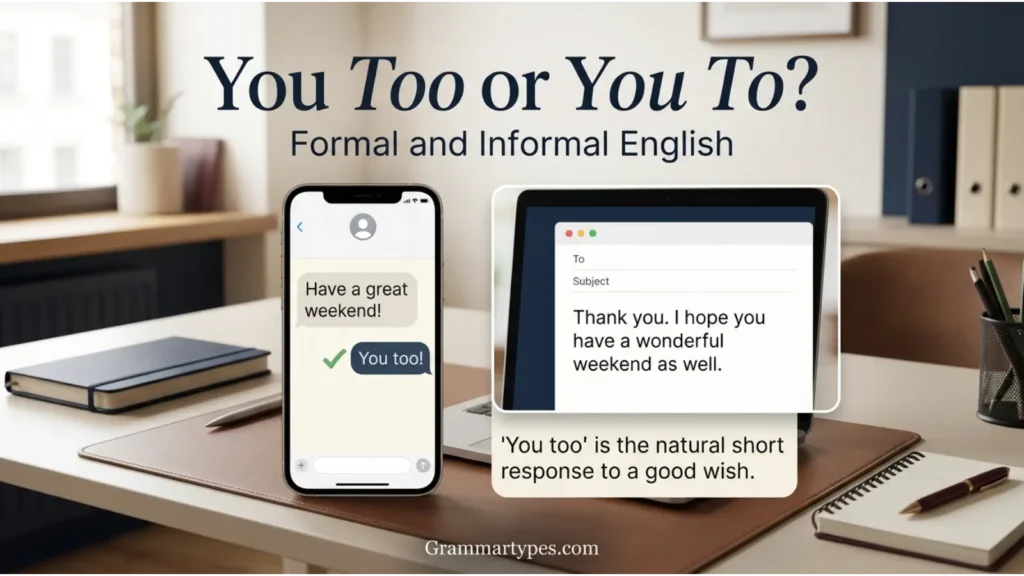
You too is natural in everyday conversation, messages, and informal writing. It is commonly used as a short response to good wishes and greetings.
Examples:
- Thanks, you too!
- Have a great weekend. You too!
- Good luck. You too!
In professional or academic writing, the appropriate wording depends on the situation. A short response such as “You too” can still be grammatically correct, but a more complete sentence may be clearer in formal correspondence.
For example:
Neither expression is automatically wrong simply because it is short. The choice depends on the context, tone, and purpose of communication.
You Too or You To: Easy Way to Remember
Use this simple memory rule:
Too = Also. To = Direction or Verb.
Try substituting “also” into the sentence.
- I love you also → I love you too. ✅
- Have a nice day also → Have a nice day too. ✅
- I want also learn → I want also learn. ❌
The last example is not grammatically correct because the infinitive structure requires to learn, not too learn.
Remember that this is a useful shortcut, not a complete explanation of every use of the words. Too has additional meanings, and to has several grammatical functions.
Practice Quiz: You Too or You To?
Test your understanding with these five questions.
Question 1
Which sentence is correct?
A. Have a great day to!
B. Have a great day too!
Answer: B. Too means “also” and expresses a returned good wish.
Question 2
Choose the correct word:
“I want ___ improve my writing.”
A. too
B. to
Answer: B. To introduces the base verb “improve.”
Question 3
Which sentence is correct?
A. I love you to.
B. I love you too.
Answer: B. Too means “also” in this sentence.
Question 4
Complete the sentence:
“I need you ___ finish this task.”
A. too
B. to
Answer: B. To introduces the verb “finish.”
Question 5
Which response is appropriate?
Person A: “Enjoy your vacation!”
A. You to!
B. You too!
Answer: B. You too returns the good wish when it applies to the other person.
FAQs
Both forms can be correct in different contexts. Use you too to mean “you also,” particularly when returning a good wish. Use you to when to is part of a larger grammatical structure, such as “I want you to come.”
Use to for purposes such as indicating direction or introducing an infinitive, as in “go to work” and “to study.” Use too to mean “also” or “more than necessary,” as in “I like it too” and “too expensive.”
“I love you too” is correct when you mean “I love you also.” The word too expresses addition. “To” does not replace it in this expression.
Both can be correct. “I need you to help” uses to before a verb to describe an action. “I need you too” uses too to mean “I also need you.” The intended meaning determines the correct word.
Yes. Too can mean “more than necessary or wanted,” as in “The box is too heavy.” It can also mean “also,” as in “I want to come too.” The sentence determines which meaning is intended.
within a longer sentence, punctuation depends on its position and the intended emphasis.
For example:
You too can learn this rule.
We, too, enjoyed the event.
The use of commas around mid-position too can vary with sentence structure and style. Cambridge Grammar Today provides examples of both end-position and mid-position usage.
Cambridge Dictionary
+1
“You too” is a natural and grammatically correct expression in everyday communication. It is particularly common in short responses to good wishes. In formal writing, a complete sentence may be preferable when additional clarity or a more professional tone is needed.
Final Thought
The difference between you too or you to depends on meaning and grammar. Use you too when you mean “you also,” such as when returning a good wish or saying “I love you too.” Use to when it introduces a verb or expresses direction, as in “I need you to help” or “I went to school.”
The most useful memory trick is to associate too with “also” and to with infinitives or direction. However, remember that too can also express excess, such as in “too difficult.” By checking the sentence’s meaning and grammatical structure, you can confidently choose the correct word in messages, conversations, and formal writing.
Explore More Grammar Guide:
Commonly Confused Words: Spelling, Meaning & Usage Guide
Flyer or Flier: Which Spelling Is Correct?
Patriot vs Patriotic: Which Word Should You Use on Patriot Day?
[authorbox]
