
When you need to describe something that stops a problem before it happens, you may hesitate between preventive vs preventative. The two words look almost identical, and you can find both in phrases such as preventive care, preventative care, preventive maintenance, and preventative maintenance.
The good news is that both preventive and preventative are accepted English words, and they generally mean the same thing. The main difference is usage and preference: preventive is the shorter and more widely preferred form, particularly in professional, medical, and American English contexts.
This guide explains when to use each form, whether preventative is grammatically correct, how the words work in common expressions, and why preventive is usually the safest choice when you are unsure.
Preventive vs Preventative: The Quick Answer
Preventive and preventative are both correct adjectives meaning intended to prevent something before it happens.
For example:
- Preventive care can help identify health problems early.
- Preventative care can help identify health problems early.
- The company introduced preventive measures.
- The company introduced preventative measures.
The meaning is essentially the same in each pair.
However, preventive is generally the better default, especially in American English, formal writing, healthcare, academic writing, and technical contexts. The CDC’s current writing guidance specifically recommends preventive, while major dictionaries such as Oxford and Cambridge recognize preventative as a legitimate alternative.
So the simplest rule is:
Use preventive when you want the shorter, more conventional choice. Don’t assume preventative is wrong when you see it.
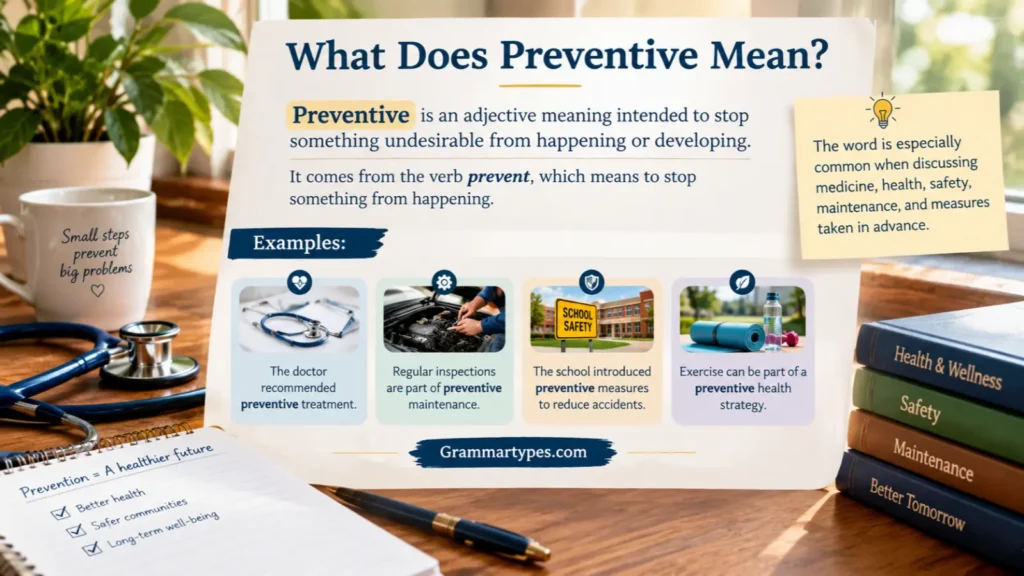
What Does Preventive Mean?
Preventive is an adjective meaning intended to stop something undesirable from happening or developing.
It comes from the verb prevent, which means to stop something from happening.
For example:
- The doctor recommended preventive treatment.
- Regular inspections are part of preventive maintenance.
- The school introduced preventive measures to reduce accidents.
- Exercise can be part of a preventive health strategy.
The word is especially common when discussing medicine, health, safety, maintenance, and measures taken in advance.
Oxford defines preventive as something intended to stop a problem or difficulty from happening and gives examples such as preventive medicine and preventive action.
What Does Preventative Mean?
Preventative is also an adjective with essentially the same meaning: intended to prevent something from happening.
For example:
- The hospital offers preventative care.
- The company uses preventative maintenance.
- They adopted preventative measures.
- The treatment has a preventative purpose.
Cambridge lists preventative as another word for preventive, while Collins describes it as another form of preventive.
Therefore, calling preventative a spelling mistake is too strong. It is a recognized English form.
Preventive vs. Preventative at a Glance
| Feature | Preventive | Preventative |
|---|---|---|
| Part of speech | Adjective | Adjective |
| Basic meaning | Intended to prevent | Intended to prevent |
| Correct English? | Yes | Yes |
| Length | Shorter | Longer |
| Common usage | More common | Less common |
| Medical writing | Very common | Also used |
| American English | Preferred in many contexts | Accepted |
| British English | Used | Also used |
| Best default | Yes | Usually not necessary |
The important distinction is preference, not basic grammatical correctness.
Is “Preventative” Grammatically Correct?
Yes. “Preventative” is grammatically correct.
Modern dictionaries recognize it as a valid word. Oxford lists preventative as an alternative form under preventive, and Cambridge similarly identifies it as another word for preventive.
That means this sentence is grammatically acceptable:
The clinic provides preventative care.
So is:
The clinic provides preventive care.
The second version is generally preferable if you are aiming for concise, conventional professional English.
The distinction matters because “less preferred” does not mean “incorrect.” A word can be accepted English while another form is more common or recommended by a particular style guide.
Is It Preventive Care or Preventative Care?
Both “preventive care” and “preventative care” are correct.
However, preventive care is the better default, particularly for American English and professional healthcare writing.
Examples:
- Preventive care can include routine screenings and vaccinations.
- The doctor discussed the importance of preventive care.
- The clinic provides preventative care to its patients.
All three uses are understandable and grammatically valid, but preventive care is the more conventional choice.
This is also consistent with the broader use of preventive in medical terminology, including expressions such as preventive medicine, preventive treatment, and preventive measures. Cambridge specifically gives preventive care as an example.
Preventive vs Preventative Maintenance
Both forms can also describe maintenance performed to prevent equipment or systems from developing problems.
Preventive maintenance is the more established choice:
The technician performs preventive maintenance on the machines every month.
But this is also possible:
The technician performs preventative maintenance on the machines every month.
The meaning does not materially change.
Preventive maintenance means maintenance carried out in advance to reduce the likelihood of breakdowns, damage, or other problems. The same concept can therefore be expressed with preventative maintenance. Collins lists preventative maintenance among the word’s common related expressions.
If you are writing technical documentation, a maintenance manual, or a professional report, preventive maintenance is usually the cleaner choice.
Preventive vs Preventative Medicine
The same principle applies to medicine.
Preventive medicine is the more conventional expression:
Preventive medicine focuses on reducing the risk of disease.
You may also encounter:
Preventative medicine focuses on reducing the risk of disease.
Both communicate the same basic idea.
Oxford specifically uses preventive medicine as an example of the adjective’s standard use.
If you are choosing wording for a medical article, academic paper, healthcare website, or professional document, preventive medicine is generally the safer option.
Why Do People Say “Preventative”?
There is no special change in meaning that makes preventative necessary. The longer form developed alongside preventive and has continued to be used by English speakers.
One reason it remains familiar is that English often permits multiple forms of words that develop from the same root. In this case, preventive and preventative have survived as variants rather than becoming two words with sharply different meanings.
Historical usage also shows that the two forms have coexisted for a long time. Modern dictionaries continue to recognize both, even though preventive is generally more frequent.
So when someone says preventative, they are not necessarily making a grammar mistake. They may simply be using the longer variant that is familiar to them.
Is “Preventive” More Correct Than “Preventative”?
Not in the simple sense of correct versus incorrect.
It is more accurate to say:
- Preventive = correct and generally preferred.
- Preventative = correct and accepted, but generally less preferred.
- Both = usually the same in meaning.
The CDC, for example, recommends preventive in its writing guidance and explains that the two forms have the same meaning.
This is an important distinction for grammar learners. If a style guide tells you to use preventive, follow that guide. But if you encounter preventative in a published document, you should not automatically assume that it is an error.
Preventive vs. Preventative in American and British English
There is not a strict rule that says preventive is American and preventative is British.
Both forms occur in both varieties of English.
Oxford’s learner dictionaries list preventative as an alternative to preventive, and Collins likewise records the longer form in both American and British English contexts.
There can be differences in frequency and editorial preference, however. For American professional writing, preventive is often the more natural choice.
So avoid this oversimplification:
❌ Preventive is American; preventative is British.
A better explanation is:
✅ Both are used in American and British English, but preventive is generally the more common and preferred form.
Common Examples
Here are some natural examples of both forms:
Preventive
- The doctor recommended preventive care.
- Regular inspections are part of preventive maintenance.
- The vaccine is used as a preventive measure.
- Exercise may have preventive benefits.
- The company developed a preventive strategy.
Preventative
- The doctor recommended preventative care.
- Regular inspections are part of preventative maintenance.
- The vaccine is used as a preventative measure.
- The program takes a preventative approach.
- The company introduced preventative strategies.
The sentences demonstrate why the difference can be confusing: in ordinary adjective use, replacing one with the other generally leaves the meaning unchanged.
Common Mistakes With These Words
Mistake 1: Assuming “preventative” is always wrong
❌ Preventative is not a real English word.
✅ Preventative is a recognized alternative form of preventive.
Major dictionaries recognize it.
Mistake 2: Assuming the two words have different meanings
❌ Preventative means something different from preventive.
✅ They generally have the same meaning.
Both describe something intended to prevent a problem before it occurs.
Mistake 3: Assuming the longer word is more formal
❌ Preventative is more professional because it is longer.
✅ Preventive is usually the more concise and conventional choice in professional writing.
A longer word is not automatically more formal or sophisticated.
Mistake 4: Changing established terminology unnecessarily
If a company, medical organization, or publication has a house style that consistently uses preventative, there may be no reason to rewrite every instance simply because preventive is more common.
Consistency with the applicable style guide is often more useful than making arbitrary word substitutions.
Which One Should You Use?
If you are unsure, choose preventive.
It is especially appropriate when you are writing:
- Academic papers
- Professional documents
- Healthcare content
- Technical documentation
- Business writing
- Educational material
- General American English
For example, choose:
Preventive care
instead of:
Preventative care
when you simply want the most conventional wording.
Choose preventative when it is already established in the terminology you are quoting, preserving, or following, or when that form is natural for your audience.
The key is not to treat preventative as a grammatical error when it is simply a less preferred variant.
Easy Way to Remember
Use this simple rule:
Preventive = preferred default.
Preventative = accepted alternative.
Think of preventive as the shorter, streamlined form. When there is no house style or audience preference telling you otherwise, it is usually the easiest choice.
Does AP Style Prefer Preventive or Preventative?
For professional American writing, preventive is the safer choice when following a concise editorial style.
However, do not turn this into a claim that preventative is grammatically forbidden. Style preferences and grammatical correctness are different things.
If you are writing for an organization, newspaper, university, medical publication, or company, always follow its current house style when it specifies a preferred form.

Preventive vs Preventative: A Practical Rule
When choosing between the two, ask three questions:
1. Do I need a word meaning “intended to prevent”?
Yes → Both preventive and preventative can work.
2. Does my style guide specify a preferred form?
Yes → Follow the style guide.
3. No style guide?
Choose preventive as the default.
That approach works for preventive care, preventive maintenance, preventive medicine, preventive measures, and similar expressions.
Final Thoughts
Preventive vs preventative is not really a battle between a correct word and an incorrect one. Both forms are recognized English adjectives, and both generally mean intended to prevent something before it happens.
The practical difference is preference. Preventive is shorter and is generally the better default for professional, medical, academic, and American English writing. Preventative is still acceptable and should not automatically be treated as a grammar mistake.
So, if you are writing preventive care, preventive medicine, or preventive maintenance, you are choosing the conventional form. If you encounter preventative, you can understand it as a legitimate alternative not an automatic error.
The easiest rule to remember: when in doubt, use preventive; when you see preventative, don’t assume it’s wrong.
FAQs
Yes. Preventative is grammatically correct and recognized as an alternative form of preventive. It is generally less preferred than preventive, but it is not simply a spelling error.
Both are correct, but preventive care is generally the preferred and more conventional form, especially in American professional and medical writing.
Oxford lists preventive as the main adjective and gives preventative as an alternative form. Oxford’s entry defines the word as something intended to stop a problem from happening.
Preventative is an established variant of preventive. People use it because it has been part of English usage for a long time and remains recognized by modern dictionaries.
For most writers, preventive is the better default because it is shorter, widely used, and commonly preferred in professional contexts. Preventative remains acceptable.
Yes. Usage references generally identify preventive as the more common form. Garner’s Modern English Usage, for example, reports a substantially higher frequency for preventive in modern print sources.
In most adjective uses, yes. You can normally say preventive measures or preventative measures without changing the basic meaning.
No. Preventative care is not grammatically wrong. However, preventive care is usually the more conventional choice, particularly in American English.
Explore More Grammar Guides:
Indure vs Endure: The Correct Spelling, Meaning & Usage
Attornies or Attorneys: Which Is Correct? Examples & Usage
Calfs or Calves: Which Spelling Is Correct? Meaning & Examples
HIPPA or HIPAA: Correct Spelling, Meaning, and Usage
