
Have you ever written about a legal professional and paused to wonder whether the plural should be attornies or attorneys? The two spellings look similar, and the wrong one can easily slip into an email, school assignment, business document, or legal article.
The confusion comes from a familiar English spelling rule. Words such as city and party change their final y to ies when pluralized. Because attorney also ends in y, it may seem logical to apply the same pattern. However, the letter immediately before the y determines which rule to follow.
The correct plural is attornies or attorneys. In this article, you will learn why the spelling works this way, what an attorney means, how to use the word in sentences, and how to avoid related mistakes involving possessives and legal expressions.
Which Spelling Is Correct: Attorneys or Attornies?
Attorneys is the correct plural of attorney. Attornies is a misspelling and is not accepted as the standard modern English plural.
Use attorney when referring to one person and attorneys when referring to two or more people. The spelling remains the same in American and British English, although attorney is used much more commonly in American legal contexts.
| Word | Correct? | Meaning |
|---|---|---|
| Attorney | Yes | One attorney |
| Attorneys | Yes | Two or more attorneys |
| Attornies | No | Nonstandard misspelling |
| Attorney’s | Yes | Something belonging to one attorney |
| Attorneys’ | Yes | Something belonging to multiple attorneys |
Examples:
- Correct: The firm hired three experienced attorneys.
- Incorrect: The firm hired three experienced attornies.
- Correct: Both attorneys reviewed the agreement before signing.
The distinction is about spelling, not meaning. You do not need to choose between two different kinds of legal professionals; you simply need the accepted plural form.
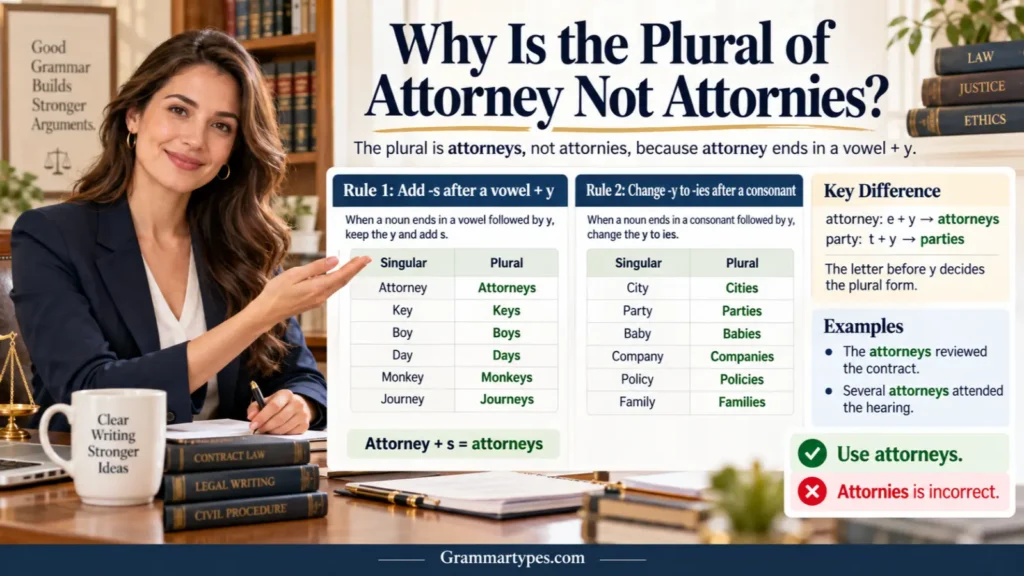
Why Is the Plural of Attorney Not Attornies?
The reason is a basic English pluralization rule involving nouns that end in y. Although the rule is straightforward, it depends on the letter immediately before the final y.
Rule 1: Add -s after a vowel and y
When a noun ends in a vowel followed by y, you generally keep the y and add s to form the plural.
Examples include:
| Singular | Plural |
|---|---|
| Attorney | Attorneys |
| Key | Keys |
| Boy | Boys |
| Day | Days |
| Monkey | Monkeys |
| Journey | Journeys |
In attorney, the final two letters are e and y. Since e is a vowel, the word takes a simple s.
The formation is:
Attorney + s = attorneys
There is no need to remove the y or replace it with ie.
Rule 2: Change -y to -ies after a consonant
When a noun ends in a consonant followed by y, the usual plural rule is to change the y to ies.
For example:
| Singular | Plural |
|---|---|
| City | Cities |
| Party | Parties |
| Baby | Babies |
| Company | Companies |
| Policy | Policies |
| Family | Families |
Here, the letter before the final y is a consonant. That is why the spelling changes.
Compare party → parties with attorney → attorneys. The words look similar at the end, but the letters immediately before the y are different.
This is the key to understanding the rule: look at the letter before the final y, not just the final y itself.
What Does Attorney Mean?
An attorney is a lawyer or, more broadly in some contexts, a person legally authorized to act on someone else’s behalf. The exact scope of the role depends on the legal system and the authority involved.
The word is particularly common in the United States, where attorneys may represent clients, provide legal advice, prepare legal documents, and handle disputes.
Here are a few examples:
- Defense attorney: The defense attorney questioned the witness during the trial.
- Corporate attorney: The company consulted its attorney before finalizing the merger.
- Family law attorney: They hired an attorney to help with the custody arrangements.
- Power of attorney: She granted her brother power of attorney to manage certain financial matters.
In everyday English, attornies or attorneys and lawyer are often used interchangeably in the United States. However, their precise meanings and professional implications can vary by jurisdiction. A person authorized to act for someone else under a power of attorney, for instance, is not necessarily a lawyer.
Understanding the meaning helps you use the word appropriately, but the plural spelling follows the same rule regardless of the legal specialty.
How to Use Attorneys in Sentences
The plural attorneys works in ordinary conversation, professional correspondence, academic writing, news reports, and legal discussions.
The following original examples show how to use it naturally.
1. In a professional setting
The company consulted two attorneys before signing the contract.
2. In a courtroom context
The attorneys presented their arguments before the judge.
3. In a business discussion
Several attorneys reviewed the proposed changes to the partnership agreement.
4. In an educational context
The students interviewed local attorneys about careers in law.
5. In a news report
Attorneys for both parties requested additional time to prepare their cases.
6. In a sentence about fees
The firm explained its attorneys’ fees before the clients signed the agreement.
Notice that attorneys refers to more than one person in every example. The context changes, but the spelling does not.
Incorrect and Correct Examples
Here are some common errors and their corrections.
- ❌ The attornies will contact you tomorrow.
- ✅ The attorneys will contact you tomorrow.
Why: The plural requires -s, not -ies.
- ❌ Three attornies attended the hearing.
- ✅ Three attorneys attended the hearing.
How: The number three indicates that the noun must be plural, but it does not change the spelling rule.
- ❌ Our company works with several attornies.
- ✅ Our company works with several attorneys.
Why: Words such as several, many, and numerous take plural nouns, and the accepted plural is attorneys.
For formal documents, take an extra moment to proofread the word. Spell-checking tools can help, but understanding the rule makes it easier to recognize errors yourself.
Attorney, Attorneys, Attorney’s, and Attorneys’ Explained
One related source of confusion is the difference between a plural noun and a possessive noun. These forms look similar, but they serve different grammatical purposes.
| Form | Grammatical use | Example |
|---|---|---|
| Attorney | Singular | The attorney called the client. |
| Attorneys | Plural | The attorneys called the client. |
| Attorney’s | Singular possessive | The attorney’s office is nearby. |
| Attorneys’ | Plural possessive | The attorneys’ offices are nearby. |
When should you use attorney’s?
Use attorney’s when something belongs to or is associated with one attorney.
Example: The attorney’s advice helped the client understand the agreement.
The apostrophe comes before the s because the noun is singular.
When should you use attorneys’?
Use attorneys’ when something belongs to or is associated with multiple attorneys.
Example: The attorneys’ schedules were coordinated before the hearing.
The noun is already plural, so the apostrophe follows the final s.
Is attorneys’ the same as attorneys?
No. Attorneys is simply the plural form, while attorneys’ is possessive.
- The attorneys arrived early. — plural
- The attorneys’ meeting began early. — plural possessive
Do not add an apostrophe merely because a word ends in s. Use one only when the sentence requires a possessive or another appropriate apostrophe construction.
Is the Plural Different in American and British English?
No. The standard plural spelling is attornies or attorneys both American and British English. The form attornies is not a standard regional alternative.
However, the word attorney is especially associated with American legal terminology. In other English-speaking legal systems, terms such as solicitor, barrister, or lawyer may be more common or may refer to particular professional roles.
For example:
- American usage: The attorneys prepared the case.
- British usage: The lawyers prepared the case.
Both sentences are grammatically correct. The difference is primarily one of terminology and legal context, not plural spelling.
If you are writing for an American audience, attorney and attorneys are natural choices when discussing legal professionals. For an international audience, lawyer may be more widely understood, depending on the subject.

Special Case: Attorneys General
The phrase attorneys general is a useful related example because its plural form may look unusual.
An attorney general is a senior legal official, such as the chief legal officer of a government. The conventional plural is attorneys general, with the noun attorney becoming plural while general remains unchanged.
Examples:
- The attorneys general issued a joint statement.
- Several state attorneys general discussed the proposed legislation.
This expression follows a compound-noun pattern in which the principal noun takes the plural ending.
Do not confuse this special construction with the ordinary plural of attorney. When referring to multiple attorneys who work at a law firm, simply write attorneys.
Another expression worth remembering is power of attorney. When referring to multiple such legal authorizations, the usual plural is powers of attorney, not power of attorneys.
These expressions are useful to learn, but they do not change the basic rule: one attorney, two attorneys.
Easy Way to Remember the Correct Spelling
If you frequently confuse attornies and attorneys, use this simple memory trick:
Vowel + y = add s. Consonant + y = usually change y to ies.
Think of these examples:
- Attorney → attorneys
- Key → keys
- City → cities
- Party → parties
The word attorney ends in -ey, so keep the y and add s.
You can also remember the phrase “one attorney, two attorneys.” Repeating the singular and plural together helps reinforce the correct spelling.
When proofreading, check the word’s ending rather than relying on how the plural looks or sounds. A quick check can prevent a small spelling mistake from appearing in a professional document.
Quick Practice Quiz
Test your understanding with these five questions.
Question 1: Which is the correct plural of attorney?
A. Attornies
B. Attorneys
Answer: B. Attorneys.
Explanation: The word ends in a vowel followed by y, so you add s.
Question 2: Complete the sentence: The firm hired four _____.
A. attornies
B. attorneys
Answer: B. attorneys.
Explanation: The number four requires a plural noun, and attorneys is the correct form.
Question 3: Which sentence uses the possessive correctly when one attorney owns the office?
A. The attorneys’ office is on Main Street.
B. The attorney’s office is on Main Street.
Answer: B. The attorney’s office is on Main Street.
Explanation: The singular possessive uses an apostrophe before the s.
Question 4: Which is the conventional plural of attorney general?
A. Attorneys general
B. Attorney generals
Answer: A. Attorneys general.
Explanation: In this compound title, the principal noun is pluralized.
Question 5: Is attornies a standard British English spelling?
A. Yes
B. No
Answer: B. No.
Explanation: Attorneys is the standard plural in both American and British English.
If you answered all five correctly, you understand the main pluralization rule and several related forms.
Final Thoughts
When choosing between attornies or attorneys, always use attorneys as the standard plural of attorney. The confusion comes from applying they → ies rule too broadly. That change generally occurs when a consonant comes immediately before the final y, as in city → cities. Because attorney ends in -ey, you simply add s.
Remember the related forms, too: attorney refers to one person, attorneys refers to multiple people, attorney’s is singular possessive, and attorneys‘ is plural possessive. The standard spelling remains attorneys in both American and British English. Whether you are writing a school assignment, business email, or legal article, this simple vowel-plus-y rule will help you spell the word correctly and write with confidence.
FAQs
The plural of attorney is attorneys. Add s to the singular word and keep the final y. For example, “Two attorneys attended the meeting.”
Yes, particularly in American English, attorney is commonly used as a synonym for lawyer. However, the precise professional meaning can vary depending on the legal system and the person’s authorization to practice or represent others.
No. Attornies is not the standard modern English plural of attorney. Use attorneys in essays, emails, legal discussions, professional documents, and everyday writing.
The letter immediately before the final y is e, a vowel. English nouns ending in a vowel plus y generally form their plurals by adding s. Therefore, attorney becomes attorneys, just as key becomes keys.
Attorneys is the correct spelling in the UK as well as the US. Although attorney is more strongly associated with American legal terminology, the spelling of its plural does not change between the two varieties of English.
Attorneys is the plural noun, referring to two or more legal professionals. Attorneys’ is the plural possessive, indicating that something belongs to or is associated with multiple attorneys. For example, “The attorneys arrived” versus “The attorneys’ meeting began.”
Explore More Grammar Guides:
Vender vs Vendor: Which Spelling Is Correct? Meaning & Examples
HIPPA or HIPAA: Correct Spelling, Meaning, and Usage
Puddy or Putty: Which Spelling Is Correct?
Flier vs. Flyer: Meaning, Difference, and Correct Usage
