
Have you ever written a sentence about an instruction manual and wondered whether the correct spelling is manual vs Manuel? These two words look almost identical, so it is easy to confuse them when typing an email, writing an assignment, or searching for the meaning of a word.
The main difference between Manuel vs manual is their meaning and grammatical use. Manuel is primarily a personal name, while manual is an English word that describes something done by hand or refers to a book containing instructions. Both spellings are valid, but they are not interchangeable.
Understanding this difference helps you choose the right word for the situation. Below, you will learn the meaning, spelling, usage, and examples of each word, along with the difference between a manual and instructions, common mistakes, and a simple way to remember which spelling to use.
What Is the Difference Between Manuel and Manual?
The difference between Manuel vs manual is that Manuel is a proper noun used as a person’s name, whereas manual is a common English word used for instruction books, physical work, and hand-operated processes. The correct choice depends on what you want to communicate.
Consider these examples:
- Manuel: Manuel helped me install the printer.
- Manual: I read the printer manual before installing it.
In the first sentence, Manuel identifies a person. In the second, manual refers to a document that explains how to use a printer.
| Feature | Manuel | Manual |
|---|---|---|
| Word type | Proper noun | Noun or adjective |
| Main meaning | A person’s name | An instruction book or something done by hand |
| Capitalization | Normally capitalized | Usually lowercase, except at the beginning of a sentence or in a title |
| Example | Manuel called this morning. | I downloaded the user manual. |
| Common context | Names and personal references | Books, machines, work, and controls |
Both words can be correct in English, but context determines the correct spelling. If you mean a person, use their actual name. If you mean a guidebook or something performed by hand, use manual.
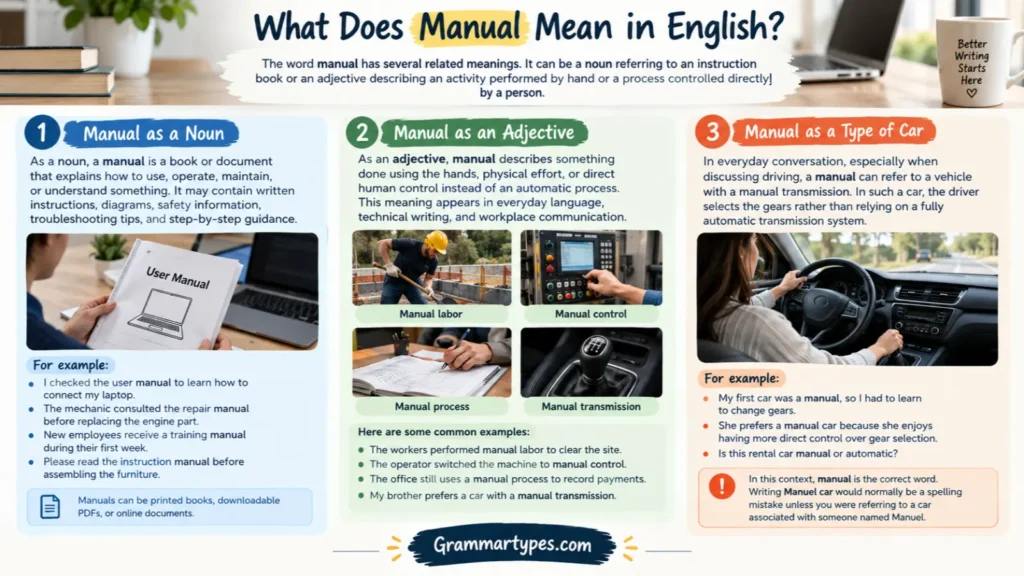
What Does Manual Mean in English?
The word manual has several related meanings. It can be a noun referring to an instruction book or an adjective describing an activity performed by hand or a process controlled directly by a person.
1. Manual as a Noun
As a noun, a manual is a book or document that explains how to use, operate, maintain, or understand something. It may contain written instructions, diagrams, safety information, troubleshooting tips, and step-by-step guidance.
For example:
- I checked the user manual to learn how to connect my laptop.
- The mechanic consulted the repair manual before replacing the engine part.
- New employees receive a training manual during their first week.
- Please read the instruction manual before assembling the furniture.
In each example, manual refers to a practical guide or reference document. Manuals can be printed books, downloadable PDFs, or online documents.
2. Manual as an Adjective
As an adjective, manual describes something done using the hands, physical effort, or direct human control instead of an automatic process. This meaning appears in everyday language, technical writing, and workplace communication.
Here are some common examples:
- Manual labor: The workers performed manual labor to clear the site.
- Manual control: The operator switched the machine to manual control.
- Manual process: The office still uses a manual process to record payments.
- Manual transmission: My brother prefers a car with a manual transmission.
Notice that manual does not always mean a book. Its meaning changes with the sentence. A manual can explain how to operate equipment, while a manual process involves work or control carried out directly by a person.
3. Manual as a Type of Car
In everyday conversation, especially when discussing driving, a manual can refer to a vehicle with a manual transmission. In such a car, the driver selects the gears rather than relying on a fully automatic transmission system.
For example:
- My first car was a manual, so I had to learn to change gears.
- She prefers a manual car because she enjoys having more direct control over gear selection.
- Is this rental car manual or automatic?
In this context, manual is the correct word. Writing Manuel car would normally be a spelling mistake unless you were referring to a car associated with someone named Manuel.
What Does Manuel Mean?
Manuel is primarily a masculine given name used in Spanish- and Portuguese-speaking communities and in other cultures. It is related to the name Emanuel, which is associated with the Hebrew name Immanuel and the traditional meaning “God is with us.”
Unlike manual, Manuel is not the standard spelling of the English word for an instruction book or hand-operated activity. It identifies a person, so its capitalization matters in ordinary English writing.
For example:
- Manuel is joining us for dinner tonight.
- I sent the revised document to Manuel yesterday.
- Our new colleague, Manuel, will lead the meeting.
- Manuel explained how he repaired the computer.
Each sentence uses the name to identify a specific person. If someone spells their name Manuel, keep that spelling when addressing or referring to them.
Is Manuel a Word in English?
Yes, Manuel is used in English as a personal name, although it is not the ordinary English word for an instruction guide. The distinction is between a valid name and a common vocabulary word, not simply between a correct and an incorrect spelling.
For example:
- Correct: Manuel showed us how to use the equipment.
- Correct: The equipment came with a manual.
The first sentence refers to a person, while the second refers to a guide. Both sentences are grammatically correct because the words have different meanings.
How Do You Spell Manual as in a Book?
The correct spelling is M-A-N-U-A-L: manual. Use this spelling when referring to a book, document, or guide that provides instructions for using or understanding something.
For example:
- Correct: Please download the manual before installing the software.
- Incorrect: Please download the Manuel before installing the software.
The second sentence is incorrect if the intended meaning is an instruction book. However, Manuel would be correct if the sentence referred to a person named Manuel.
Remember that the letters in manual appear in this order: M-A-N-U-A-L. The final letters are u-a-l, not u-e-l. Paying attention to these letters can help you avoid the common spelling confusion.
What Is the Difference Between a Manual and Instructions?
A manual is usually a complete guide or document, while instructions are directions explaining how to complete a task or perform a particular action. The terms are related, but they are not identical.
A manual may contain several sets of instructions, along with explanations, diagrams, warnings, maintenance advice, and troubleshooting information.
| Term | Meaning | Example |
|---|---|---|
| Manual | A guide containing practical information about a product, process, or task | Read the washing machine manual. |
| Instructions | Directions explaining how to do something | Follow the instructions to connect the hose. |
| Guide | A resource that helps someone understand or complete a task | Use the installation guide to set up the software. |
| Handbook | A reference book containing useful information or rules | The employee handbook explains workplace policies. |
For example, a furniture manual might contain assembly instructions, illustrations of each component, and safety warnings. The instructions tell you what to do, while the manual provides the broader information you may need.
In everyday conversation, people sometimes use manual and instructions loosely to refer to the same material. However, in formal or technical writing, the distinction can make your meaning clearer.
Manuel vs Manual Meaning in Everyday Situations
The easiest way to choose between Manuel vs manual is to identify what the sentence describes. The same spelling rule applies in emails, school assignments, technical documents, conversations, and online searches.
In Emails and Professional Writing
Use manual when referring to documentation, procedures, or tasks performed by hand. Use Manuel when addressing a colleague or another person with that name.
Examples:
- Correct: Please review the employee manual before your first day.
- Correct: Dear Manuel, please review the updated report.
- Incorrect: Please review the employee Manuel before your first day.
The last sentence is incorrect if you mean a workplace guide. Choosing the right word makes professional communication clearer.
In Technology and Software
Technology often involves user manuals, installation guides, and troubleshooting documents. These resources help users operate devices and resolve common problems.
Examples:
- The software manual explains how to configure the settings.
- I searched the website for the printer manual.
- Manuel helped me troubleshoot the software.
The first two sentences refer to documentation, while the third identifies a person. The correct spelling depends on the intended meaning, not the subject of the sentence alone.
In School and Academic Writing
Students may encounter the word manual when discussing laboratory equipment, reference documents, or practical procedures.
Examples:
- Our teacher gave us a laboratory manual.
- I checked the science manual before completing the experiment.
- Manuel submitted his assignment before the deadline.
These examples show why it is useful to understand both words. One describes a resource, while the other identifies a student or another individual.
Common Mistakes When Using These Words
The most common mistake is using Manuel when the sentence requires manual. However, the reverse can also be incorrect if you misspell someone’s name.
Mistake 1: Writing Manuel Instead of Manual
❌ Incorrect: I lost the instruction Manuel for my new phone.
✅ Correct: I lost the instruction manual for my new phone.
Why: The sentence refers to a document containing instructions, so the correct spelling is manual.
Mistake 2: Writing Manual Instead of Someone’s Name
❌ Incorrect: Manual will join us for the meeting. (If the person’s name is Manuel.)
✅ Correct: Manuel will join us for the meeting.
Why: Personal names should be written using their established spelling. Do not change someone’s name to match a common English word.
Mistake 3: Capitalizing Manual Without a Reason
❌ Incorrect: I downloaded the Manual for my camera. (In ordinary sentence text.)
✅ Correct: I downloaded the manual for my camera.
Why: Common nouns such as manual are normally lowercase in the middle of a sentence. Capitalization may be appropriate at the beginning of a sentence or when following a specific title’s capitalization style.
Mistake 4: Assuming Both Words Are Interchangeable
❌ Incorrect: The car came with a Manuel transmission.
✅ Correct: The car came with a manual transmission.
Why: Manual describes the type of transmission. Manuel would refer to a person, not the transmission type.
These examples demonstrate that spelling and meaning work together. Correcting the letters alone is not enough; you must also select the word that expresses your intended message.
Easy Way to Remember the Difference
A simple memory trick can help you distinguish Manuel vs manual from manual whenever you write.
- Manuel = a name. Think of a person you know or a character named Manuel.
- Manual = a guide or something done by hand. Think of a user manual, manual labor, or a manual car.
You can also remember the final three letters:
- Manu-a-l → manual
- Manu-e-l → Manuel
For example, if you need help operating a washing machine, you need its manual. If you need to ask your friend Manuel for help, write Manuel.
The most reliable rule is to check the context before correcting the spelling. A person’s name should retain its actual spelling, while a common English word should follow standard spelling conventions.

Manuel vs Manual Meme: Why Is It Funny?
A Manuel vs manual meme can play on the fact that the two spellings differ by just one letter but have different meanings. The humor often comes from imagining that someone meant to ask for an instruction book but accidentally wrote a person’s name instead.
For example, someone might write, “Where can I find the Manuel for this printer?” Another person could jokingly respond, “Have you tried asking Manuel?”
The joke works because manual means an instruction guide, whereas Manuel is a person’s name. It is a spelling-based joke rather than a different grammatical rule.
In real writing, however, context matters more than the joke. Use manual for the document and Manuel for the person.
Final Thoughts
The difference between Manuel vs manual comes down to spelling, meaning, and context. Manuel is primarily a personal name, while manual is the standard English word for an instruction book or something performed by hand. Both forms are valid, but they serve different purposes.
When writing about a product, use manual for its user guide, instruction document, or manual operation. When referring to a person named Manuel, preserve the name’s correct spelling and capitalization. Remember the final letters: manual ends in -ual, while Manuel ends in -uel.
Once you understand this distinction, choosing the right word becomes straightforward. Always consider what your sentence means before deciding which spelling to use.
FAQs
Manual is a common English word that can mean an instruction book or something done by hand. Manuel is primarily a personal name. For example, “Read the manual” refers to a guide, while “Ask Manuel” refers to a person.
The correct spelling is manual, written M-A-N-U-A-L. It refers to a book or document that explains how to use something or complete a task. For example, “The camera manual explains how to adjust the settings.”
A manual is generally a guide or document containing practical information, while an instruction is a direction explaining what to do. A manual may contain many instructions, illustrations, explanations, and safety warnings.
Yes. Manuel is a valid personal name used in English and many other languages. It is correct when referring to someone whose name is Manuel, but it is not the standard spelling of the English word for an instruction book.
Manual can function as both a noun and an adjective. As a noun, it means an instruction book. As an adjective, it describes something done by hand or controlled directly by a person, as in “manual work” or “manual transmission.”
A manual usually provides practical instructions or detailed information about operating, maintaining, or understanding something. A guide is a broader term for a resource that helps someone complete a task or understand a subject. Their meanings overlap, and the best choice depends on the document’s purpose.
Explore More Grammar Guides:
Greatly or Grately: Which Spelling Is Correct? (2026 Guides)
Preventive vs Preventative: Which One Should You Use?
Indure vs Endure: The Correct Spelling, Meaning & Usage
HIPPA or HIPAA: Correct Spelling, Meaning, and Usage
