
People often hesitate when typing of course because the phrase sounds almost like one word in quick speech. This can lead to confusion over of course or ofcourse, especially in texts, comments, and other informal online writing. The correct form is of course, with a space between the two words.
The correct form in standard English is of course, written as two separate words. Ofcourse is a nonstandard spelling and should not be used in formal, academic, professional, or carefully edited writing.
But spelling is only part of the question. Of course can express agreement, permission, certainty, or something obvious, and its punctuation and tone can change depending on how it is used. Here is how to use it naturally and correctly.
Of Course or Ofcourse: The Quick Answer
Of course is the correct spelling. Ofcourse is not the standard English form.
| Form | Correct? | Use |
|---|---|---|
| of course | ✅ Yes | Standard English |
| ofcourse | ❌ No | Nonstandard spelling |
| of-course | ❌ No | Not the standard spelling |
Examples:
- ✅ Of course, I can help you.
- ✅ You can, of course, ask me later.
- ❌ Ofcourse, I can help you.
The key rule is simple: always leave a space between “of” and “course.”
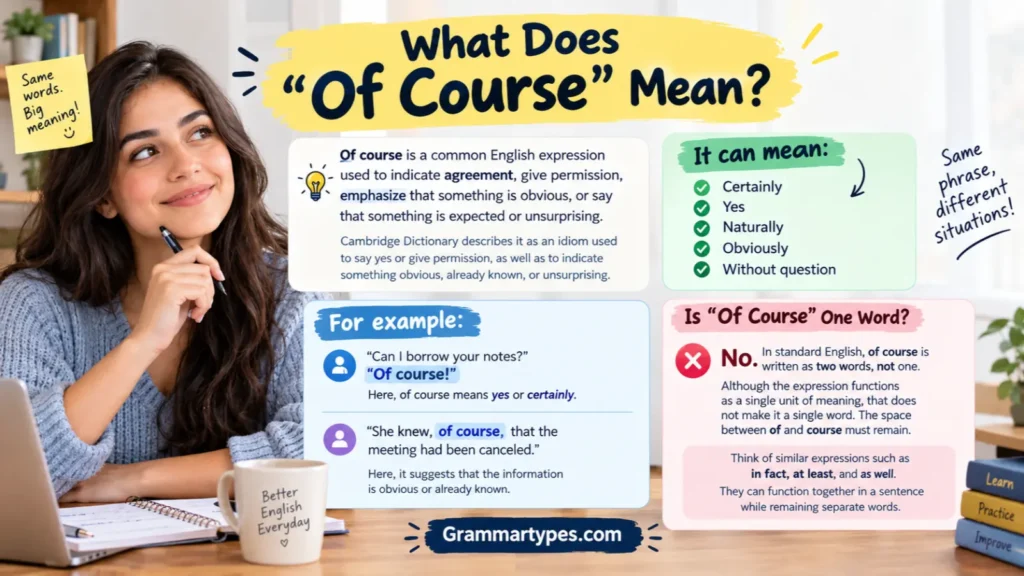
What Does “Of Course” Mean?
Of course is a common English expression used to indicate agreement, give permission, emphasize that something is obvious, or say that something is expected or unsurprising. Cambridge Dictionary describes it as an idiom used to say yes or give permission, as well as to indicate something obvious, already known, or unsurprising.
Depending on the context, it can mean:
- Certainly
- Yes
- Naturally
- Obviously
- Without question
For example:
“Can I borrow your notes?”
“Of course!”
Here, of course means yes or certainly.
In another sentence:
“She knew, of course, that the meeting had been canceled.”
Here, it suggests that the information is obvious or already known.
Is “Of Course” One Word?
No. In standard English, of course is written as two words, not one.
Although the expression functions as a single unit of meaning, that does not make it a single word. The space between of and course must remain.
Think of similar expressions such as in fact, at least, and as well. They can function together in a sentence while remaining separate words.
Why Do People Write “Ofcourse”?
The most likely reason is that of course is frequently pronounced quickly, making the two words sound connected. When people hear or type a phrase repeatedly, they may naturally assume it is written as one word.
Fast typing also contributes to the mistake. In casual messages, social media posts, and comments, people often omit spaces or use nonstandard spellings without stopping to proofread.
For example, you may encounter:
- ofcourse
- alot
- infact
- atleast
- aswell
Seeing these forms online does not make them standard spellings.
A useful distinction is frequency versus correctness: a spelling can appear frequently on the internet and still be nonstandard.
How to Use “Of Course” Correctly
The expression can appear in several positions within a sentence. Its meaning and tone depend partly on the context.
1. At the Beginning of a Sentence
When of course begins a sentence, it often expresses certainty, agreement, or something the speaker considers obvious.
Examples:
- Of course, I will send the document today.
- Of course, you can come with us.
- Of course, she remembers your name.
A comma is often appropriate when of course functions as an introductory expression.
2. In the Middle of a Sentence
When of course interrupts a sentence as a parenthetical expression, commas can set it off.
Examples:
- You can, of course, contact me tomorrow.
- The answer is, of course, much simpler than it appears.
- He was, of course, surprised by the announcement.
The commas help show that of course is an aside rather than an essential part of the sentence’s basic structure.
3. As a Complete Response
Of course can stand alone as a natural response to a request or question.
“Could you help me with this?”
“Of course.”
“May I sit here?”
“Of course!”
In these situations, it usually means yes, certainly, or you have permission.
Cambridge specifically notes this permission/agreement use.
Is “Of Course Yes” Correct?
“Of course, yes” can be grammatically acceptable, but the punctuation and context matter.
For example:
“Are you coming to the party?”
“Of course, yes!”
However, “Yes, of course” or simply “Of course” often sounds more natural in everyday English.
Compare:
- Yes, of course. — Natural and common.
- Of course. — Natural and concise.
- Of course, yes. — Possible, but more emphatic or conversational.
- Ofcourse yes. — Incorrect spelling.
The important point is that of course remains two words regardless of where it appears.
“Yes, Of Course” vs. “Of Course, Yes”
Both combinations can occur, but they do not always have exactly the same conversational effect.
Yes, of course usually gives a straightforward affirmative answer:
“Can you send me the file?”
“Yes, of course.”
Of course, yes places stronger emphasis on the speaker’s certainty or agreement:
“Would you say that this is the best option?”
“Of course, yes.”
For ordinary replies, yes, of course or simply of course will generally sound more natural.
“Of Course” in Formal and Informal English
Of course can be used in both formal and informal communication. The expression itself is not restricted to casual speech. Cambridge labels the agreement/permission sense as informal, while its grammar guidance also demonstrates uses in broader written contexts.
For example, it can appear naturally in:
Conversation:
“Can I call you later?”
“Of course.”
Professional communication:
“Of course, we can discuss the proposal during tomorrow’s meeting.”
Academic or formal prose:
The results are, of course, subject to the limitations discussed above.
That said, of course can sometimes sound impatient or imply that something should have been obvious. Cambridge warns that using it to answer a question about information the listener does not already know can sound impolite.
For example:
“Did you attend the conference?”
“Of course. I attended all three days.”
Depending on the relationship and tone, the response may suggest that the question was unnecessary.
A neutral “Yes, I did” may be more appropriate when you simply want to provide information.
Grammar Rule Behind the Two-Word Spelling
The expression contains two separate words:
- of — a preposition
- course — a noun
Together, of course forms a fixed expression that can function adverbially in a sentence.
The fact that two words work together does not mean they should be joined. English contains many expressions that behave as a unit while retaining their spaces.
For example:
- in fact
- at least
- by the way
- of course
- as well
So there is no standard spelling rule that turns of course into ofcourse.
Is “Ofcourse” Ever Correct?
In standard English writing, no. The normal spelling is of course.
You may encounter ofcourse in usernames, informal posts, messages, search queries, or other user-generated content. That is evidence of actual usage, but it does not make the form the standard spelling.
Some dictionaries or language resources may mention ofcourse specifically as a nonstandard form, rather than treating it as an accepted standard spelling.
Therefore, if you are writing an essay, email, article, resume, school assignment, or professional document, use of course.
Common Mistakes With “Of Course”
Mistake 1: Joining the Words
❌ Ofcourse, I agree with you.
✅ Of course, I agree with you.
Why: The standard expression is written as two words.
Mistake 2: Adding a Hyphen
❌ Of-course, you can use my computer.
✅ Of course, you can use my computer.
Why: Of course is not normally hyphenated.
Mistake 3: Treating Every “Of Course” as a Simple “Yes”
Of course can mean yes, but it has other functions too.
Compare:
Of course, you may leave early.
Here it gives permission.
The answer is, of course, obvious from the evidence.
Here it indicates that the speaker considers the information obvious.
Mistake 4: Using It When a Neutral Answer Is Better
Because of course can imply that something is obvious, it may occasionally sound dismissive.
Instead of:
“Of course, I did.”
you might simply say:
“Yes, I did.”
when you want to avoid suggesting that the question was obvious.
Of Course vs. Off Course
Be careful not to confuse of course with off course. They are completely different expressions.
| Expression | Meaning | Example |
|---|---|---|
| of course | certainly, naturally, obviously | Of course, I’ll help. |
| off course | away from the intended route or direction | The boat drifted off course. |
The spelling off course is correct when you are talking about something being away from its intended path.
So:
Of course, she knew the answer.
means naturally/certainly.
But:
The plane was off course.
means it was not following its intended route.
Easy Way to Remember the Correct Spelling
Use this simple rule:
Of + space + course = of course.
If you can remember that of is a separate word and course is a separate word, the spelling becomes easy.
You can also connect it mentally with other two-word expressions:
in fact
at least
as well
of course
They may function as familiar expressions, but they do not lose their spaces.
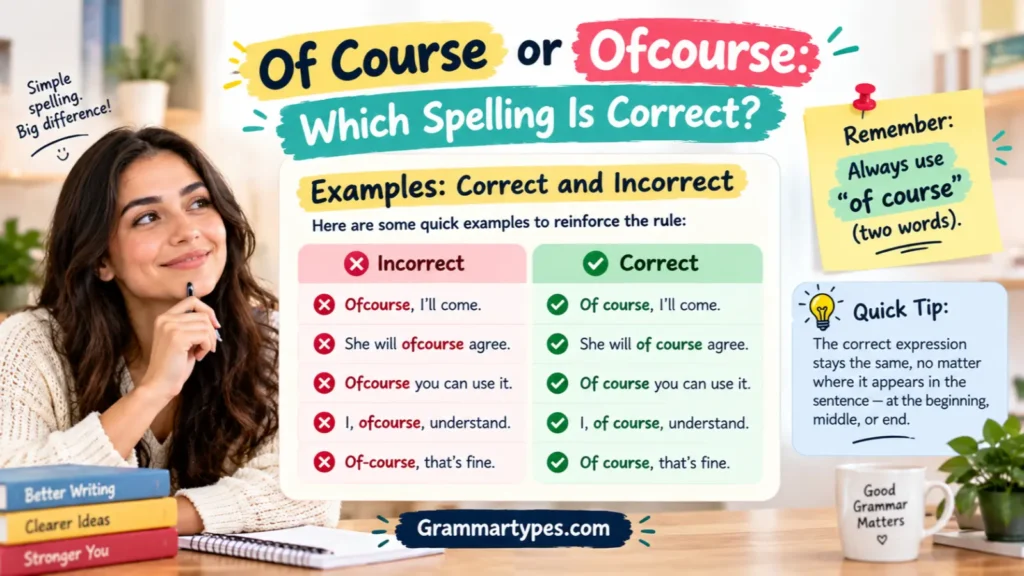
Examples: Correct and Incorrect
Here are some quick examples to reinforce the rule:
| Incorrect | Correct |
|---|---|
| ❌ Ofcourse, I’ll come. | ✅ Of course, I’ll come. |
| ❌ She will ofcourse agree. | ✅ She will of course agree. |
| ❌ Ofcourse you can use it. | ✅ Of course you can use it. |
| ❌ I, ofcourse, understand. | ✅ I, of course, understand. |
| ❌ Of-course, that’s fine. | ✅ Of course, that’s fine. |
Notice that the correct expression remains of course whether it appears at the beginning, middle, or end of a sentence.
Mini Quiz: Of Course or Ofcourse?
1. Choose the correct spelling:
A. Ofcourse
B. Of course
Answer: B. Of course
2. Complete the sentence:
“_____ you can borrow my book.”
A. Ofcourse
B. Of course
Answer: B. Of course
3. Which sentence is correct?
A. She will ofcourse help us.
B. She will of course help us.
Answer: B. She will of course help us.
4. True or false:
“Ofcourse” is the standard spelling in formal English.
Answer: False.
5. Which phrase means “certainly”?
A. Of course
B. Ofcourse
Answer: A. Of course
Final Thoughts
When deciding between of course or ofcourse, choose of course. The expression is conventionally written as two words, and ofcourse is a nonstandard spelling that should be avoided in polished English.
Of course can mean yes, certainly, naturally, or obviously, depending on the context. It works in conversations, emails, professional writing, and appropriate academic prose, although its tone can sometimes imply that something should have been obvious.
The easiest rule to remember is simple: keep the space between “of” and “course.” When in doubt, write of course, never ofcourse.
FAQs
Ofcourse is not the standard spelling of the expression. In standard English writing, use of course as two words. You may see the joined form in informal online writing, but it should not be used as the normal spelling.
Ofcourse is generally intended to mean of course, which can mean certainly, naturally, or yes depending on context. The standard spelling is of course, with a space.
British speakers use of course just as American speakers do. The pronunciation may vary by accent, but there is no separate British spelling that changes of course into one word.
No, not in standard English. Of course is written as two words. The fact that the phrase may sound connected when spoken quickly does not change its standard spelling.
It can be used in both formal and informal English. Its appropriateness depends partly on context and tone. In some situations, it can sound overly obvious or dismissive, so a neutral response such as yes may be preferable.
Yes, “of course, yes” can be used, particularly when emphasizing agreement. However, “yes, of course” or simply “of course” is often more natural in everyday conversation.
Explore More Grammar Guides:
Parents vs. Parents’: What’s the Difference and When to Use Each?
Farther vs Further: What’s the Difference and When Should You Use Each?
Flier vs. Flyer: Meaning, Difference, and Correct Usage
Indure vs Endure: The Correct Spelling, Meaning & Usage
