
Have you ever stopped while writing a sentence because you were unsure whether to spell the word putting vs puting? This small spelling difference can be confusing, especially when you are typing quickly, completing an assignment, or writing about golf.
The confusion comes from how English verbs change when the ending -ing is added. Some verbs keep their original spelling, while others double their final consonant. The verb put follows the second pattern, which is why one of these spellings is correct and the other is not.
Understanding the difference between putting vs puting will help you avoid this mistake in everyday writing. Below, you will find the correct spelling, the rule behind the double t, the meaning of putting, examples from different contexts, and answers to common questions about its use.
Is It Putting or Puting?
Putting is the correct spelling; puting is a misspelling in standard English. When you add -ing to the verb put, you must double the final t.
- ✅ Putting: The correct form of the verb put with the -ing ending.
- ❌ Puting: An incorrect spelling when you mean the word putting.
The spelling rule applies whether you are describing placing an object, expressing an idea, or performing a golf stroke.
| Spelling | Correct? | Explanation |
|---|---|---|
| Putting | Yes | The standard -ing form of put |
| Puting | No | Misspells the intended word by omitting one t |
| Put | Yes | The base verb |
| Puts | Yes | The third-person singular form of put |
| Put away | Yes | A phrasal verb meaning to return something to its proper place |
Examples:
- Correct: She is putting her books on the shelf.
- Incorrect: She is puting her books on the shelf.
- Correct: He is putting his ideas into practice.
- Incorrect: He is puting his ideas into practice.
Remember that the correct form always has two consecutive t letters: puting vs putting.
Why Does Putting Have Two Ts?
The spelling follows a common English rule called the consonant-doubling rule.
When a short, one-syllable verb ends in a single vowel followed by a single consonant, that final consonant is generally doubled before adding a vowel-starting suffix such as –ing. This applies when the vowel has a short sound and the usual spelling conditions are met.
The word put fits this pattern:
- P is the first consonant.
- U is the vowel with a short sound.
- T is the final consonant.
Therefore, the final t doubles before the ending is added.
THE SPELLING RULE
PUT + ING = PUTTING
Add the ending and double the final t.
Compare putting with other verbs that follow a similar pattern:
| Base verb | Correct -ing form |
|---|---|
| Put | Putting |
| Sit | Sitting |
| Run | Running |
| Get | Getting |
| Stop | Stopping |
| Swim | Swimming |
However, not every verb doubles its final consonant. For example, read becomes reading, and help becomes helping. The spelling depends on the word’s structure and the applicable rule.
This is why writing puting is not simply an alternative spelling. It fails to follow the standard spelling pattern for this verb.
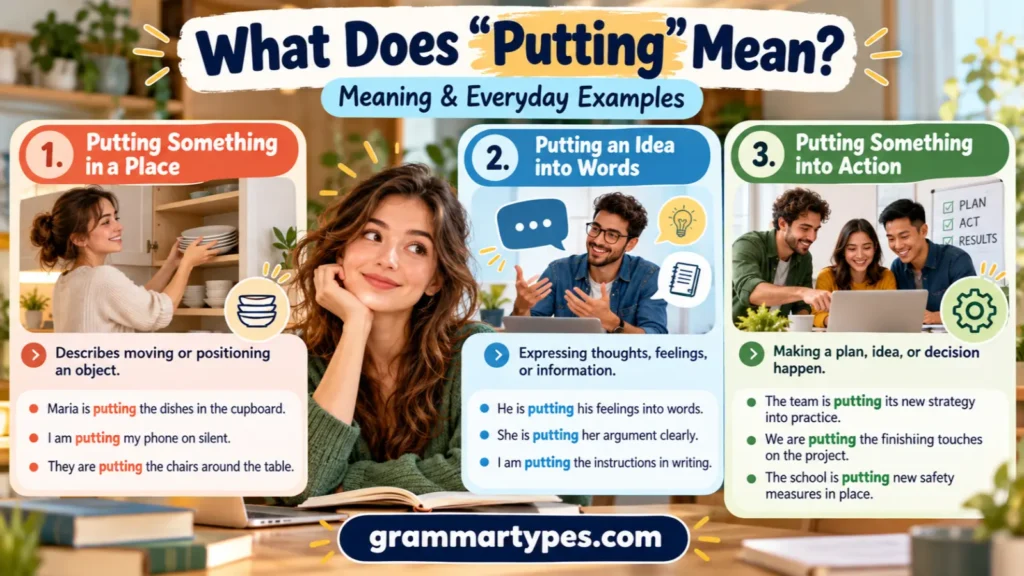
What Does “Putting” Mean?
The word puting vs putting has more than one use, depending on the sentence. Most commonly, it refers to the act of placing something somewhere. It can also describe expressing an idea, causing a particular situation, or performing a specific action in golf.
1. Putting Something in a Place
In everyday English, putting describes moving or positioning an object in a particular place.
Examples:
- Maria is putting the dishes in the cupboard.
- I am putting my phone on silent.
- They are putting the chairs around the table.
In each sentence, putting describes an action that is happening or continuing.
2. Putting an Idea into Words
The word can also refer to expressing thoughts, feelings, or information.
Examples:
- He is putting his feelings into words.
- She is putting her argument clearly.
- I am putting the instructions in writing.
Here, putting relates to communicating or presenting something rather than simply moving a physical object.
3. Putting Something into Action
Another common use involves making a plan, idea, or decision happen.
Examples:
- The team is putting its new strategy into practice.
- We are putting the finishing touches on the project.
- The school is putting new safety measures in place.
These expressions show how putting can be used in professional, academic, and everyday communication.
Is “Putting” Correct When Talking About Golf?
Yes. Putting is the correct spelling when discussing golf. In this context, it comes from the verb putt, which means to strike a golf ball gently so that it rolls toward the hole, usually on the putting green.
Examples:
- She is practicing her puting vs putting before the tournament.
- His putting improved after several lessons.
- The golfer missed the hole while putting from a short distance.
Notice that put and putt are different base verbs:
| Word | Meaning | Example |
|---|---|---|
| Put | To place something somewhere | He is putting his golf bag down. |
| Putt | To make a short, controlled golf stroke | She needs to putt the ball toward the hole. |
| Putting | The -ing form of either verb | He is putting away his equipment. / She is putting on the green. |
Although both verbs produce the spelling puting vs putting, their meanings depend on context. The everyday verb put and the golf verb putt are not interchangeable.
For golf, use putting, never puting, when describing the action or skill.
How to Use Putting Correctly in a Sentence
The word putting serves two main grammatical functions: it can form a continuous verb tense or act as a noun-like gerund. Recognizing the difference helps you use it naturally.
Putting as a Present Participle
A present participle is the -ing form of a verb. It can be used with a form of be to describe an ongoing action.
Examples:
- I am putting the groceries away.
- She is putting her notes in order.
- They were putting the equipment back when it started raining.
In these sentences, putting is part of a verb phrase that describes an action in progress.
Putting as a Gerund
A gerund is an -ing form that functions as a noun within a sentence.
Examples:
- Putting your phone away during class shows respect.
- Putting things off can make a deadline harder to meet.
- Putting in consistent effort helps you improve.
In the first example, putting your phone away during class is the subject of the sentence. In the others, the -ing phrases name actions or activities.
Common Expressions with Putting
The word frequently appears in expressions that have meanings beyond physically moving an object.
| Expression | Meaning | Example |
|---|---|---|
| Putting away | Returning something to its place | He is putting away his clothes. |
| Putting off | Delaying something | She keeps putting off the appointment. |
| Putting together | Assembling or organizing something | We are putting together a presentation. |
| Putting into practice | Applying an idea or skill | He is putting his training into practice. |
| Putting pressure on | Trying to influence or force someone | They are putting pressure on the manager. |
These expressions are useful in conversation, emails, essays, and workplace communication. In all of them, the spelling remains putting.
Common Spelling Mistakes to Avoid
Even though the rule is straightforward, writers sometimes omit the second t or confuse the base verb with its -ing form.
Mistake 1: Leaving Out the Second T
❌ Incorrect: I am puting the groceries in the refrigerator.
✅ Correct: I am putting the groceries in the refrigerator.
Why? The verb put doubles its final consonant before the -ing ending. The correct form is putting.
Mistake 2: Using the Wrong Spelling in a Golf Sentence
❌ Incorrect: He is practicing his puting before the competition.
✅ Correct: He is practicing his putting before the competition.
Why? The golf term comes from putt, and its -ing form is also spelled putting.
Mistake 3: Assuming Every Verb Follows the Same Pattern
❌ Incorrect: She is writting a letter.
✅ Correct: She is writing a letter.
Why? English consonant-doubling rules depend on the word’s spelling and sound pattern. The verb write does not double its final consonant before –ing, whereas put does.
Mistake 4: Treating Puting as an Alternative Spelling
❌ Incorrect: Both puting and putting are acceptable spellings.
✅ Correct: Putting is the standard spelling.
Why? Puting is not an accepted alternative for the ordinary verb form or the golf term in standard English.
Easy Way to Remember the Correct Spelling
A simple memory trick is to remember that put needs two Ts when you add -ing.
Think of the transformation as three steps:
- Start with the base verb: put.
- Double the final consonant: putt.
- Add -ing: putting.
You can reinforce this pattern by comparing it with sit → sitting and run → running. These familiar examples follow a similar consonant-doubling pattern.
One important distinction: doubling the final consonant does not mean doubling every final letter. The rule applies to particular spelling patterns, not all English verbs.

Quick Practice Quiz
Test your understanding with these five questions.
1. Which spelling is correct?
- A. Puting
- B. Putting
Answer: B — Putting. The final t is doubled before adding -ing.
2. Complete the sentence: “She is ___ her shoes on.”
- A. puting
- B. putting
Answer: B — putting. This is the correct -ing form of put.
3. Which spelling should you use when describing the golf technique?
- A. Puting
- B. Putting
Answer: B — putting. The golf term uses two t letters.
4. Which sentence is correct?
- A. They are putting the books away.
- B. They are puting the books away.
Answer: A. Putting is the standard spelling.
5. Which word does not double its final consonant before adding -ing?
- A. Sit
- B. Run
- C. Read
Answer: C — Read. It becomes reading, not readding.
Final Thoughts
When deciding between putting vs puting, always choose putting. It is the correct -ing form of the verb put and the standard spelling of the golf term derived from putt. The spelling puting is incorrect when either of these words is intended.
The reason is simple: the final t in put doubles before the -ing ending is added. The same general pattern appears in words such as sitting and running, although not every English verb follows this rule.
Whether you are writing an email, completing a school assignment, describing an everyday action, or discussing golf, remember the extra letter. Put + ing becomes putting. Once you recognize this spelling pattern, you can avoid the mistake with confidence.
FAQs
Both spellings might appear when people type, but putting is the correct spelling in standard English. Use it for the act of placing something somewhere and for the golf term. Puting is a spelling mistake when either meaning is intended.
Yes. Putting is grammatically correct when used in an appropriate sentence. It can function as a present participle in a continuous verb phrase, as in “She is puting vs putting the groceries away,” or as a gerund, as in “Putting things in order takes time.”
Putting commonly means placing something in a particular position. It can also mean expressing an idea, applying a plan, or performing a golf stroke. The exact meaning depends on the surrounding words and context.
Spell it P-U-T-T-I-N-G. The golf term comes from putt, meaning to strike a golf ball with a short, controlled stroke. Its -ing form is putting.
Not as the standard spelling of the verb form or golf term discussed here. If you mean placing something or playing a golf stroke, use putting. A different proper name or specialized term would need to be assessed in its own context.
There is no standard meaning difference between these two spellings. Putting is the correct word; puting is a misspelling when it is intended to represent the same word. The difference is spelling, not meaning.
Explore More Grammar Guides:
HIPPA or HIPAA: Correct Spelling, Meaning, and Usage
Onsite or On Site: Which Is Correct? Meaning, Usage & Examples
Prooving or Proving: Which Spelling Is Correct? Meaning & Examples
Lovey or Lovie: Meaning, Spelling & Examples
