
Choosing between in-person or in person can be confusing because both forms have the same basic meaning, but they perform different grammatical jobs. You may write “We met in person” in one sentence and then wonder whether the same phrase should be hyphenated in “an in-person meeting.”
The difference is mainly about how the phrase functions in a sentence. The hyphenated form in-person is generally used as a compound adjective before a noun, while in person is normally used as an adverbial phrase to describe how an action happens.
Once you understand this distinction, the choice becomes straightforward. This guide explains the hyphen rule, meaning, grammar, meeting and interview examples, AP-style considerations, common mistakes, and practical alternatives.
Quick Answer: In-Person or In Person?
Both in-person and in person are correct. The right choice depends on how the phrase functions in your sentence.
Use in-person as a compound adjective before a noun, as in “an in-person meeting,” “an in-person interview,” or “in-person training.”
Use in person when you mean that someone does something personally or meets someone while physically present, as in “We met in person” or “She attended the interview in person.”
Quick rule: Write an in-person meeting but meet in person. The hyphen helps connect the words when they work together to describe a noun.
In-Person or In Person Meeting: Which Is Correct?
Both forms can appear when talking about a meeting, but they serve different grammatical purposes.In-Person or In Person Meeting: Which Is Correct?
Use in-person meeting when describing the type of meeting:
- We scheduled an in-person meeting with the client.
- The team prefers in-person meetings for important decisions.
- Is an in-person meeting necessary, or can we discuss this online?
Use meet in person when describing how people will meet:
- We should meet in person to discuss the proposal.
- The manager wants to meet the new employees in person.
- Can we meet in person next week instead of joining another video call?
The same distinction applies to interviews. Write “an in-person interview” when describing the interview, but “interview the candidate in person” when describing how the interview takes place.
Remember: In-person meeting describes a noun; meet in person describes an action.personally or while physically present.
Quick Comparison
| Form | Function | Typical position | Example |
|---|---|---|---|
| in-person | Compound adjective | Before a noun | an in-person interview |
| in person | Adverbial phrase | Usually with/after a verb | We met in person. |
The important point is that the hyphen does not create a different basic meaning. It helps show the grammatical relationship between the words.

When to Use “In-Person”
Use in-person with a hyphen when the phrase directly modifies a noun.
Here, in-person works as a compound adjective. It tells the reader what kind of meeting, interview, class, appointment, or event is being discussed.
Common examples include:
- an in-person meeting
- an in-person interview
- an in-person appointment
- an in-person class
- an in-person workshop
- an in-person consultation
- an in-person conference
- an in-person training session
- an in-person event
- an in-person discussion
For example:
The company scheduled an in-person interview for Monday.
The university offers both online and in-person classes.
We have an in-person appointment at 10 a.m.
The manager requested an in-person discussion with the team.
The hyphen joins in and person into a single compound modifier that describes the noun following it. General hyphenation guidance supports using hyphens for compound modifiers when they function together before a noun.
Why Is “In-Person Meeting” Hyphenated?
In in-person meeting, the words in-person work together to describe the noun meeting. The hyphen makes that relationship immediately clear.
Compare:
❌ We scheduled an in person meeting.
✅ We scheduled an in-person meeting.
The second version follows the standard compound-modifier pattern.
When to Use “In Person”
Use in person without a hyphen when the phrase describes how an action is performed or indicates that someone is physically present.
For example:
We finally met in person.
I would rather discuss the issue in person.
She applied for the position in person.
The manager spoke to the employee in person.
They attended the conference in person.
Here, the phrase is not directly describing a noun. Instead, it tells us how the action happened.
Cambridge defines in person as doing something yourself or being physically present, including situations where someone meets rather than communicates remotely.
Common Verb + “In Person” Patterns
You will frequently see these combinations:
- meet in person
- talk in person
- speak in person
- attend in person
- appear in person
- discuss something in person
- apply in person
- interview someone in person
- present in person
For example:
I hope we can meet in person soon.
You can submit the application in person.
The speaker will appear in person at the event.
We should discuss this problem in person rather than by email.
In-Person vs. In Person in Meetings
Meetings provide one of the easiest ways to understand the difference.
When you describe the type of meeting, use the hyphenated form:
We have an in-person meeting tomorrow.
When you describe how the meeting will take place, use the two-word form:
We will meet in person tomorrow.
The same distinction works with other related expressions:
| Before a noun | Describing an action |
|---|---|
| in-person meeting | meet in person |
| in-person interview | interview in person |
| in-person training | train in person |
| in-person appointment | attend in person |
| in-person conference | attend in person |
| in-person consultation | consult in person |
This is why you might correctly use both forms in a single paragraph:
The company arranged an in-person interview, and the candidate will meet the hiring manager in person.
There is no contradiction. The grammatical function has changed.
What Does “Meet in Person” Mean?
Meet in person means to meet someone physically at the same location rather than communicating through a phone call, email, video conference, or another remote method.
For example:
We have exchanged emails for months, but we have never met in person.
This means the two people have not physically met.
Another example is:
Can we meet in person to discuss the project?
The speaker is suggesting a face-to-face meeting rather than an online or remote conversation.
Cambridge similarly defines in person in contexts where someone physically goes somewhere or meets another person rather than communicating remotely.
What Does “In-Person” Mean?
In-person describes something involving people who are physically present in the same place.
For example:
The company offers in-person training.
This means the training takes place with participants physically present rather than entirely online.
Other examples include:
The clinic provides in-person appointments.
Students can choose between online and in-person classes.
We are organizing an in-person workshop.
The Cambridge Dictionary uses in-person for activities involving people being physically in the same place rather than using technology.
Is There a Hyphen in “In Person”?
Is “In-Person” Hyphenated or One Word?
The standard forms are in-person and in person. The spelling inperson, written as one word, is not standard in ordinary English writing.
Use the hyphenated form before a noun when it acts as a compound adjective:
- Correct: We arranged an in-person consultation.
- Incorrect: We arranged an inperson consultation.
Use two words when the phrase describes an action:
- Correct: I would like to speak with you in person.
- Incorrect: I would like to speak with you inperson.
You may occasionally see nonstandard spellings online, but they are not recommended in professional emails, academic assignments, business documents, or published articles.
If you are unsure how to write the phrase, ask yourself whether it describes a noun or explains how an action takes place. That simple check will usually help you choose the appropriate form.
Is “Meet In-Person” Correct?
In standard usage, write:
✅ We will meet in person.
Not:
❌ We will meet in-person.
The reason is that in person describes the verb meet. It tells us how the meeting will happen.
However, compare it with:
✅ We will have an in-person meeting.
Here, in-person describes the noun meeting, so the hyphenated form is appropriate.
This same pattern applies to attend, speak, talk, discuss, and similar verbs.
In-Person or In Person for an Interview
Both forms can be correct, depending on the sentence.
Use in-person interview when the phrase describes the interview:
The applicant has an in-person interview tomorrow.
Use interview in person when the phrase describes how the action occurs:
The manager will interview the applicant in person.
Another example:
I prefer an in-person interview to a video interview.
But:
The recruiter wants to speak with the candidate in person.
The same grammatical distinction applies to training, appointments, classes, and meetings.
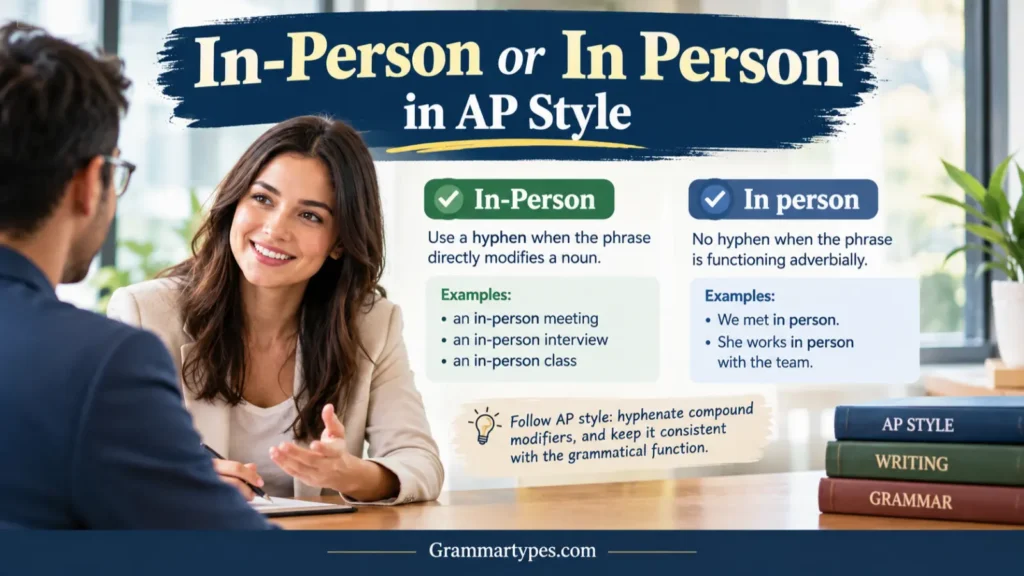
In-Person or In Person in AP Style
When writing for a publication that follows Associated Press (AP) style, pay attention to the grammatical role of the phrase and the publication’s current style guidance.
In standard edited American English, in-person is commonly hyphenated when it acts as a compound modifier before a noun:
- The reporter attended an in-person briefing.
- The company announced an in-person training session.
- Candidates must complete an in-person interview.
When the phrase describes how an action happens, the open form in person is generally preferred:
- The reporter spoke with the mayor in person.
- Candidates must appear in person.
- We discussed the proposal in person.
If you are preparing copy for a newspaper, website, or newsroom, check its current stylebook for any house-specific guidance. Do not assume that every publication handles every compound in exactly the same way.
In-Person or In Person Capitalization
In ordinary sentences, write in-person and in person in lowercase unless the phrase begins a sentence or appears in a title where your capitalization style requires otherwise.
Examples:
- We arranged an in-person meeting.
- The candidates will meet in person.
- In-Person or In Person: Which Is Correct?
In title case, capitalization depends on the title style your website follows. In sentence case, a title would normally be written “In-person or in person: Which is correct?”
The hyphenation rule does not change simply because the phrase appears in a heading. Choose capitalization for the title format and hyphenation for the phrase’s grammatical function.
Better Ways to Say “In Person”
Sometimes you may want to avoid repeating in person, especially in professional or academic writing. The best alternative depends on the context.
Face-to-face
Face-to-face is a natural alternative when two or more people meet physically.
We discussed the issue face-to-face.
Personally
Personally can work when the meaning is that someone did something themselves.
I will deliver the documents personally.
However, personally does not always mean exactly the same thing as in person, so context matters.
Physically present
This is more formal and emphasizes physical presence.
All participants must be physically present during the examination.
On-site
On-site can be useful when the meaning involves being at a particular workplace, facility, or location.
The technician will provide on-site support.
It is not a universal replacement for in person, though. Someone can be physically present without being at a designated site.
Common Mistakes With the Hyphen
Mistake 1: Leaving Out the Hyphen Before a Noun
❌ We scheduled an in person interview.
✅ We scheduled an in-person interview.
Why: In-person functions as a compound adjective modifying interview.
Mistake 2: Adding the Hyphen After a Verb
❌ We discussed the problem in-person.
✅ We discussed the problem in person.
Why: The phrase describes how the discussion happened.
Mistake 3: Writing “Inperson”
❌ We had an inperson meeting.
✅ We had an in-person meeting.
“Inperson” as one word is not the standard form. The standard choices are in-person and in person, depending on grammatical function.
Mistake 4: Hyphenating Every Use
❌ I prefer to speak in-person.
✅ I prefer to speak in person.
The fact that the phrase is sometimes hyphenated does not mean it should always be hyphenated.
Easy Way to Remember the Difference
Use this simple test:
Describing a noun? → in-person
Describing an action? → in person
For example:
in-person class → describes class
attend in person → describes attend
You can also remember it as:
Thing = in-person
Action = in person
This is not a rule that changes the meaning of the phrase. It is a practical way to identify whether the words are functioning as a compound adjective or an adverbial phrase.
Quick Practice Quiz
1. Which sentence is correct?
A. We scheduled an in person meeting.
B. We scheduled an in-person meeting.
Answer: B. In-person describes the noun meeting.
2. Which sentence is correct?
A. We met in-person yesterday.
B. We met in person yesterday.
Answer: B. In person describes how the action of meeting occurred.
3. Choose the correct form:
The university offers ______ classes.
Answer: in-person
The phrase describes the noun classes.
4. Choose the correct form:
I would rather discuss the issue _____.
Answer: in person
The phrase describes how the discussion should happen.
5. Which sentence is correct?
A. She attended an in-person interview.
B. She attended an in person interview.
Answer: A.
Final Thought
The choice between in-person or in person depends on the grammatical role of the phrase. Use in-person with a hyphen when it acts as a compound adjective directly before a noun: “an in-person meeting,” “an in-person interview,” or “in-person training.” Use in person as two words when it describes how an action happens: “We met in person” or “She attended in person.”
The phrase in person means physically present or face-to-face rather than communicating remotely. The easiest rule to remember is simple: before a noun, use in-person; when describing an action, use in person. Once you identify what the phrase modifies, the correct form becomes much easier to choose.
FAQs
Both forms are correct. Use in-person as a compound adjective before a noun, as in “an in-person meeting.” Use in person when describing an action, as in “We met in person.”
Yes. “In-person meeting” is standard because the hyphenated phrase describes the noun meeting. For example, “We scheduled an in-person meeting for Thursday.”
The usual grammatical distinction is to hyphenate in-person when it modifies a noun and to write in person when it describes an action. Writers following AP style should also consult the current AP Stylebook and their publication’s house rules.
Depending on the context, alternatives include face-to-face, personally, and physically present. However, these expressions are not always exact substitutes, so choose one according to the intended meaning.
Yes. In-person meeting is the standard form because in-person functions as a compound adjective modifying the noun meeting.
In standard usage, write meet in person. The phrase describes the action of meeting, so the hyphen is unnecessary.
No. The standard spelling is either in-person, with a hyphen, or in person, as two separate words. Inperson is not the standard form.
Explore More Grammar Guides:
Jobsite or Job Site: What Is the Difference & Which Is Correct?
Wracking or Racking: What’s the Difference and Which Spelling Is Correct?
Nosey or Nosy: What Is Difference & Which Spelling Is Correct?
Flyer or Flier: Which Spelling Is Correct?
