
Have you ever typed natzi or nazi into Google because you weren’t sure how to spell the word? The confusion is understandable: the way Nazi is pronounced can make some people think a t belongs in the written form. However, knowing the correct spelling is especially important when discussing history, politics, or educational topics.
The correct spelling is Nazi, while Natzi is not the standard English spelling of this historical term. In this article, you’ll learn the difference between the two forms, what Nazi means, how to pronounce it, why the spelling can be confusing, and how to use the word accurately in sentences.
Natzi or Nazi: Which Spelling Is Correct?
Nazi is the correct spelling. Natzi is a misspelling when it is intended to refer to the Nazi movement or its members.
English speakers write the standard spelling as N-A-Z-I, using it as both a noun and an adjective in historical and general writing.
| Spelling | Correct? | Explanation |
|---|---|---|
| Nazi | ✅ Yes | Standard English spelling |
| Natzi | ❌ No | Misspelling of Nazi |
| Natsi | ❌ No | Nonstandard spelling variation |
| Nazzi | ❌ No | Typographical or spelling variation |
For example:
- ❌ The Natzi Party controlled Germany.
- ✅ The Nazi Party controlled Germany from 1933 to 1945.
The second sentence uses the established historical spelling. The United States Holocaust Memorial Museum identifies the Nazi Party as the National Socialist German Workers’ Party, led by Adolf Hitler.
What Does Nazi Mean?
The word Nazi refers to a member or supporter of the National Socialist German Workers’ Party, commonly known as the Nazi Party. The party was led by Adolf Hitler and controlled Germany from 1933 to 1945.
The term can function as a noun or adjective.
Nazi as a noun
A noun identifies a person associated with the Nazi movement.
Examples:
- The historian studied the political rise of the Nazis.
- The museum contains documents from the Nazi era.
- The book examines the decisions made by Nazi leaders.
In these sentences, Nazi refers to people or members associated with the historical movement.
Nazi as an adjective
An adjective describes something connected to the Nazi Party, its ideology, or its historical period.
Examples:
- The documentary examines Nazi Germany.
- Researchers studied Nazi propaganda.
- The museum displays historical records from the Nazi regime.
The Cambridge Dictionary lists Nazi as both a noun and an adjective.
Why Do People Write Natzi Instead of Nazi?
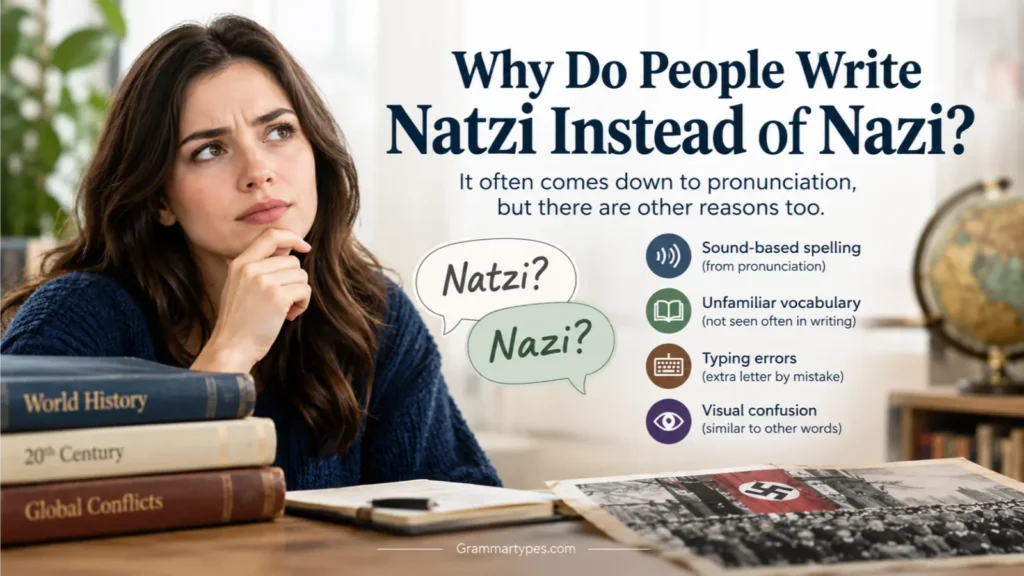
The spelling confusion is closely connected to pronunciation. English speakers may hear the word and attempt to represent its sound using letters they associate with similar words.
However, the explanation needs an important correction: Nazi is commonly pronounced with a /t/ sound in English. That sound does not mean the spelling should include the letter t.
Other possible reasons for the error include:
- Sound-based spelling: A writer tries to spell the word from its pronunciation.
- Unfamiliar vocabulary: Someone encounters the historical term without having seen it written frequently.
- Typing errors: An extra letter is entered accidentally.
- Visual confusion: The writer associates the sound with other words containing tz.
These are possible explanations rather than established findings about why every person makes this spelling mistake. The essential writing rule remains the same: use Nazi in standard English.
How Do You Pronounce Nazi?
The English pronunciation of Nazi is commonly represented as:
/ˈnɑːt.si/
A simple pronunciation guide is approximately NAHT-see.
The Cambridge Dictionary gives this pronunciation for both British and American English. Its sound-by-sound breakdown includes the /t/ sound, followed by /s/.
Pronunciation and spelling comparison
| Word | Pronunciation guide | Spelling |
|---|---|---|
| Nazi | NAHT-see | Nazi |
| Natzi | Not a standard spelling | Natzi |
The key lesson is that pronunciation and spelling do not always correspond letter by letter. Hearing a sound does not automatically tell you which letters belong in a word.
Is the T sound real?
Yes. The /t/ sound appears in common English dictionary pronunciations of Nazi. The mistake is assuming that this sound requires a written t in the word.
This distinction helps English learners understand how different spelling patterns can represent the same sounds in English.
Nazi Meaning in German and Its Origin
The English word Nazi is connected to the German term Nationalsozialist, meaning “National Socialist.” It became a commonly used shortened form associated with the National Socialist German Workers’ Party.
The full party name in German is Nationalsozialistische Deutsche Arbeiterpartei (NSDAP).
The Nazi Party rose to power in Germany in 1933 under Adolf Hitler. Its racist and antisemitic ideology contributed to persecution, dictatorship, World War II, and the Holocaust. The United States Holocaust Memorial Museum provides detailed historical information about the party and its rule.
Why historical context matters
A spelling article about Nazi should not treat the word as an ordinary invented term or casual vocabulary item without context. It refers to a specific historical political movement with a documented record of persecution and mass murder.
Accurate spelling supports clear historical communication, but correct spelling alone does not explain the significance of the events associated with the term.
Is Natzi a Bad Word?
Natzi is not the standard spelling of Nazi. Whether someone considers a word “bad” depends on the meaning, context, and use being discussed.
If Natzi is simply an accidental misspelling of Nazi, the issue is spelling accuracy. The correctly spelled word Nazi, however, refers to a historical movement associated with racist and antisemitic ideology, persecution, and the Holocaust.
Is Nazi always an insult?
Not necessarily. The word can be used in historical, academic, and descriptive contexts.
For example:
- The student wrote a report about Nazi Germany.
- The documentary discusses Nazi persecution of Jewish communities.
- The historian analyzed Nazi ideology.
The word can also appear in informal figurative expressions, such as grammar Nazi, to describe someone perceived as extremely strict about grammar. This usage is often considered offensive or insensitive because it invokes a term associated with the Nazi regime. Writers should consider their audience and context before using such expressions.
Natzi or Nazi Germany: Which Form Is Correct?
The correct phrase is Nazi Germany, not Natzi Germany.
Nazi Germany refers to Germany under the Nazi regime, particularly during the period from 1933 to 1945.
Correct examples
- Historians study Nazi Germany to understand the rise of dictatorship.
- The book describes life under the Nazi regime.
- The museum explains how Nazi policies affected Jewish communities.
Common spelling error
❌ The article discusses Natzi Germany during World War II.
✅ The article discusses Nazi Germany during World War II.
The correction is straightforward: replace Natzi with Nazi. The historical phrase does not require an additional letter.
What Is Hitler’s German Name?
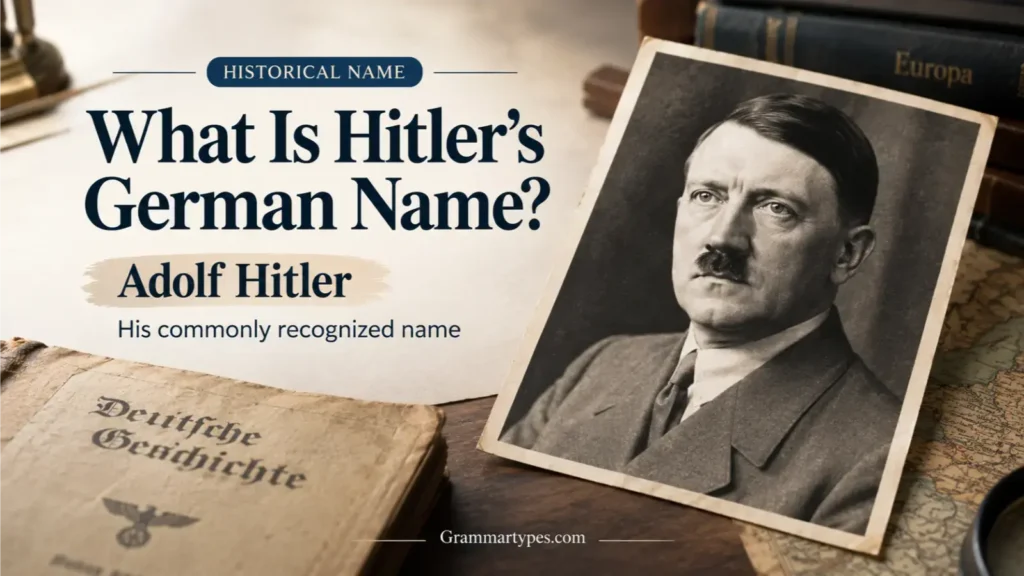
Hitler’s name was Adolf Hitler.
He was born in Austria and became the leader of Nazi Germany. He served as Germany’s chancellor beginning in 1933 and later held dictatorial power as Führer.
The question “What is Hitler’s German name?” may arise from searches about the Nazi Party, German history, or pronunciation. There is no need to change his name into a different spelling to make it German; Adolf Hitler is his commonly recognized name.
For reliable historical information, consult resources such as the United States Holocaust Memorial Museum rather than relying on informal historical claims.
Common Mistakes When Writing Nazi
Spelling mistakes can occur in school assignments, online articles, historical discussions, and general writing. The following examples show how to use the term correctly.
Mistake 1: Adding an unnecessary T
❌ The Natzi Party was established in Germany.
✅ The Nazi Party was established in Germany.
Why: The accepted spelling is Nazi. The pronunciation does not justify adding a letter t.
Mistake 2: Using the incorrect spelling in a compound phrase
❌ The documentary covers Natzi propaganda.
✅ The documentary covers Nazi propaganda.
Why: The adjective Nazi describes propaganda associated with the Nazi movement.
Mistake 3: Treating the misspelling as a separate standard word
❌ Natzi is the German spelling of the political party.
✅ Nazi is the established English spelling associated with the political party.
Why: Natzi is not the standard English spelling of the historical term.
How to Remember the Correct Spelling
A simple memory technique is to remember the four-letter form:
N-A-Z-I = Nazi
When you hear the pronunciation, don’t automatically add a t to the written word. Instead, recall the established spelling from historical books, dictionaries, and educational resources.
You can also remember the phrase:
Nazi Germany — four letters in Nazi.
This approach is more reliable than attempting to spell the word entirely from its sound.
Nazi vs. Natzi: Quick Reference
| Question | Answer |
|---|---|
| Which spelling is correct? | Nazi |
| Is Natzi standard English? | No, when intended as a spelling of Nazi |
| What does Nazi mean? | A member or adjective associated with the Nazi movement |
| How is Nazi pronounced? | Approximately NAHT-see |
| Is Nazi used as a noun? | Yes |
| Is Nazi used as an adjective? | Yes |
| Is Nazi Germany correct? | Yes |
| What was Hitler’s name? | Adolf Hitler |
When Should You Use the Word Nazi?
Use Nazi when discussing the historical political movement, its members, its ideology, its government, or associated historical subjects.
The word is appropriate in factual contexts such as:
- History essays
- Educational articles
- Museum descriptions
- Academic research
- Historical documentaries
- Journalism
Examples:
- The history course covers the Nazi Party’s rise to power.
- The author researched Nazi persecution during the Holocaust.
- The documentary explores the political history of Nazi Germany.
When writing about the subject, prioritize historical accuracy and avoid casual language that trivializes persecution or the experiences of victims.
Is There a Plural Form of Nazi?
Yes. The standard English plural form is Nazis.
| Singular | Plural |
|---|---|
| Nazi | Nazis |
Examples:
- The historian studied the actions of Nazi leaders.
- The museum documents the crimes committed by the Nazis.
- Several books examine the policies of the Nazi regime.
The plural is formed by adding -s to the singular noun. The spelling does not change to Natzis.
Is Nazi a Formal or Informal Word?
Nazi is a standard word used in formal historical, academic, and journalistic writing. Its appropriateness depends on the context and the accuracy of the statement.
For example, a formal research paper may discuss the Nazi Party, Nazi ideology, or Nazi Germany. These are established historical terms.
However, using Nazi as a casual label for someone who is merely strict or demanding can be insensitive or misleading. Writers should distinguish historical description from figurative insult.
Final Thought
When choosing between natzi or nazi, the correct spelling is Nazi. The word refers to a member or something associated with the National Socialist German Workers’ Party, the movement led by Adolf Hitler. Natzi is not the standard English spelling of this term.
Remember that Nazi is pronounced with a /t/ sound in common English, but the written form contains no t. Whether you’re writing a history assignment, explaining Nazi Germany, or checking a spelling question, use the established form and consider the historical context. Accurate spelling and responsible language help readers understand important subjects clearly.
FAQs
The correct spelling is Nazi. Natzi is a misspelling when referring to the historical Nazi movement or its members. The standard form contains four letters: N-A-Z-I.
Natzi is not the standard spelling of Nazi. If it is an accidental misspelling, it is a spelling error. The correctly spelled word refers to a historical movement associated with persecution, racism, antisemitism, and the Holocaust.
Hitler’s name was Adolf Hitler. He became the leader of Nazi Germany and held dictatorial power during the Nazi regime.
Nazi refers to a member or supporter of the National Socialist German Workers’ Party, led by Adolf Hitler. It can also function as an adjective describing something connected to the Nazi Party or its ideology.
In common English, people pronounce Nazi with a clear /t/ sound, making it sound like “NAHT-see.”
Pronunciation in English
The plural of Nazi is Nazis. For example: “The historian studied the policies of the Nazis.”
Yes. Nazi Germany is the standard historical phrase for Germany under Nazi rule, especially during the period from 1933 to 1945.
The spelling confusion may result from pronunciation, unfamiliarity with the written word, or typing errors. The /t/ sound in the English pronunciation does not mean that a written t belongs in Nazi.
Explore More Grammar Guides:
Nosey or Nosy: What Is Difference & Which Spelling Is Correct?
Jobsite or Job Site: What Is the Difference & Which Is Correct?
You Too or You To: Which Is Correct? Complete Grammar Guide
Flyer or Flier: Which Spelling Is Correct?

Pingback: Discard or Disgard: Which Spelling Is Correct? (2026)