
Have you ever typed “goodmorning” in a text message or email, then wondered whether you should leave a space between the two words? If you’re asking goodmorning or good morning, this small spelling question can cause confusion, especially when familiar expressions sound like they belong together.
The difference between goodmorning or good morning is straightforward, but it also raises questions about capitalization, punctuation, professional greetings, and everyday usage. Expressions such as “goodnight” can make the spelling seem less predictable.
In this guide, you’ll learn which form is correct, why the greeting is written separately, how to use it in emails and conversations, and how to avoid common mistakes. You’ll also find useful examples, a comparison with “goodnight,” and answers to related questions about morning greetings.
Quick Answer: Goodmorning or Good Morning?
The correct standard English form is good morning, written as two separate words. When used as a greeting, it is an expression used to say hello politely when meeting someone in the morning. Cambridge Dictionary classifies it as an exclamation.

English meaning – Cambridge Dictionary
+1
| Form | Correct? | Explanation |
|---|---|---|
| Good morning | ✅ Yes | Standard English greeting |
| Goodmorning | ❌ No | Not the standard spelling of the greeting |
| Good Morning | ✅ Context-dependent | Acceptable capitalization in some headings or styles |
| Good morning, Sarah. | ✅ Yes | Correct greeting with direct address |
Correct Examples
- Good morning, everyone!
- Good morning, Sarah. How are you?
- I hope you have a good morning.
- Good morning, team. Let’s begin the meeting.
Incorrect Standard Spelling
- Goodmorning, everyone. ❌
- Goodmorning, Sarah! ❌
- I said goodmorning to my teacher. ❌
Easy rule: Write good morning as two words when you mean the everyday greeting.
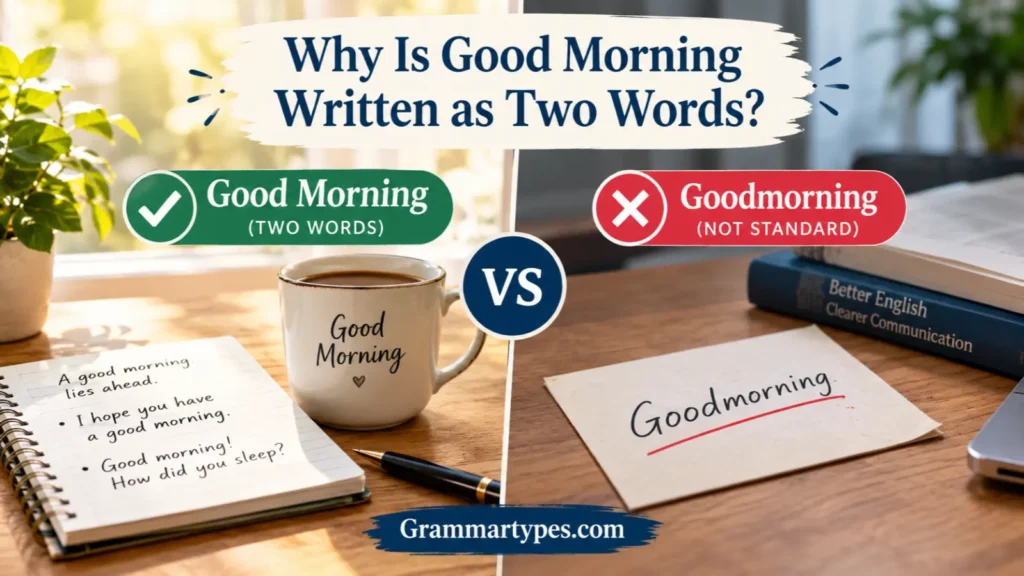
Why Is Good Morning Written as Two Words?
The expression “good morning or goodmorning” consists of two separate words: good and morning. In its ordinary greeting use, the words are not combined into a single standard English word.
The word good is an adjective that can describe a noun, while morning is a noun referring to a part of the day. However, the greeting itself functions as a conventional expression rather than simply a complete adjective-noun sentence.
For example:
- A good morning lies ahead.
- I hope you have a good morning.
- Good morning! How did you sleep?
In the first two examples, “good morning” appears within a sentence describing or wishing for a pleasant morning. In the last example, it functions as a greeting.
Is Goodmorning a Compound Word?
No. Goodmorning is not the standard closed compound spelling for this greeting.
English includes both open phrases and compound words, and not every combination of words follows the same spelling pattern. For example:
| Open phrase | Closed compound |
|---|---|
| Good morning | Bedroom |
| Good afternoon | Notebook |
| Good evening | Football |
This comparison is only about spelling patterns. It does not mean every adjective and noun must always remain separate.
When writing the familiar greeting, use the established form goodmorning or good morning.
Good Morning Meaning and Usage
What does “good morning” mean? It is a polite greeting used when you meet someone during the morning. It can also be used as a friendly opening in spoken or written communication.
In simple English, it expresses a friendly wish for a pleasant morning or serves as a polite way to say hello.
Examples of Meaning
Example 1: Greeting someone
Good morning! How are you today?
Here, the speaker is greeting another person in the morning.
Example 2: Wishing someone well
I hope you have a good morning.
In this sentence, “good morning” refers to having a pleasant morning, rather than serving as a direct greeting.
Example 3: Greeting a group
Good morning, everyone. Welcome to the workshop.
The speaker is politely addressing a group.
When Do You Use Good Morning?
There is no universal requirement that you stop using “good morning” at a specific minute. It is generally associated with the morning, and the exact time people use it can depend on the context and local habits.
You can use it when:
- Meeting someone in the morning.
- Starting a school class.
- Beginning a workplace meeting.
- Greeting a customer in the morning.
- Opening a morning email.
- Sending a friendly message to a friend.
The greeting remains appropriate in both formal and informal communication.
Good Morning in Formal and Informal Communication
One reason people search for the correct spelling is that they want to communicate clearly and appropriately. Fortunately,goodmorning or good morning works in many different settings.
Good Morning in Professional Emails
In a professional email, the greeting can be polite, direct, and natural.
Examples:
Good morning, Ms. Taylor,
Good morning, team. I am writing to share the updated schedule.
Good morning, Professor Smith. Thank you for your feedback.
Use the spelling “good morning” with a space. Your choice of greeting can also depend on how formal your relationship is with the recipient.
For a more formal message, you may include the person’s title and name. In a familiar workplace, “Good morning, team” may be sufficient.
Good Morning in Text Messages
The same two-word spelling applies to casual texts.
Examples:
Good morning! Hope you slept well.
Good morning, buddy! Have a great day.
Good morning 😊
Texting often includes shortened expressions, emojis, and creative formatting. These informal habits do not change the standard spelling of the greeting.
A person may write “goodmorning” in a casual message, but it remains a nonstandard spelling when intended as the ordinary English greeting.
Capitalization Rules for Good Morning
Capitalization depends on where the phrase appears and the writing style being used.
1. At the Beginning of a Sentence
Capitalize the first word of the sentence.
✅ Good morning! I hope you’re doing well.
The word “morning” remains lowercase because it is not a proper noun.
2. In the Middle of a Sentence
Use lowercase when the phrase appears within an ordinary sentence.
✅ I said good morning to my neighbor.
The first word is lowercase because the expression is not beginning a sentence.
3. In an Email Greeting
Both of the following styles can be encountered:
Good morning, Alex,
Good Morning, Alex,
The first follows sentence-style capitalization. The second may reflect a heading or title-style convention used by some writers.
For consistent professional writing, sentence-style capitalization is a clear choice:
Good morning, Alex,
Follow your organization’s preferred style when one exists.
4. In Titles and Headings
Titles can use title case according to the chosen style guide.
Examples:
- Good Morning Messages
- Good Morning Quotes
- Good Morning Wishes
Here, capitalizing both words can be appropriate because the phrase is part of a title, not an ordinary sentence.
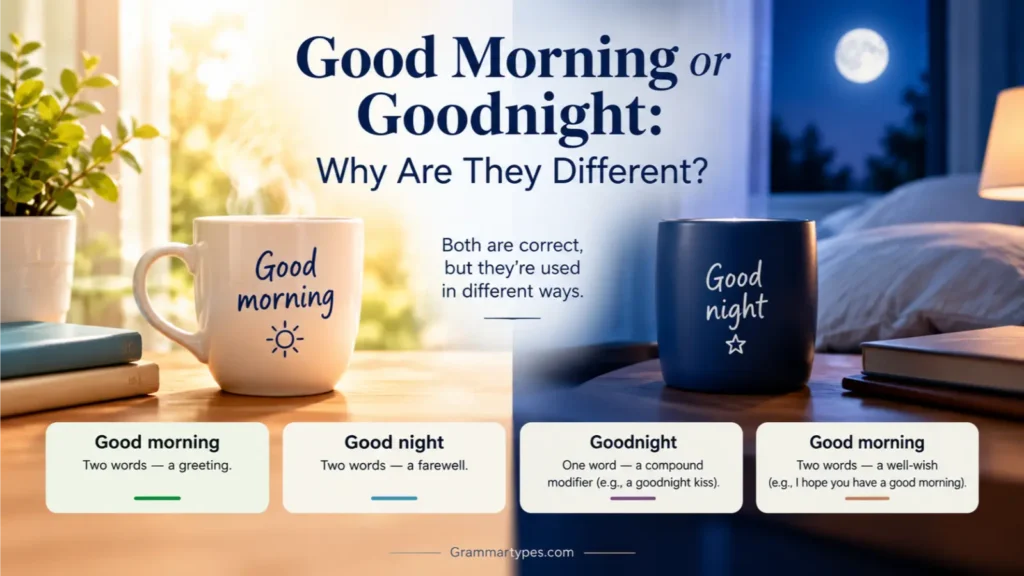
Good Morning or Goodnight: Why Are They Different?
A common question is whether “good morning” and “goodnight” should follow the same spelling pattern.
The key distinction is that English has established different forms for these expressions. Good morning is written as two words. “Goodnight” also exists as a closed form in certain uses, while “good night” is used as a phrase in expressions such as “Have a good night.”
Consider these examples:
| Expression | Example | Usage |
|---|---|---|
| Good morning | Good morning, everyone. | Morning greeting |
| Good night | Good night, everyone. | Nighttime farewell |
| Goodnight | A goodnight kiss | Compound modifier |
| Good morning | I hope you have a good morning. | Well-wish |
The important lesson is not to assume that similar expressions must share identical spelling patterns.
Is Good Morning and Goodnight One Word?
The standard greeting good morning is two words.
“Goodnight” can be written as one word in particular compound uses, such as “goodnight kiss.” However, the phrase “good night” is also used separately as a farewell.
Therefore, the presence of a closed form for “goodnight” does not make “goodmorning” a standard spelling.
Good Morning in American and British English
The spelling good morning is used in both American and British English.
There is no standard American-versus-British spelling difference that changes “good morning” into “goodmorning.” Cambridge Dictionary provides both British and American pronunciation information for the expression.
Examples in both varieties include:
- Good morning! How are you?
- Good morning, everyone.
- Good morning, Professor.
The greeting is widely understood across English-speaking contexts.
Common Mistakes With Good Morning
Knowing the correct spelling is useful, but writers can also make mistakes with punctuation and capitalization.
Mistake 1: Joining the Words Together
❌ Goodmorning, Sarah!
✅ Good morning, Sarah!
Why? The standard greeting is written as two words. Adding a space corrects the spelling.
Mistake 2: Using a Hyphen
❌ Good-morning, everyone!
✅ Good morning, everyone!
A hyphen is not needed when using “good morning” as the ordinary greeting.
However, punctuation and hyphenation can vary in other grammatical constructions, so do not apply this rule to every possible phrase containing “good” and “morning.”
Mistake 3: Missing the Comma in Direct Address
When directly addressing someone or a group, a comma is generally used to separate the greeting from the addressee.
❌ Good morning Sarah.
✅ Good morning, Sarah.
❌ Good morning everyone.
✅ Good morning, everyone.
The comma helps clarify that “Sarah” or “everyone” is being addressed.
Mistake 4: Unnecessary Capitalization
❌ I said Good Morning to my friend.
✅ I said good morning to my friend.
In the middle of a sentence, lowercase is normally appropriate unless a particular style or formatting context requires otherwise.
How to Remember the Correct Spelling
If you often confuse goodmorning or good morning, use a simple memory technique.
Remember the Space
Think of the expression as:
Good + space + morning
You are writing two words, not creating a new closed compound word.
Compare Similar Greetings
Remember these familiar forms:
- Good morning
- Good afternoon
- Good evening
These greetings are written as separate words in their ordinary uses.
Read Before Sending
Before sending an email or message, quickly check the greeting:
❌ Goodmorning
✅ Good morning
This small review can help you avoid an unnecessary spelling error.
Flirty and Friendly Ways to Say Good Morning
Some people search for morning greetings because they want to send a warm, playful, or romantic message. The standard spelling does not change based on the tone.
Here are some original examples:
Friendly
Good morning! Wishing you a peaceful and productive day.
Sweet
Good morning! I hope today brings you plenty of reasons to smile.
Flirty
Good morning, you. I hope I’m one of the first things that makes you smile today.
Romantic
Good morning, love. I hope your day is as wonderful as you are.
These examples are communication suggestions rather than grammar rules. Choose a greeting that suits your relationship with the recipient.
Good Morning Quotes, Texts, and Messages
The phrase “good morning” can be used in many kinds of written content.
A Simple Good Morning Text
Good morning! I hope your day starts with good news and ends with a smile.
Sending Good Morning Wishes to a Friend
Good morning, my friend! Take things one step at a time and enjoy your day.
Good Morning for a Professional Audience
Good morning, everyone. Thank you for joining today’s discussion.
Good Morning Quote
Good morning is a small greeting that can begin a thoughtful conversation.
The phrase should remain two words regardless of whether it appears in a text, social media caption, message, or quote.
Mini Quiz: Test Your Grammar
Question 1: Which spelling is correct?
A. Goodmorning
B. Good morning
Answer: B. Good morning
The standard greeting is written as two separate words.
Question 2: Choose the correct punctuation.
A. Good morning everyone!
B. Good morning, everyone!
Answer: B. Good morning, everyone!
The comma separates the greeting from the directly addressed group.
Question 3: Which sentence uses the correct capitalization?
A. I said Good Morning to my teacher.
B. I said good morning to my teacher.
Answer: B. I said good morning to my teacher.
The phrase appears in the middle of the sentence, so lowercase is appropriate.
Question 4: Which is suitable for a professional email?
A. Goodmorning team
B. Good morning, team.
Answer: B. Good morning, team.
The second example uses the standard spelling and appropriate punctuation.
FAQs
Good morning is the correct standard English spelling for the greeting. It is written as two separate words. “Goodmorning” is not the standard form of this expression.
No. When you use the expression as an ordinary English greeting, write it as good morning, with a space.
Yes. “Good morning” is appropriate for professional emails, workplace communication, academic messages, and other formal situations. You can adjust the greeting based on the recipient and context.
It can be. Titles often follow title-case capitalization, which may capitalize both “Good” and “Morning.” In ordinary sentences, only the first word is normally capitalized when the greeting begins the sentence.
Good morning works in both formal and informal communication. Your wording, punctuation, and additional message determine the overall tone.
You can write, “Good morning, you. I hope I’m one of the first things that makes you smile today.” A flirty greeting should match your relationship with the recipient.
Not as the standard spelling of the everyday greeting. A business name, username, or other proper name may have its own spelling, but that does not change the standard greeting.
The standard greeting good morning is two words. “Goodnight” is an accepted closed form in certain uses, such as “goodnight kiss,” while “good night” is used as a separate phrase for a farewell.
Final Thought
The correct answer to goodmorning or good morning is good morning, written as two separate words. It is the standard form used in morning greetings, professional emails, texts, conversations, and educational writing.
Although “goodmorning” may appear in informal online communication or creative names, it is not the standard spelling of the everyday greeting. Remember that capitalization depends on sentence position and writing style, while a comma is useful when directly addressing someone.
Whether you’re greeting a teacher, coworker, friend, or family member, use the simple form: Good morning! A small spelling detail can make your communication clearer and more polished.
Explore More Grammar Guides:
You Too or You To: Which Is Correct? Complete Grammar Guide
Patriot vs Patriotic: Which Word Should You Use on Patriot Day?
Flyer or Flier: Which Spelling Is Correct?
[authorbox]

Pingback: Good Afternoon: The Right Time, Meaning & Greetings