
Have you ever typed “prooving” and wondered whether it should actually be “proving”? The extra o can look tempting, especially because prove contains the long /uː/ sound. This makes prooving or proving an easy spelling question to hesitate over.
The answer is straightforward: proving is the standard spelling of the -ing form of prove. The form prooving is a misspelling when you mean the verb prove. However, there is another source of confusion involving proofing, proofed, and bread dough, because prove and proof can have specialized baking meanings.
This article explains why proving is correct, how the spelling is formed, what proving means, and how it differs from proofing, proofed, proved, and related forms.
Prooving or Proving: Which Is Correct?
Proving is the correct standard English spelling. Prooving is an incorrect spelling when it is intended as the -ing form of prove.
The correct formation is:
prove → proving
The final e in prove is removed before the -ing ending is added. Cambridge lists proving as the present participle of prove, and defines prove in senses including showing that something is true or showing a particular result or quality.
| Form | Correct? | Example |
|---|---|---|
| prove | ✅ Yes | I need to prove my point. |
| proving | ✅ Yes | She is proving her argument. |
| prooved | ❌ No | — |
| proove | ❌ No | — |
| prooving | ❌ No | — |
So if you are writing “He is proving his point,” the word should contain only one o after the r.
Why Is “Prooving” Incorrect?
The mistake usually comes from treating prove as though its letters should simply remain unchanged when -ing is added.
That would produce:
prove + ing → prooving
But English spelling does not work that way for this verb.
Instead, the final silent e is removed:
prove → prov + ing → proving
The same general pattern appears in words such as:
- move → moving
- love → loving
- hope → hoping
- write → writing
- make → making
- use → using
Therefore:
prove → proving
not:
prove → prooving

What Does “Proving” Mean?
Proving is the present participle of prove. It generally means showing or establishing that something is true, correct, effective, valid, or genuine. It can also describe something that turns out to have a particular quality over time. Cambridge gives examples of prove in both of these senses.
For example:
- She is proving that the theory works.
- He is proving his point with strong evidence.
- The new method is proving effective.
- They are proving the theorem step by step.
The word can also function as a gerund:
Proving the claim required additional evidence.
Here, proving the claim functions as a noun-like phrase and acts as the subject of the sentence.
As a present participle:
She is proving her point.
Here, proving forms part of the progressive verb phrase.
The grammatical function can change, but the spelling remains proving.
Why Does “Prove” Become “Proving”?
The spelling follows the common pattern for verbs ending in a final silent e.
When -ing is added to many such verbs, the final e is dropped.
| Base verb | -ing form |
|---|---|
| prove | proving |
| move | moving |
| hope | hoping |
| write | writing |
| drive | driving |
| save | saving |
| create | creating |
The important point is that the spelling change does not involve adding another o.
The word prove already has o and e in its spelling. The final e disappears:
prove → proving
That is why prooving is not the standard -ing form.
What About “Proove”?
Proove is also not the standard modern spelling of the verb meaning “to demonstrate that something is true.”
The standard base form is:
prove
Its common forms include:
- prove
- proves
- proved
- proving
- proven
So these are incorrect when intended as forms of the modern verb prove:
- proove
- prooves
- prooved
- prooving
The spelling starts with the correct base word prove, and the other forms follow from it.
Proving vs. Proofing: What Is the Difference?
This is an important distinction because searches for “prooving or proving bread” can actually involve a different vocabulary question.
Proving and proofing are not simply two spellings of the same word.
In ordinary contexts, prooving or proving comes from prove and means demonstrating or establishing something.
The evidence is proving the claim.
Proofing, on the other hand, comes from proof and can mean checking something for errors, preparing something, or, especially in baking, allowing dough to rise.
For example:
I am proofing the article before publication.
Here, proofing means checking the article.
In baking:
The dough is proofing before it goes into the oven.
Here, proofing refers to the process that allows yeast dough to rise.
The American Heritage Dictionary lists proofing as a form of proof and gives baking senses involving activating yeast and working dough into the proper lightness.
Is “Proving” Also Used for Bread?
Yes, and this is where regional usage can make the topic more confusing.
Oxford records prove as a verb with a specific bread-related meaning: dough can prove by swelling before baking because of yeast. Its example includes “while the dough is proving.”
Therefore, in some English varieties, especially British English, you may see:
The dough is proving.
This is a legitimate use of proving, but it has a baking meaning.
In American English, proofing is also widely used for the same general baking process:
The dough is proofing.
So proving bread is not necessarily a spelling mistake. The context matters.
Proving or Proofing Bread: Which Should You Use?
If you are talking about bread dough, both proving and proofing can be encountered, but usage varies by variety of English and context.
A useful distinction is:
- proving — traditionally common in British English for dough rising
- proofing — widely used for the baking process, especially in American English
Oxford explicitly records prove in the sense of dough swelling before baking.
For example:
British-style usage:
Leave the dough somewhere warm while it is proving.
Common American-style usage:
Leave the dough somewhere warm while it is proofing.
Neither should be confused with prooving, which is not the standard spelling of either word.
If your article or recipe is intended for an international audience, proofing may be clearer when you specifically mean the baking process, because it avoids confusion with the more common meaning of proving.
Proved or Proofed: Which Is Correct?
The answer depends on what you mean.
Proved is the past-tense form of prove.
The experiment proved successful.
It can also be used as a past participle:
The evidence has proved the claim.
Cambridge lists proved as a standard past form and also recognizes proven, particularly in American usage.
Proofed, meanwhile, is a valid form of the verb proof. It has meanings such as checking written material for errors or performing certain baking-related processes.
For example:
The editor proofed the document before publication.
And in baking:
The baker proofed the dough overnight.
So proved and proofed are not interchangeable.
Quick Comparison
| Word | Comes from | Main meaning | Example |
|---|---|---|---|
| proving | prove | demonstrating or establishing | She is proving her point. |
| proved | prove | past form of prove | The test proved successful. |
| proven | prove | past participle/adjective | It is a proven method. |
| proofing | proof | checking/preparing; baking process | The dough is proofing. |
| proofed | proof | past form of proof | The editor proofed the article. |
This distinction directly answers the question “Which is correct: proved or proofed?” Both are correct words, but they belong to different verbs and therefore have different meanings.
Common Mistakes With “Proving”
1. Writing “Prooving”
❌ Incorrect: She is prooving her point.
✅ Correct: She is proving her point.
Why: Prove loses its final silent e before -ing.
2. Writing “Proveing”
❌ Incorrect: He is proveing that the answer is correct.
✅ Correct: He is proving that the answer is correct.
Why: The final e is removed rather than retained.
3. Using “Proofing” When You Mean “Proving”
❌ Incorrect: The evidence is proofing that the claim is true.
✅ Correct: The evidence is proving that the claim is true.
Why: When you mean “demonstrating that something is true,” the correct verb is prove, giving proving.
4. Using “Proving” When You Mean Editing
❌ Incorrect: I am proving the article for spelling mistakes.
✅ Correct: I am proofing the article for spelling mistakes.
Why: Proofing can mean checking written material for errors.
5. Assuming “Prooving” Is a British Spelling
❌ Incorrect idea: Prooving is the British version of proving.
✅ Correct: Proving is the standard spelling in both American and British English.
The regional difference is more relevant to specialized uses such as proving/proofing dough, not to the spelling of the -ing form of prove.
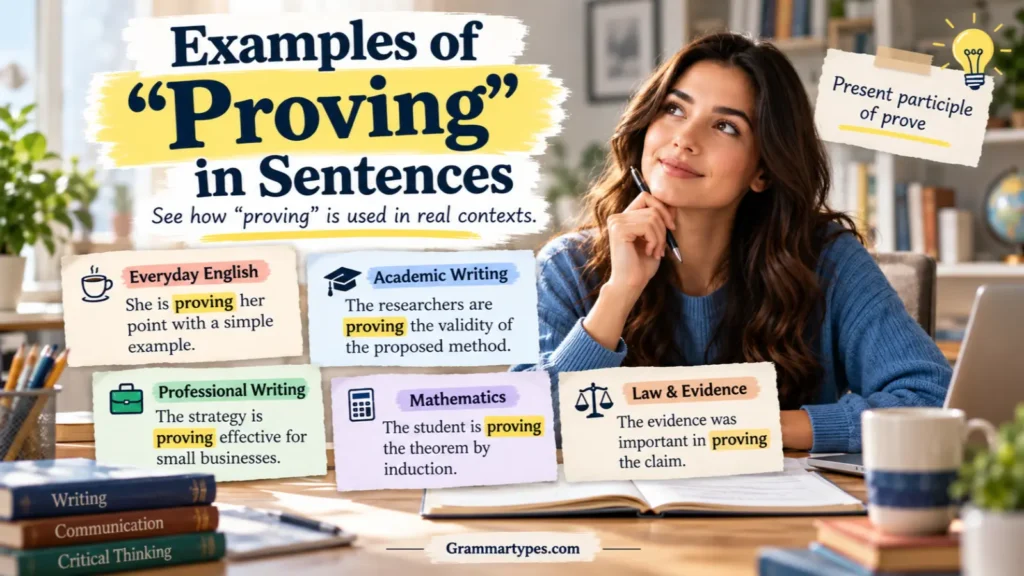
Examples of “Proving” in Sentences
Seeing the correct form in different contexts can make the spelling easier to remember.
Everyday English
- You keep proving that you can handle difficult situations.
- She is proving her point with a simple example.
- He is proving everyone wrong.
Academic Writing
- The researchers are proving the validity of the proposed method.
- The students practiced proving mathematical statements.
- The evidence is useful for proving the relationship between the two variables.
Professional Writing
- The new system is proving more reliable than expected.
- The strategy is proving effective for small businesses.
- The results are proving valuable to the research team.
Mathematics
- The student is proving the theorem by induction.
- Proving the statement requires several logical steps.
- The exercise focuses on proving that the two expressions are equivalent.
Law and Evidence
- The prosecution focused on proving the required elements of the case.
- The evidence was important in proving the claim.
The exact legal standard of proof depends on the jurisdiction and type of proceeding, but the spelling of the verb remains proving.
Proving vs. Proved vs. Proven
These forms all come from prove, but they serve different grammatical purposes.
| Form | Typical use | Example |
|---|---|---|
| prove | Base verb | We need to prove the claim. |
| proves | Present tense, third person singular | The evidence proves the point. |
| proving | -ing form | She is proving the theory. |
| proved | Past tense/past participle | The experiment proved successful. |
| proven | Past participle/adjective | It is a proven method. |
Both proved and proven are established forms, although their distribution varies by construction and variety of English. Cambridge notes proved or mainly US proven in its dictionary entry.
The key point for this article is that neither proved nor proven changes the spelling of proving.
Easy Way to Remember the Correct Spelling
Use this simple formula:
PROVE → remove E → PROV + ING → PROVING
Think of these pairs:
- move → moving
- love → loving
- hope → hoping
- prove → proving
If you remember prove → proving, you will avoid both major mistakes:
❌ prooving
❌ proveing
✅ proving
The simplest rule is: When you add -ing to prove, drop the final e. Do not add another o.
Is “Prooving” a Common Misspelling?
Yes, prooving can occur as a spelling mistake because the pronunciation of prove makes the extra o seem plausible.
The confusion is understandable: prove contains the letters o and e, while its pronunciation contains a long vowel sound. A writer may incorrectly assume that the sound should be represented by an additional o when adding -ing.
But the standard written form is fixed:
prove → proving
There is no standard spelling variation prooving.
Final Thoughts
When choosing between prooving or proving, use proving. It is the standard -ing form of the verb prove, meaning to demonstrate, establish, or show that something is true or effective. The spelling follows the familiar pattern of removing the final silent e before adding -ing: prove → proving.
Do not write prooving or proving when you mean this verb form. Also keep proving separate from proofing, which can refer to checking text or allowing bread dough to rise. In baking, proving itself can also be used, particularly in British English.
The easiest rule to remember is simple: prove loses its final e before -ing, giving proving not prooving.
FAQs
No. When intended as the -ing form of prove, prooving is a misspelling. The correct form is proving.
Prove is correct. Proove is not the standard modern spelling of the verb meaning to demonstrate or establish something as true.
It is spelled P-R-O-V-I-N-G.
The word comes from prove, with the final e removed before -ing is added.
Both are correct, but they come from different verbs. Proved is the past form of prove, while proofed is the past form of proof. For example, “The experiment proved successful” and “The editor proofed the document” use the words correctly.
It is a recognizable spelling mistake caused by incorrectly retaining or extending the vowel pattern in prove. The correct form is always proving when you mean the -ing form of prove.
Proving generally means demonstrating or establishing something. Proofing can mean checking something for errors or, in baking, allowing dough to rise. They come from different verbs.
Both expressions can occur. Proving is especially associated with British baking terminology, while proofing is widely used for the baking process, particularly in American English. Oxford records prove specifically for dough rising before baking.
Explore More Grammar Guides:
Discard or Disgard: Which Spelling Is Correct?
Puddy or Putty: Which Spelling Is Correct? (2026 Guide)
Greatly or Grately: Which Spelling Is Correct? (2026 Guides)
Fulness or Fullness: Which Is Correct? Meaning & Examples
