
Have you ever paused while writing a sentence to decide whether to use farther vs further? These two words look and sound similar, and both can describe distance. However, they are not interchangeable in every situation, and understanding the difference between them can help you choose the right word with confidence.
The traditional grammar rule is straightforward: use farther for physical distance and further for additional information, progress, or an abstract degree. In everyday English, though, the distinction is not absolute. Further can also refer to physical distance, which is why you may see both words used in similar sentences.
Understanding the difference between farther vs further helps you choose words more confidently in emails, essays, conversations, and professional writing. Below, you will find clear definitions, practical examples, regional usage notes, common expressions, and a short quiz to help you remember the rule.
What Is the Difference Between Farther and Further?
Farther traditionally refers to a greater physical distance, while further commonly means additional, more, or to a greater extent. Both words can describe distance, but further has meanings that farther does not.
Compare these examples:
- Farther: The gas station is farther down the highway.
- Further: We need further information before making a decision.
- Further: Let’s discuss this issue further tomorrow.
In the first sentence, farther describes a physical location. In the second, further means additional. In the third, it means continuing the discussion in greater detail.
The distinction is useful, but it is not a rigid rule for every context. Major dictionaries recognize that farther and further overlap when describing distance.
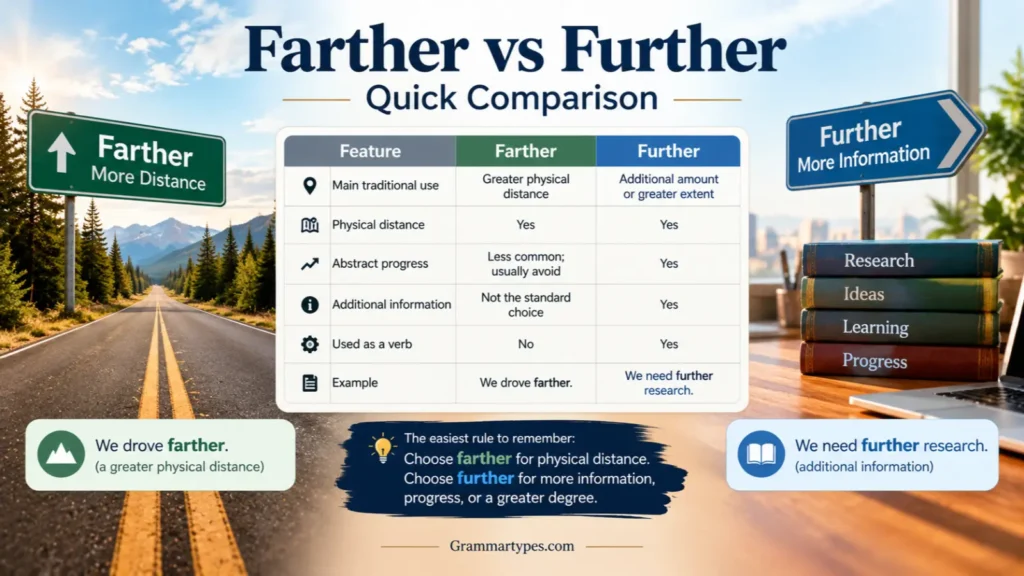
Farther vs Further: Quick Comparison
| Feature | Farther | Further |
|---|---|---|
| Main traditional use | Greater physical distance | Additional amount or greater extent |
| Physical distance | Yes | Yes |
| Abstract progress | Less common; usually avoid | Yes |
| Additional information | Not the standard choice | Yes |
| Used as a verb | No | Yes |
| Example | We drove farther. | We need further research. |
The easiest rule to remember: choose farther when you want to emphasize measurable physical distance. Choose further for additional information, continued discussion, progress, or a greater degree. When referring to distance, either word may be acceptable depending on the sentence and regional usage.
When Should You Use Farther?
Use farther when you want to describe a greater physical distance, especially in American English. It is useful when comparing locations, travel distances, walking routes, or how far apart two objects are.
Examples of farther in a sentence
- We walked farther than we had planned.
- The nearest pharmacy is farther from here than the grocery store.
- Can you throw the ball farther than your brother?
- Their new house is farther away from the city center.
- Move the chair a little farther from the window.
- We drove ten miles farther before finding a hotel.
- The hikers traveled farther along the trail before taking a break.
In each example, farther describes physical distance or movement through space.
Is it farther away or further away?
Both farther away and further away are acceptable when describing physical distance.
- The school is farther away than I expected.
- The school is further away than I expected.
The first version follows the traditional American English preference for farther when discussing measurable distance. The second is also standard, particularly in British English, where further is frequently used for physical distance.
For formal American English, farther away is a reliable choice when the meaning is clearly physical.
When Should You Use Further?
Use further when you mean additional, more, to a greater extent, or to advance something. Unlike farther, it works naturally in several expressions that have nothing to do with physical distance.
1. Further means additional
When you want to indicate something extra or something more, use further.
Examples:
- Please contact us if you need further assistance.
- Do you have any further questions?
- We need further information before approving the application.
- The company announced a further increase in prices.
- The school will provide further details next week.
In these sentences, further means additional. Replacing it with farther would sound incorrect or unnatural in standard contemporary English.
2. Further means to a greater extent
You can use further when discussing an idea, an argument, a process, or a situation that needs to develop or continue.
Examples:
- We should investigate the complaint further.
- Let me explain the problem further.
- The new evidence further complicated the investigation.
- She wants to explore the subject further.
- The discussion helped us understand the issue further.
Here, the word describes depth, degree, or continued examination rather than a measurable distance.
3. Further as a verb
One important difference in the farther vs further comparison is that further can function as a verb meaning to advance, promote, or help something progress.
Examples:
- She took additional courses to further her career.
- The organization raised funds to further its mission.
- These changes should further our efforts to improve customer service.
- He hopes to further his education next year.
You cannot ordinarily replace the verb further with farther in these sentences.
4. Further as a transition word
Further can also introduce an additional point, particularly in formal writing.
Example:
The proposal requires additional funding. Further, the team needs more time to complete the research.
In this context, further means something like “in addition.” Farther does not have this standard transitional use.
Is It Money Goes Further or Farther?
The usual expression is “money goes further.”
When people say that their money goes further, they mean that the same amount of money buys more goods or services, covers more expenses, or provides greater value.
Examples:
- Your money goes further when you shop during seasonal sales.
- Moving to a less expensive city can help your salary go further.
- We compared grocery prices to make our budget go further.
- Buying in bulk may help your money go further, provided you use everything you buy.
Why further? The expression refers to purchasing power or the amount of value money provides, not simply the physical distance it travels.
Although farther can be used in some figurative distance contexts, “make your money go further” is the established and natural expression for getting more value from your budget.
Farther vs Further for Time and Abstract Distance
The difference becomes less straightforward when a sentence refers to time, progress, or metaphorical distance. Both words have historically been used in a range of distance-related contexts, including time and abstract extent. However, further is often the more natural choice for figurative meanings.
Farther vs further in time
Consider these examples:
- We cannot postpone the meeting any further.
- The deadline is three days farther into the future than we expected.
- We will discuss the remaining details at a further meeting.
- The launch date has been pushed further into the year.
The first sentence uses further to mean any more. The third uses it to mean an additional meeting. The other examples concern time as a kind of distance, where usage may vary.
For ordinary writing, use further for continued delay, additional stages, or developments. Use farther when you deliberately want to emphasize a comparison involving distance in time, though further is also acceptable in such contexts.
Further along vs farther along
Both expressions can be correct, but context helps determine the most natural choice.
- Physical location: We walked farther along the river.
- Progress: She is further along in her training than I am.
- A project: The team is further along than expected.
- A route: The next gas station is farther along the highway.
When the sentence focuses on physical travel, farther along is a useful choice in American English. When it describes progress or development, further along is generally preferable.
Farther or further from the truth?
The established expression is “nothing could be further from the truth.”
For example:
He thinks I deliberately ignored his message, but nothing could be further from the truth.
The expression means that an idea or claim is completely inaccurate. Here, further describes an abstract degree of difference, not physical distance.
You may encounter farther from the truth in actual writing, but further from the truth is the familiar, conventional wording. It is the safer choice for essays, articles, and professional communication.
Why Do Americans Say Farther Instead of Further?
American English often favors farther for literal, measurable distance and further for additional information, progress, or abstract meanings. This is a common usage preference rather than an absolute grammatical rule.
For example:
- American preference: We drove farther than we intended.
- Also acceptable: We drove further than we intended.
- Standard usage: We need further research.
- Standard usage: The training will further her career.
British English tends to use further more frequently for physical distance, too. Oxford’s learner’s dictionaries identify farther and further as alternatives for distance while noting that further is preferred for meanings such as additional or to a greater extent.
Canadian English and other varieties can show similar variation. Therefore, it is more helpful to understand the meaning and follow your chosen style guide than to assume that one word is always correct in a particular country.
Farther vs Further Pronunciation
In American English, the two words are pronounced approximately as follows:
- Farther: FAR-thur — /ˈfɑːrðər/
- Further: FUR-thur — /ˈfɝːðər/
The first syllable is the main difference. Farther begins with the vowel sound in far, while further begins with the vowel sound in fur.
In many American accents, the pronunciations are distinct, although regional accents can affect the exact vowel sounds. In British English, the pronunciation also varies by accent.
Because the words sound similar, pay attention to their meaning when speaking and writing rather than relying on pronunciation alone.
Farther vs Further: Common Mistakes to Avoid
Understanding a few recurring mistakes can make your word choice much easier.
Mistake 1: Using farther to mean additional
❌ Please send me farther information about the course.
✅ Please send me further information about the course.
Why: Further means additional in this sentence. Farther is not the standard choice for this meaning.
Mistake 2: Assuming further cannot describe physical distance
❌ You must use farther whenever a distance can be measured.
✅ You can use farther or further to describe physical distance, although regional preferences differ.
Why: The traditional distinction is useful, but it does not reflect every accepted use of these words.
Mistake 3: Writing “farther your career”
❌ She wants to farther her career in marketing.
✅ She wants to further her career in marketing.
Why: Further is a verb meaning to advance or promote. Farther does not normally function as a verb in contemporary standard English.
Mistake 4: Using farther in a familiar expression
❌ Nothing could be farther from the truth.
✅ Nothing could be further from the truth.
Why: The version with further is the established expression. Although farther may appear in some contexts, further is the natural choice here.
Mistake 5: Assuming the words are always interchangeable
❌ Please contact the office for farther details.
✅ Please contact the office for further details.
Why: The words overlap when describing distance, but further has additional meanings that farther does not normally share.
An Easy Way to Remember the Difference
Use this simple memory aid:
- Farther = physical distance. Think of traveling farther down a road.
- Further = more or additional. Think of further information or further discussion.
Remember that this is a practical guideline, not an inflexible rule. Further can also describe physical distance, so do not automatically mark it incorrect when someone uses it that way.
When editing a sentence, ask yourself whether you mean a greater distance or something additional. If you mean additional information, further progress, or advancing a goal, further is the appropriate choice.
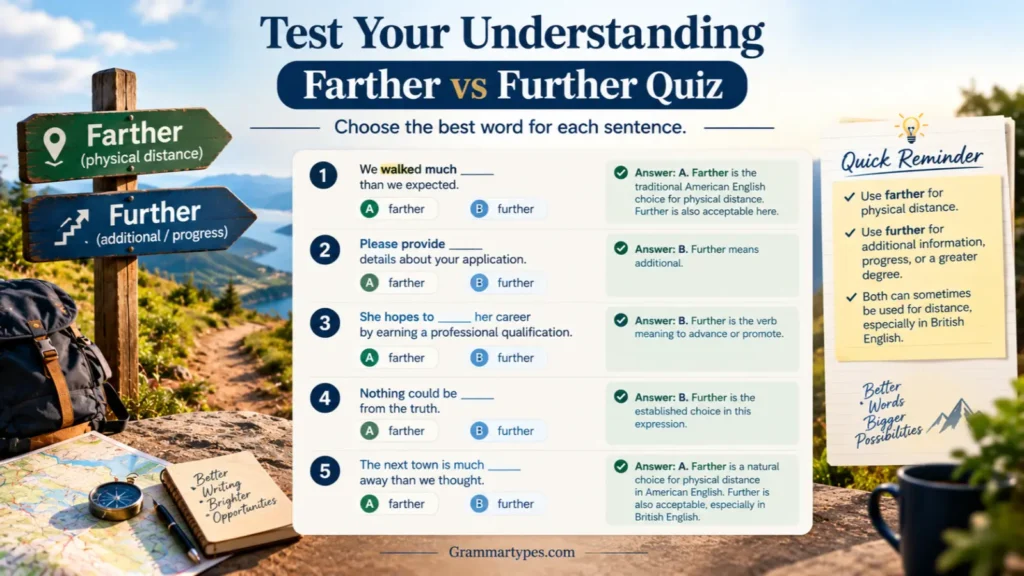
Test Your Understanding: Farther vs Further Quiz
Choose the best word for each sentence.
1. We walked much ___ than we expected.
- A. farther
- B. further
Answer: A. Farther is the traditional American English choice for physical distance. Further is also acceptable here.
2. Please provide ___ details about your application.
- A. farther
- B. further
Answer: B. Further means additional.
3. She hopes to ___ her career by earning a professional qualification.
- A. farther
- B. further
Answer: B. Further is the verb meaning to advance or promote.
4. Nothing could be ___ from the truth.
- A. farther
- B. further
Answer: B. Further is the established choice in this expression.
5. The next town is much ___ away than we thought.
- A. farther
- B. further
Answer: A. Farther is a natural choice for physical distance in American English. Further is also acceptable, especially in British English.
Final Thoughts
The difference between farther vs further comes down to meaning, context, and established usage. Farther is especially useful for physical distance, while further means additional, more, or to advance something. However, both words can describe distance, and the preferred choice varies across English-speaking regions.
For American English, choose farther when comparing measurable distances, such as how far someone walked or how far away a location is. Choose further for further information, further discussion, career development, and familiar expressions such as “nothing could be further from the truth.”
You do not need to treat every use as a strict right-or-wrong decision. Use further for additional meaning and farther as your default for physical distance, while recognizing that both can be correct for distance. This practical rule will help you write clearly and confidently.
FAQs
Both farther and far further can be grammatical, but they serve different purposes. Farther compares distances, while far further intensifies the idea of being further along, going further, or extending something to a greater degree. For example, “We traveled farther” and “We need to investigate this far further” use different constructions.
No. Both words are standard English. Further is often preferred in formal writing when it means additional or to a greater extent, while farther is common for physical distance in American English. Formality alone does not determine which word is correct.
Both expressions are correct. Use go farther when emphasizing physical distance in American English. Use go further when discussing additional progress, extending an argument, or taking an action to the next stage. Either can describe physical distance.
Use farther for literal distance if you follow the traditional American English distinction. Use further for additional evidence, further analysis, and continued research. If your institution or publication has a style guide, follow its recommendations consistently.
The corresponding superlative forms are farthest and furthest. Both can describe the greatest distance, while furthest is also used for the greatest extent or most advanced stage. For example, “She ran the farthest” and “This is the furthest we have progressed.”
Explore More Grammar Guides:
Convex vs Concave: Differences, Examples, and Uses
HIPPA or HIPAA: Correct Spelling, Meaning, and Usage
Attornies or Attorneys: Which Is Correct? Examples & Usage
Putting vs Puting: Which Spelling Is Correct? Meaning & Examples
